

April 20, 2026
In one week of September 2026, a CRS score of 389 was enough to win an invitation for Canada PR. In the same week, another round needed 734.
That 345-point gap comes from how Express Entry rounds of invitations work: the type of round Immigration, Refugees and Citizenship Canada (IRCC) holds, how many invitations it sends and, when scores tie, the exact minute each profile was submitted.
Table of Contents
ToggleKey Takeaways: Express Entry Draws in 2026
- Round types: IRCC holds general, program-specific (such as PNP-only) and category-based rounds.
- CRS cut-off: the lowest score invited in a round. If candidates tie at the cut-off, IRCC invites those who submitted their profile first.
- Competition: on 13 September 2026, only 21,358 of 226,793 candidates in the pool had a CRS score above 500.
- Category share: category-based rounds issued 17,779 of 30,599 invitations (58%) between 4 August and 1 October 2026.
- After an ITA: you have 60 days to submit your PR application. Declining the invitation returns your profile to the pool if you remain eligible.
What Is an Express Entry Round of Invitations?
An Express Entry round of invitations is a draw in which IRCC invites the top-ranked candidates in the pool to apply for permanent residence. Only candidates eligible for one of the three Express Entry programs can enter the pool. In every round, IRCC:
- chooses the type of round
- sets the number of invitations
- ranks eligible candidates by Comprehensive Ranking System (CRS) score
- sends an Invitation to Apply (ITA) to every candidate within that limit, applying the tie-breaking rule when candidates share the cut-off score
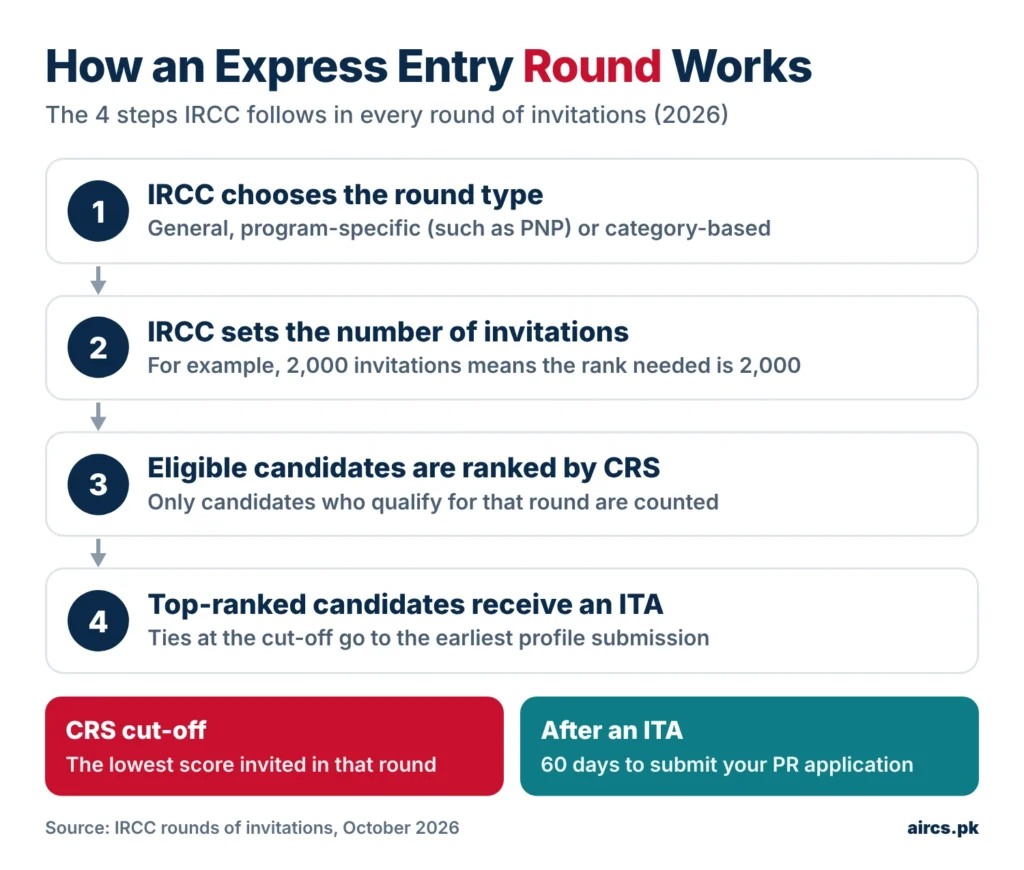
Invited candidates receive their ITA in their IRCC account. On the day of each round, IRCC publishes the date and time, the number of invitations, the round type, any category rules and the CRS cut-off. You can check every result on its rounds of invitations page.
Not sure which rounds you qualify for?
Send us your Profile on WhatsApp and get free assessment.
What Types of Express Entry Rounds Does IRCC Hold?
IRCC holds three types of Express Entry rounds, and the round type determines who can be invited:
- General rounds: open to the highest-ranked candidates across the Federal Skilled Worker Program (FSWP), the Canadian Experience Class (CEC) and the Federal Skilled Trades Program (FSTP).
- Program-specific rounds: limited to one program, such as CEC or the Provincial Nominee Program (PNP). Candidates with a provincial nomination are invited through general and PNP rounds.
- Category-based rounds: limited to candidates who qualify for a category the Minister sets to fill labour shortages, such as work experience in a listed occupation or strong French.
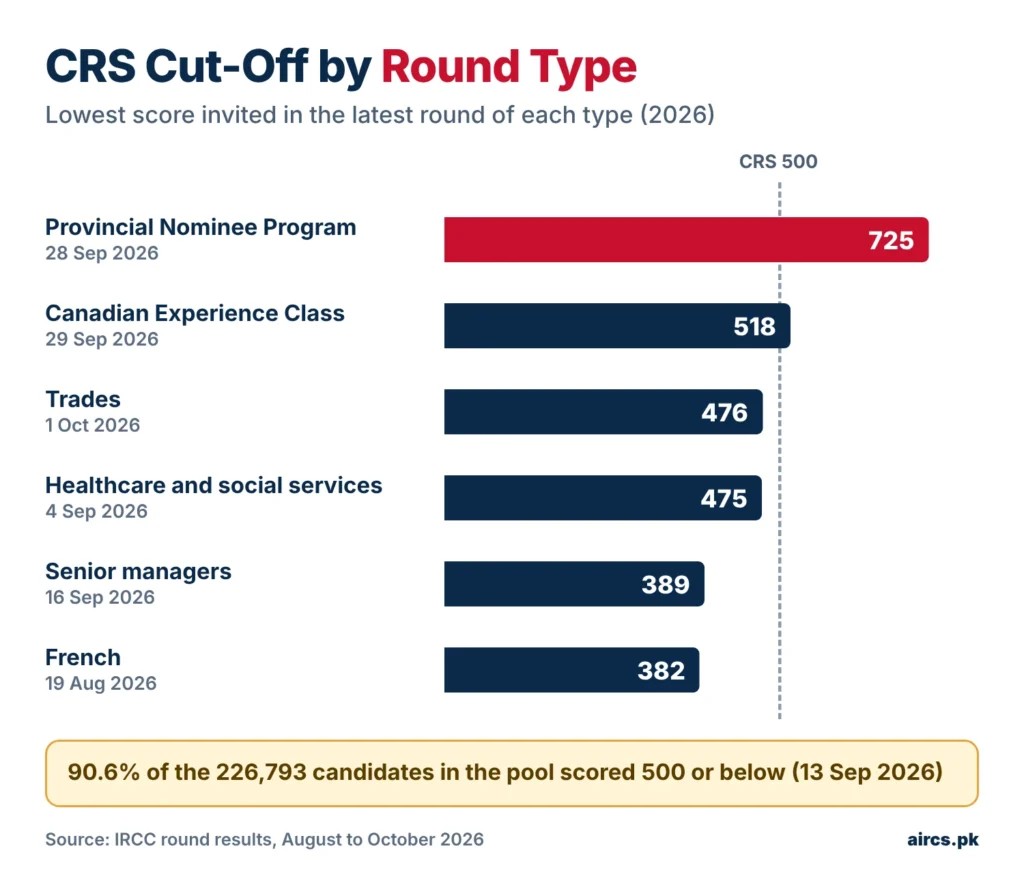
Category cut-offs depend on how many candidates qualify and how many invitations are issued, so they are not always lower. In August and September 2026, however, French rounds invited at 382 and healthcare at 475, compared with 518 for CEC.
On 18 February 2026, IRCC announced 10 categories for the year:
- French-language proficiency
- healthcare and social services
- STEM
- trades
- education
- transport
- physicians with Canadian work experience
- senior managers with Canadian work experience
- researchers with Canadian work experience
- skilled military recruits
Our guide to category-based draws explains who qualifies for each category.
How Is the CRS Cut-Off Determined for Each Express Entry Draw?
IRCC never sets the cut-off in advance. The cut-off is the score of the lowest-ranked candidate invited, which means it changes with the round type, the number of invitations and the scores of eligible candidates in the pool.
Your chance of an invitation depends on your rank among eligible candidates, not on your score alone. On 13 September 2026, the 226,793 candidates in the pool were distributed as follows:
CRS score | Candidates in the pool |
601 to 1,200 | 574 |
501 to 600 | 20,784 |
451 to 500 | 72,107 |
401 to 450 | 61,560 |
400 or below | 71,768 |
Total | 226,793 |
Source: IRCC CRS score distribution, reported by CIC News.
In total, 90.6% of candidates scored 500 or below, so most candidates need a category round or a provincial nomination to be invited. Between 4 August and 1 October 2026, those two round types issued 20,599 of 30,599 invitations (67%).
A nomination through an Express Entry-linked provincial stream adds 600 points. Without one, the highest possible CRS score is 695.
How Do You Read an Express Entry Round Result?
Each round result shows six details: the date and time, the round type, the number of invitations, the rank needed, the lowest CRS score invited and the tie-breaking rule. The rank needed always equals the number of invitations, because IRCC invites candidates strictly in rank order. The rank is calculated among candidates eligible for that round, so in a category round you compete with others in the same category, not with the whole pool.
For example, on 16 September 2026, the round for senior managers with Canadian work experience issued 250 invitations, so candidates needed to rank within the top 250. The lowest score invited was 389. The tie-breaking time was 1 September 2026 at 23:05:13 UTC, so candidates with exactly 389 points who submitted their profile after that time were not invited.
What Do Recent Express Entry Draws Show?
The table below lists the latest result for six types of round:
Round type | Date | Invitations | Lowest CRS score |
Trades | 1 Oct 2026 | 3,500 | 476 |
Canadian Experience Class | 29 Sep 2026 | 2,000 | 518 |
Provincial Nominee Program | 28 Sep 2026 | 733 | 725 |
Senior managers | 16 Sep 2026 | 250 | 389 |
Healthcare and social services | 4 Sep 2026 | 3,500 | 475 |
French | 19 Aug 2026 | 5,000 | 382 |
Source: IRCC round results. See every 2026 round in our Express Entry draw results tracker.
IRCC held no general round between 4 August and 1 October 2026. For FSWP applicants living in Pakistan, that left only category and PNP rounds, because CEC rounds require Canadian work experience.
How Often Do Express Entry Draws Happen?
IRCC does not publish a draw schedule or announce rounds in advance. By 1 October 2026, it had held about 60 rounds that year, reaching round #447. The 17 rounds between 4 August and 1 October came in five clusters, each with three or four rounds in a single week.
IRCC publishes each result on its website the same day. Canada plans 109,000 admissions through its Express Entry-managed programs in 2026, which shapes how many invitations IRCC issues across the year.
What Happens After You Receive an ITA?
An ITA gives you 60 days to submit a complete application for permanent residence. If your documents are not ready, you can decline the invitation. Your profile then returns to the pool, provided you remain eligible.
Letting the ITA expire is worse than declining it. Once the 60 days pass, your profile is removed and you must create a new one. Profiles remain valid for 12 months, and language results must be less than 2 years old both when you create your profile and when you apply. Our guide on what to do after receiving an ITA lists the key documents to prepare.
How Can Pakistani Applicants Improve Their Chances in the Next Draw?
Pakistani applicants can improve their chances in two ways: by raising their CRS score or by qualifying for a round with a lower cut-off.
- Improve your language score: a 29-year-old applicant without a spouse, with a master’s degree and 3 years of work experience outside Canada, scores 363 at CLB 7 but 469 at CLB 9 in every skill. That is a gain of 106 points.
- Add French: NCLC 7 in all four French skills plus CLB 5 or higher in English adds 50 points and qualifies you for French rounds, where the cut-off was 382 on 19 August 2026.
- Target a category: 12 months of work in a listed occupation within the past 3 years qualifies you for rounds such as healthcare (cut-off 475) or trades (cut-off 476). This rule has applied since 18 February 2026.
- Explore provincial nomination: a nomination through an Express Entry-linked stream adds 600 points, although many provincial streams now require a job offer.
- Keep your profile up to date: update it as soon as you gain experience, retake a test or change family status, because IRCC ranks you on your current details.
For more ways to gain points, read how to improve your CRS score fast.
Frequently Asked Questions
How often does IRCC hold Express Entry rounds of invitations?
There is no fixed schedule. IRCC held about 60 rounds in 2026 by 1 October, often three or four in a single week.
What is the minimum CRS score for an Express Entry invitation?
There is no fixed minimum. Between 4 August and 1 October 2026, cut-offs ranged from 198 in a physicians round to 768 in a PNP round. CEC cut-offs stayed between 516 and 523.
What does “rank needed” mean in an Express Entry draw?
It is your position among candidates eligible for that round. If a round issues 2,000 invitations, you must be ranked within the top 2,000, and the lowest score in that group becomes the cut-off.
What happens if two candidates have the same CRS score?
If they tie at the cut-off, IRCC invites the tied candidates who submitted their profile before the date and time set in the tie-breaking rule.
Can I get an ITA with a low CRS score?
Yes, through a category-based round or a provincial nomination. Category rounds often have lower cut-offs, and a nomination through an Express Entry-linked stream adds 600 points.
Get Your Express Entry Profile Reviewed
As a Canada PR consultant in Pakistan, AIRCS Group reviews your CRS rank, category eligibility and provincial options so you are prepared for the next round. Message us on WhatsApp or book an appointment.