
November 20, 2026
An ACS skills assessment is the first step to Australian PR for IT, data science and cyber security professionals. The Australian Computer Society (ACS) reviews your degree and work history against your nominated ICT occupation, and a positive outcome lets you apply for skilled visas such as Subclass 189, 190 and 491.
Knowing the rules before you apply helps you claim every point you have earned. A software engineer in Rawalpindi or Faisalabad with a BS Computer Science and 8 years of experience usually has 6 years counted as skilled employment, which earns 10 points.
This guide explains the ACS fees, the experience rules, the RPL pathway for IT professionals without an ICT degree, and the documents you need to apply from Pakistan.
Key Takeaways
- Assessing authority: Australian Computer Society (ACS), for IT, data science and cyber security occupations
- General Skills fee: AUD 1,498 for up to 3 ANZSCO occupations, rising to AUD 1,551 on 5 January 2027
- Processing time: About 4 to 6 weeks for a complete application
- Validity: 2 years from the outcome date
- Experience rule: 2 years count toward your skill level when your ICT-major bachelor’s degree is closely related to your occupation
- Eligible employment: Paid professional IT work of at least 20 hours a week, from age 18 onward
- Pakistani qualifications: HEC attestation for your degree certificate and full transcript
- English test: Not required for the skills assessment
What Is an ACS Skills Assessment?
An ACS skills assessment, also called the ACS migration skills assessment, is the Australian Computer Society’s review of applicants in IT, data science and cyber security occupations. It confirms that your qualifications and work experience are at a professional ICT level and closely related to your nominated ANZSCO occupation.
A positive outcome opens the door to skilled visas such as the Subclass 189 visa, Subclass 190 and Subclass 491.
Pakistani IT professionals most often nominate these ANZSCO occupations, which Home Affairs uses for skilled migration in 2026:
- Software Engineer (ANZSCO 261313)
- Developer Programmer (ANZSCO 261312)
- Analyst Programmer (ANZSCO 261311)
- ICT Business Analyst (ANZSCO 261111)
- Computer Network and Systems Engineer (ANZSCO 263111)
- ICT Security Specialist (ANZSCO 262112)
Choose the occupation that matches the duties in your reference letters, because ACS assesses your job duties rather than your job title.
ACS Assessment Fee and Processing Time
The ACS assessment fee depends on your pathway, and most Pakistani applicants with an IT degree use the General Skills pathway.
ACS fees are set to rise on 5 January 2027, so starting your application before that date can save you up to AUD 926.
| ACS pathway | Fee until 4 January 2027 (AUD) | Fee from 5 January 2027 (AUD) |
|---|---|---|
| General Skills | 1,498 | 1,551 |
| Recognition of Prior Learning (RPL) | 625 | 1,551 |
| Level 1 appeal | 516 | 535 |
| Level 2 appeal | 620 | 642 |
Source: ACS fees and payment, verified 20 November 2026.
One fee covers up to three ANZSCO occupations, such as Software Engineer, Developer Programmer and Analyst Programmer, when your qualifications and experience support each one. ACS issues a separate outcome letter for each suitable occupation.
You pay when you choose your pathway on the ACS portal, and you then have 90 days to submit your application. ACS decides a complete application in about 4 to 6 weeks.
ACS decides Level 1 appeals within 30 days and Level 2 appeals within 60 days, and it refunds the appeal fee in full when the outcome changes. ACS closes from 21 December 2026 to 4 January 2027, so submitting early keeps your timeline on track.
How Does the ACS Experience Deduction Work?
ACS uses part of your work history to confirm that you reached a skilled level. The date you reach it is your skill level requirement met date, and all paid work after that date counts toward your visa points.
| Qualification | Relevance to your occupation | Experience used to meet the skill level |
|---|---|---|
| Bachelor’s or higher, ICT major | Closely related | 2 years in the last 10 years, or 4 years at any time |
| Bachelor’s or higher, ICT major | Not closely related | 4 years at any time |
| Bachelor’s or higher, ICT minor | Closely related | 5 years in the last 10 years, or 6 years at any time |
| Bachelor’s or higher, ICT minor | Not closely related | 6 years at any time |
| Diploma or associate degree, ICT major | Closely related | 5 years in the last 10 years, or 6 years at any time |
| Diploma or associate degree, ICT major | Not closely related | 6 years at any time |
Source: ACS General Skills pathway, verified 6 November 2026.
ACS counts work that meets these rules:
- Paid work from age 18 onward
- At least 20 hours a week
- Each period of time once, even when two jobs overlap
- Professional work outside internships that formed part of your degree
The 10-year window counts back from the date you submit your application.
How the Experience Rule Affects Your Visa Points
Example: A software engineer in Rawalpindi has a BS Computer Science and 8 years of experience. ACS uses the first 2 years to confirm his skill level, and the remaining 6 years count as skilled employment.
- Before the assessment: 8 years would earn 15 points for overseas skilled employment
- After the assessment: 6 years earns 10 points
For Subclass 189, 190 and 491 visas, Home Affairs counts skilled employment from the 10 years before your invitation.
ACS RPL Report for IT Workers Without an ICT Degree
The Recognition of Prior Learning (RPL) pathway opens the ACS skills assessment to IT professionals with a non-ICT degree or no tertiary qualification. On this pathway, ACS assesses your experience and your RPL report in place of your degree.
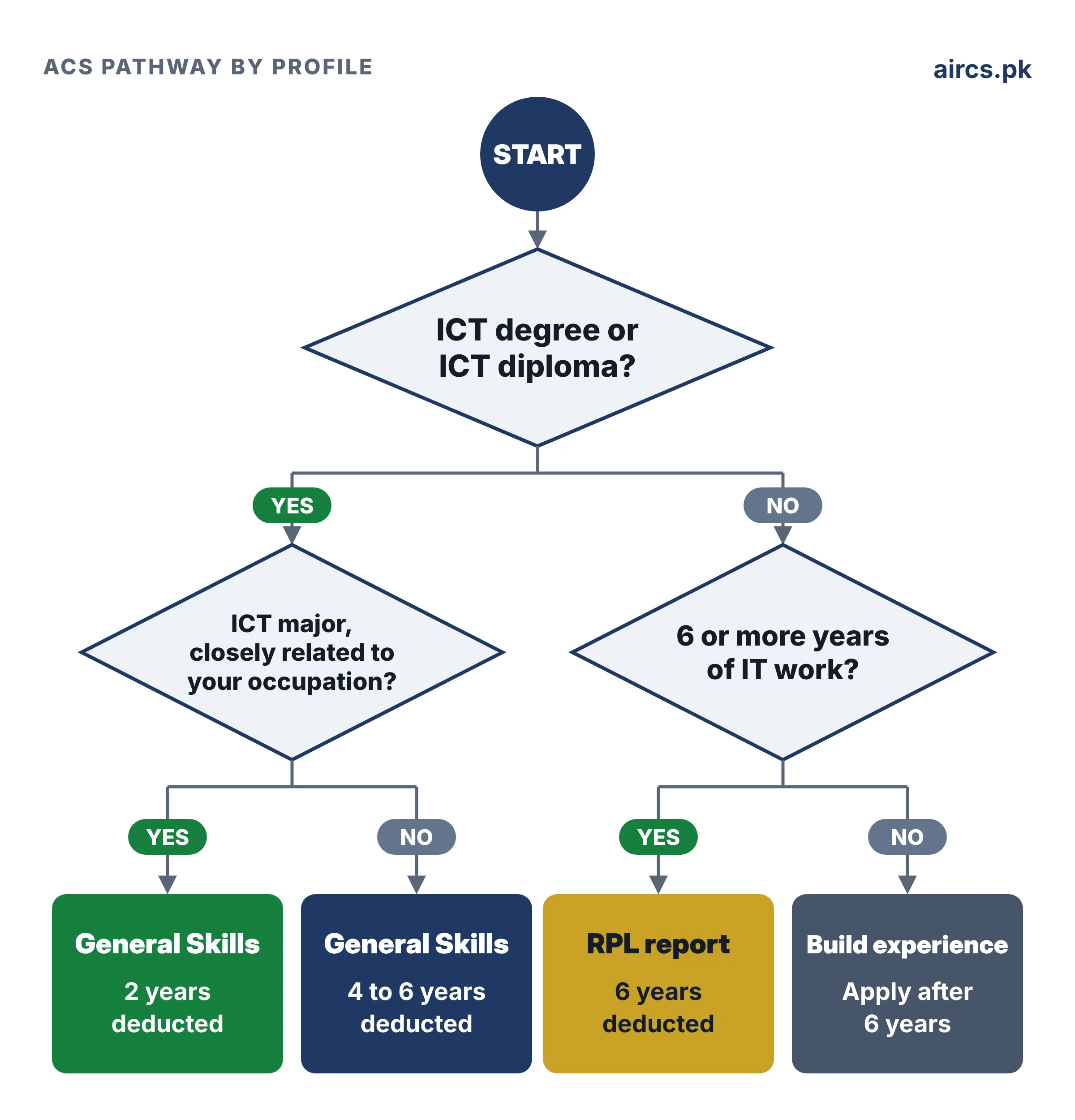
- Without a tertiary qualification: 6 years of relevant experience, with your most recent work within the last 2 years
- With a non-ICT degree: ACS sets the years you need during the assessment
- Project reports: Two reports, one from a project in the last 2 years and one from the last 4 years
- Professional currency evidence: At least two items from the last 2 years, such as a CCNA or other vendor certification, published work or professional training
ACS uses these required years to confirm your skill level. With no degree, 8 years of experience gives 2 years of skilled employment, and 9 years gives 3 years, which earns 5 points.
Each report should describe your own role, the IT knowledge you applied and the problem you solved. Write each report yourself, because ACS checks every report for originality.
How to Apply for an ACS Skills Assessment from Pakistan
The process runs in six steps, from choosing your occupation to receiving your outcome.
- Choose your occupation: Select the ANZSCO code that matches your duties, plus up to two more that also fit
- Get HEC attestation: Have HEC attest your degree certificate and transcript. RPL applicants follow separate evidence requirements.
- Collect work evidence: Gather reference letters and payment evidence for each job you want ACS to assess, with English translations of any Urdu documents
- Start your application: Create an account on the ACS portal, upload your ID, choose your pathway and pay the fee
- Submit within 90 days: Upload every document and every job you want assessed, because ACS assesses the file as submitted
- Use your outcome: Your outcome letter shows your ANZSCO code and skill date. Lodge your Expression of Interest in SkillSelect while your assessment is valid.
A positive ACS outcome prepares you for the next stages: the EOI, state nomination and visa application. Our Australia PR service covers each of them.
ACS Document Checklist for Pakistani Applicants
A complete file is the fastest route to a positive outcome. Prepare these documents before you start your application.
- Identity: Two forms of photo ID, such as your passport and CNIC, plus proof of any name change
- Education: HEC-attested degree certificate and full transcript
- Reference letters: On company letterhead, signed and dated, with your job title, dates, employment status, weekly hours, salary, work location and the duties you personally performed. The signatory should give a work email address.
- Payment evidence: Two types of evidence for the start and the end of each job, such as salary slips and bank statements, with at least one from outside your employer.
- Without an employer letter: An affidavit or statutory declaration in place of the reference letter
How to Avoid Common ACS Mistakes
- Choose the right occupation: If your duties match ICT Business Analyst, nominate ICT Business Analyst rather than Software Engineer
- Complete every reference letter: Include dates, weekly hours, salary and the signatory’s contact details, and describe your own duties in your own words
- Explain name differences: If your passport, CNIC and degree show different spellings, add a “one and the same person” affidavit
- Attest your degree: Have HEC attest your degree certificate and transcript for the General Skills pathway
- Submit eligible work: Include paid work of at least 20 hours a week, outside internships that formed part of your degree
Review your occupation and documents before you pay the AUD 1,498 fee, because ACS assesses the file exactly as submitted.
Frequently Asked Questions
How much does an ACS skills assessment cost in 2026?
The General Skills assessment costs AUD 1,498 and the RPL pathway costs AUD 625 until 4 January 2027. From 5 January 2027, both cost AUD 1,551.
How many years of experience does ACS deduct for a BSCS degree?
ACS usually uses 2 years to confirm your skill level when your degree is an ICT major closely related to your occupation and that experience falls within the last 10 years. All experience after your skill date counts toward visa points.
How long is an ACS skills assessment valid?
A positive ACS outcome is valid for 2 years from its issue date. To use it after 2 years, you apply for a new assessment.
Can I get an ACS skills assessment without a computer science degree?
Yes. IT professionals without a computer science degree can apply through the ACS RPL pathway, which usually needs 6 years of relevant work experience and two project reports.
Do I need IELTS for the ACS skills assessment?
No. ACS does not require an English test. Home Affairs needs at least competent English for a skilled visa, and higher IELTS or PTE scores earn extra points.
Plan Your ACS Assessment with AIRCS
A well-prepared ACS file protects every point you have earned. AIRCS Group reviews your ANZSCO code, reference letters and HEC documents before you apply as part of your Australia PR application.