November 23, 2026
The C11 work permit lets a Pakistani business owner start their own business in Canada and run it personally, with no Canadian employer involved. It is issued for up to 18 months, and your spouse and children can come with you.
Approval depends mainly on one document: your business plan. When the plan proves that your business creates jobs and value for Canadians, the officer has a clear reason to approve your file.
In 2026, C11 is one of the strongest business routes still open. IRCC closed the Start-up Visa to new applicants and paused the Self-Employed Persons Program, while the C11 work permit continues to accept applications from business owners around the world.
C11 Work Permit at a Glance
| Topic | 2026 rule |
|---|---|
| Who it suits | Business owners who start their own business in Canada |
| Canadian employer needed | No, you run your own company |
| Ownership | You own at least 51% of your business |
| Key document | A business plan that proves a significant benefit to Canada |
| Minimum investment | No fixed amount set by IRCC |
| Funds | Personal support funds plus separate business funds |
| Permit length | Up to 18 months, with extensions available |
| Government fees | CAD 155 work permit, CAD 230 compliance fee, CAD 85 biometrics |
| Processing from Pakistan | About 10 weeks, as of 12 November 2026 |
| Path to PR | Provincial entrepreneur streams |
Sources: IRCC C11 instructions and the IRCC fee list.
What Is the C11 Work Permit?
The C11 work permit is a Canadian work permit for business owners whose work brings a “significant benefit” to Canada. IRCC issues it under section 205(a) of its regulations, and C11 is the code officers use for this category.
IRCC calls these applicants business owners. A business owner is either self-employed, doing most of the work personally, or an entrepreneur who runs the company, takes the financial risk and hires staff.
Because you own the Canadian company you set up, it acts as your employer. You create the opportunity yourself, which is why C11 suits experienced business owners from Pakistan who want to grow abroad.
Who Qualifies for a C11 Work Permit?
To qualify for a C11 work permit, you need proven business experience, sufficient funds and a business plan that shows how your Canadian company benefits Canada. The company is set up as part of the application process, so you can apply directly from Pakistan. IRCC assesses five requirements:
- Ownership: You hold at least 51% of the Canadian company you set up
- Business experience: Your track record in Pakistan shows you can run this business
- Support funds: You can support yourself and your family for at least 18 months
- Business funds: You hold separate money to set up and run the business
- Significant benefit: Your business creates jobs, growth or services for Canadians
What Changed in the C11 Rules in 2025?
IRCC updated its C11 instructions on 27 May 2025. The new rules set clear tests for ownership and funds. The main changes are:
- The category is now called “business owners seeking only temporary residence”
- Applicants must own and control at least 51% of the business
- Applicants must prove both support funds and business funds
- Permits are normally issued for up to 18 months
These rules reward careful preparation. A file with clear ownership, a documented source of funds and a strong business plan now stands out quickly.
What Counts as a Significant Benefit to Canada?
A significant benefit means your business creates real opportunities for Canadians or permanent residents. Officers look at results, not only at how much money you spend.
IRCC lists these factors in its officer instructions:
- Creating jobs for Canadians
- Expanding markets or growing exports
- Supporting development in smaller regions
- Bringing new technology or products
- Paying staff at or above the median wage for the job
Location matters as well. IRCC’s own example explains that a small convenience store on a busy Toronto street may not be significant, while the same store in a rural area where the nearest grocery store is 20 kilometres away may be.
C11 Business Plan: What IRCC Officers Look For
The business plan is the most important part of a C11 application, because it is where you prove the significant benefit. IRCC instructs officers to check that the plan shows concrete steps for the business location, product, finances, marketing and customers.
A plan that wins approval answers five questions with exact numbers.
Market Research and Location
Your business plan must show why the chosen location needs your business. It identifies the target customers, the existing competition and the market gap your business fills, such as a product or service that is not available in the area.
Hiring Plan and Wages
List each job you create, the start date and the wage. IRCC expects wages at or above the median for each job, so the plan uses official Canadian wage data for your city.
Financial Projections
Give revenue, costs and profit for the first 3 to 5 years. The numbers must match your funds and your hiring plan, because officers compare every page.
Source of Funds
Your business plan must show where your investment comes from. Officers check that the funds are legally earned and fully under your control, so each amount is linked to your audited accounts, FBR tax returns and bank statements in Pakistan.
Transition Plan
Explain how the business keeps running as it grows, such as hiring and training a Canadian manager. This shows the officer that your plan is well organised and realistic.
Sample Profile: Furniture Business Owner from Rawalpindi
Imran is 42 and owns a furniture export company in Rawalpindi that he has run for 12 years with 10 employees. He plans a furniture import and showroom business in a growing town in Atlantic Canada, where no similar store operates within 50 kilometres.
- Ownership: 100% of his new Canadian company
- Business funds: CAD 200,000 from 3 years of company profits, shown in audited accounts and FBR returns
- Support funds: Separate savings that meet the LICO for his family of four for 18 months
- Hiring plan: 4 local staff in the first year, paid at or above the median wage
- Transition plan: A trained Canadian store manager who can run daily operations
Each point matches what an officer checks: clear ownership, a clean source of funds, local jobs and a defined plan.
How Much Money Do You Need for a C11 Work Permit?
IRCC does not set a minimum investment for the C11 work permit. Instead, you show two separate pools of money, and both must be available and free of loans or claims.
- Support funds: Enough to meet the low income cut-off (LICO) for your family size for at least 18 months
- Business funds: Money to set up and run the business, kept separate from your support funds
Your business plan sets the required amount based on the location, hiring plan and setup costs. Planning your investment at CAD 100,000 to 250,000, the level most provincial entrepreneur streams require, keeps the PR route open from the start.
Best C11 Business Ideas for Pakistani Entrepreneurs
The best C11 business builds on what you already do in Pakistan and fills a real need in a Canadian community. These sectors suit many Pakistani business owners:
- Import and distribution: Textiles, furniture, rice, surgical instruments or sports goods from Pakistan, with Canadian sales and warehouse staff
- IT and software services: Development, digital marketing or IT support teams serving Canadian clients
- Food processing and halal products: Packaged foods, spices and halal meat supply for growing communities
- Construction and trade services: Contracting, renovation or building materials in growing towns
- Hospitality in smaller towns: Restaurants, cafes or motels where local options are limited
- Manufacturing and assembly: Light manufacturing linked to your existing production in Pakistan
A business that matches your experience is easier to prove, because your Pakistan track record supports every promise in the plan.
Should You Start a New Business or Buy One?
For most Pakistani applicants, starting a new business is the stronger C11 route. A new business lets you choose the location, design the hiring plan and show the officer exactly what benefit your work creates.
Buying an existing business can also qualify when you take at least 51% ownership and grow the business further. Officers then look for new jobs, new markets or investment beyond the purchase price, so the plan still needs to show growth.
C11 Work Permit Requirements: Documents Checklist
A complete C11 file proves who you are, what you own and what your Canadian business delivers. Most Pakistani applicants submit:
- A valid passport and passport-size photos
- A detailed business plan with location, products, customers, marketing, hiring and financial projections
- Proof of 51% or more ownership, such as your incorporation papers
- Proof of business funds and support funds, with 6 to 12 months of bank statements
- Pakistan business records: SECP or business registration, NTN and FBR tax returns
- A CV that shows your management and business experience
- An offer of employment number from the IRCC Employer Portal, created by your own Canadian company, and the CAD 230 compliance fee receipt
- Family documents, such as your Nikah Nama and NADRA Family Registration Certificate
How to Apply for a C11 Work Permit from Pakistan
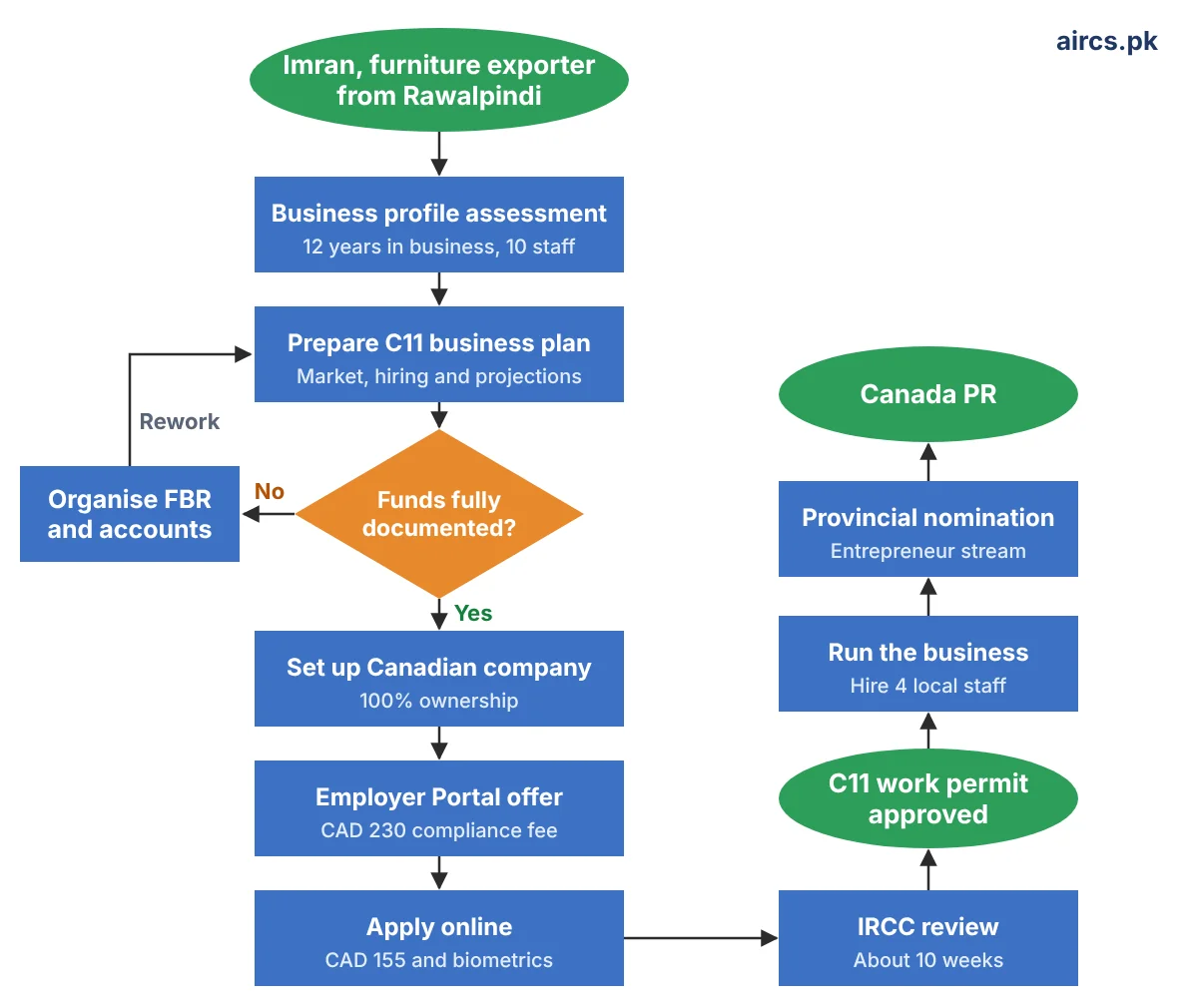
- Check your eligibility: Confirm your business experience, funds and goals with an immigration advisor
- Choose your business and location: Pick a business and a town where your work creates a clear benefit
- Prepare your business plan: Build the market research, hiring plan, projections and transition plan
- Set up your Canadian company: Incorporate the business, with you as the owner of at least 51%
- Register your company’s offer: Your own company enters the offer in the IRCC Employer Portal and pays the CAD 230 compliance fee
- Apply online: Submit your work permit application, pay CAD 155 and give biometrics at a VFS Global centre in Islamabad, Lahore or Karachi
- Travel to Canada: After approval, you receive a letter of introduction, and the border officer issues your work permit when you arrive
C11 Work Permit Fees and Processing Time
The government fees for a single C11 applicant come to CAD 470. Business plan preparation and company setup are separate professional costs.
| Fee | Amount (CAD) |
|---|---|
| Work permit, per person | 155 |
| Employer compliance fee | 230 |
| Biometrics, per person | 85 |
| Biometrics, family maximum | 170 |
| Spouse open work permit | 155 + 100 open work permit holder fee |
Source: IRCC fee list
Work permit applications from Pakistan took about 10 weeks as of 12 November 2026, according to IRCC data reported by CIC News.
Can Your Family Come with You on a C11 Work Permit?
Yes, your spouse and children can come with you to Canada. Your spouse may qualify for an open work permit when your role is in TEER 0 or 1, such as a senior manager, and your permit is valid for at least 16 more months when IRCC receives the spouse’s application.
Since C11 permits run for up to 18 months, applying for the whole family together protects that 16-month window. Your school-age children can attend Canadian schools while you run the business.
C11 vs Start-up Visa vs PNP Entrepreneur Streams
C11 is the most flexible business route open in 2026, because it has no fixed investment and no provincial selection draw.
| Route | 2026 status | Investment |
|---|---|---|
| C11 work permit | Open | No fixed minimum |
| Start-up Visa | Closed to new applicants | Not applicable |
| PNP entrepreneur streams | Open in several provinces (BC, Alberta, Manitoba, Nova Scotia, New Brunswick, PEI) | About CAD 100,000 to 250,000 |
Sources: IRCC entrepreneur measures and provincial program pages
C11 gives you a work permit after IRCC reviews your business plan, while PNP entrepreneur streams select candidates through provincial draws and lead to PR after nomination. Many business owners use C11 to start now and build toward a provincial stream.
From C11 Work Permit to Canada PR
A C11 work permit can lead to Canada PR, and the most common route is a provincial entrepreneur stream. C11 experience does not count toward the Canadian Experience Class, so a PR plan built in from the start makes the difference.
A typical C11 to PR plan has four stages:
- Launch your business on C11: Set up and run your Canadian company in a province with an open entrepreneur stream
- Build a strong track record: Grow revenue, create local jobs and keep clear financial records
- Apply for a provincial nomination: Meet the province’s net worth, investment and business requirements
- Apply for permanent residence: Submit your PR application to IRCC with your provincial nomination
Choosing the right province at the start saves time, because Ontario and Saskatchewan have closed their entrepreneur streams, while Alberta, British Columbia, Manitoba and Nova Scotia continue to accept applicants. Our Canada PR services cover each step from nomination to landing.
Why C11 Applications Get Refused and How to Avoid It
Most C11 refusals come from gaps in the business plan or the financial documents, and each one can be fixed before you apply.
- A general business plan: Give exact numbers for jobs, wages, location and customers
- Ownership below 51%: Structure your company so you own and control at least 51%
- An unclear source of funds: Match every deposit to tax returns and company accounts
- A weak benefit case: Choose a location and business type that the community needs
- No transition plan: Show who can run daily operations as the business grows
Frequently Asked Questions
Is the C11 work permit still open in 2026?
Yes. C11 remains open in 2026 and is one of the few business routes still available, as the Start-up Visa is closed to new applicants and the Self-Employed Persons Program is paused.
Do I need a Canadian employer for a C11 work permit?
No. Your own Canadian company acts as your employer and submits the required offer through the IRCC Employer Portal.
Is there a minimum investment for the C11 work permit?
No. IRCC sets no fixed minimum, but you must show enough business funds to carry out your business plan, plus separate support funds that meet the LICO for your family size for 18 months.
Do I need IELTS for a C11 work permit?
No. IRCC does not require a specific IELTS score for C11. Officers assess whether you can run the business in English or French, so a good test result strengthens your application.
What is the most important document for C11 approval?
The business plan. It shows the officer how your business benefits Canada, the jobs it creates and how it is funded.
How long is a C11 work permit valid?
A C11 work permit is normally issued for up to 18 months. You can apply for an extension if your business continues to provide a significant benefit to Canada.
Can I bring my family on a C11 work permit?
Yes. Your spouse and children can accompany you. Your spouse may qualify for an open work permit if your role falls under TEER 0 or 1 and your work permit is valid for at least 16 more months.
Can a C11 work permit lead to Canada PR?
Yes. The most common route is a provincial entrepreneur stream, where a provincial nomination lets you apply to IRCC for permanent residence.
How long does a C11 work permit take from Pakistan?
About 10 weeks, based on IRCC processing times for Pakistan as of 12 November 2026. A complete application helps you avoid additional document requests from the officer.
Can I apply for a C11 work permit from Pakistan?
Yes. You apply online and give your biometrics at a VFS Global centre in Islamabad, Lahore or Karachi.
Start Your C11 Application with AIRCS Group
A strong C11 file starts with the right business, the right province and a business plan that proves its value. AIRCS Group assesses your business profile, prepares your business plan and financial evidence and guides your family from application to arrival in Canada. Call (051) 8442721 in Rawalpindi or (041) 5482721 in Faisalabad from anywhere in Pakistan.
Book Your C11 Strategy Consultation →