

September 8, 2026
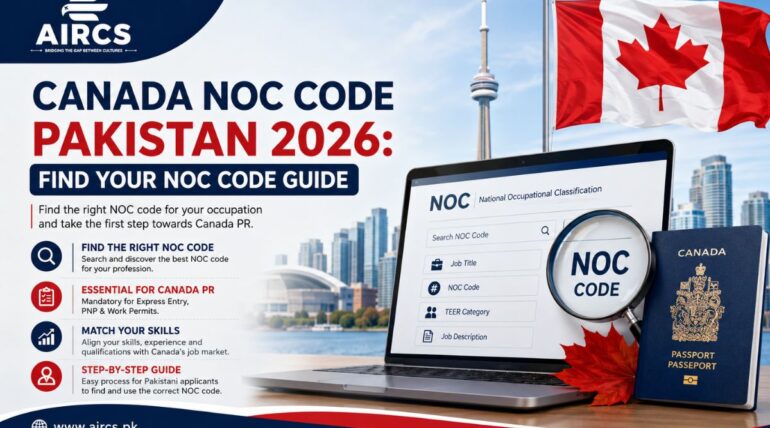
Planning to move to Canada in 2026? Your NOC code matters more than you think. This code decides if you qualify for Express Entry. It also affects your CRS points and PR chances. Many Pakistani applicants pick the wrong code by mistake. This guide shows you how to find the right one. We’ll explain TEER levels in simple words. You’ll also learn common mistakes to avoid.
Table of Contents
ToggleKey Takeaways: Canada NOC Code Pakistan 2026
Main benefits: The right NOC code confirms your Express Entry eligibility, sets your CRS points and opens the door to category-based draws.
Other factors: TEER level, real job duties and reference letter wording all affect which NOC code truly fits your work history.
Best solutions: Matching duties to the official NOC list, honest documentation and expert review help avoid refusal or misrepresentation risk.
Selection accuracy: There’s no shortcut for choosing a NOC code. It depends on your actual duties, not your job title or desired CRS score.
What Is a Canada NOC Code?
The National Occupational Classification (NOC) is the official system that Statistics Canada and Employment and Social Development Canada (ESDC) use to categorize every occupation in the Canadian labour market. Every job — from software engineer to electrician to registered nurse — is assigned a unique five-digit code based on the type of work performed and the level of training it requires.
Immigration, Refugees and Citizenship Canada (IRCC) relies on this classification to decide whether your foreign work experience counts as “skilled” for programs like the Federal Skilled Worker Program (FSWP), the Canadian Experience Class (CEC) and the Federal Skilled Trades Program (FSTP). In practice, your NOC code is the single data point that determines:
- Whether you’re eligible to create an Express Entry profile at all
- How many Comprehensive Ranking System (CRS) points your work experience earns
- Whether you qualify for a targeted category-based draw
- Whether a provincial nominee program will consider your occupation
For applicants from Pakistan, where job titles and role descriptions often don’t map neatly onto Canadian occupational language, choosing the right NOC code is rarely as simple as it looks on paper.
NOC 2021 vs Old NOC 2016 System — What Changed
If you’ve read older forum posts, immigration blogs, or even some outdated consultant advice, you’ve probably come across four-digit NOC codes and skill levels labelled 0, A, B, C and D. That’s the NOC 2016 system and it’s no longer in use.
IRCC switched to NOC 2021 for all Express Entry decisions in November 2022, replacing the old four-digit codes and letter-based skill levels with five-digit codes organized under the TEER framework. This wasn’t a cosmetic update. Occupations were regrouped, some were split into narrower, more specific codes and the eligibility logic for category-based draws now checks against exact five-digit matches rather than broad skill bands.
The practical takeaway for anyone researching Canada NOC codes in 2026 is simple: if a source is still talking about “Skill Type A” or a four-digit code, you’re looking at outdated information. Always cross-check your occupation against the current NOC 2021 structure on the official Government of Canada site before building your profile.
Understanding the TEER Framework (Training, Education, Experience, Responsibilities)
TEER stands for Training, Education, Experience, and Responsibilities. It’s the classification logic behind every NOC 2021 code and it replaced the old A/B/C/D skill-level grid entirely.
Each five-digit NOC code encodes specific information about the occupation and the second digit of that code tells you the TEER level directly. For example, NOC 63200 (cooks) has a “3” as its second digit, which means it sits in TEER 3. Understanding this structure saves you from having to memorize hundreds of job titles — once you know how to read the code, the TEER level is right there in the number itself.
TEER Levels 0 to 5 Explained
NOC 2021 sorts every occupation into one of six TEER categories:
- TEER 0 — Senior management roles with broad operational or budgetary responsibility, not just supervisory duties. Typically requires reporting to senior executives and managing significant scope.
- TEER 1 — Professional occupations that usually require a bachelor’s degree or higher. This covers most engineers, IT professionals, accountants and similar university-educated roles.
- TEER 2 — Occupations that generally need a two- to three-year college diploma, apprenticeship training or supervisory responsibility in a technical field.
- TEER 3 — Roles requiring a college diploma of less than two years, or several years of on-the-job training or a Red Seal trade certification.
- TEER 4 — Occupations that typically need a high school diploma plus several weeks of job-specific training.
- TEER 5 — Occupations requiring little to no formal education, usually just short on-the-job demonstrations.
For Express Entry purposes, only TEER 0, 1, 2 and 3 count as skilled work experience. TEER 4 and 5 occupations cannot be used to qualify for the FSWP, CEC, or FSTP, though they may still open doors through certain Provincial Nominee Program streams or sector-specific pilots.
Why Your NOC Code Matters for Pakistani Applicants
For applicants coming out of Pakistan’s job market, this matters more than it might seem at first glance. Job titles in Pakistan often don’t correspond directly to how Canada defines the same role. A “Manager Operations” in a Pakistani textile company, for instance, might actually match a TEER 1 or TEER 2 Canadian occupation depending on actual duties — not a TEER 0 code just because the word “manager” appears in the title.
Your NOC code directly affects:
- Express Entry eligibility — whether you can create a profile under FSWP, CEC, or FSTP in the first place
- CRS points — skilled work experience only counts if it’s tied to an eligible TEER 0–3 NOC
- Category-based draw eligibility — healthcare, STEM, trades and other priority streams are defined by specific NOC lists
- Provincial nomination fit — provinces publish in-demand occupation lists tied to exact NOC codes
- Credibility of your application — visa officers compare your job duties, reference letters and pay slips against the NOC’s official duty list, so mismatches raise red flags fast
How to Find Your Correct NOC Code
Finding your NOC code correctly starts with your actual job duties, not your job title. Here’s the process that works reliably:
- Write down your real day-to-day responsibilities — not the designation on your business card, but what you actually did on a daily basis.
- Search the official NOC 2021 database on Canada.ca using keywords related to your role.
- Read the lead statement of each candidate occupation — this single paragraph describes the core function of the job.
- Compare your duties against the “main duties” list published for that code. IRCC expects a strong overlap, not a partial or loose match.
- Check the employment requirements section to confirm the education and experience level matches your background.
- Confirm the five-digit code and TEER level and note them for your Express Entry profile and reference letters.
If your duties genuinely span two occupations, choose the one where the majority of your responsibilities and time were spent — and make sure your employer reference letters describe those duties in detail, using language that mirrors the NOC’s official wording where accurate.
NOC Codes by TEER Level for Common Pakistani Occupations
Many Pakistani applicants come from IT, engineering, banking, healthcare and skilled trades backgrounds. Here’s how common roles typically map across TEER levels — always verify the exact match against the official NOC database, since duties vary by employer.
TEER 0 & 1 Occupations (Managers, IT Professionals, Engineers)
- Senior managers in finance, healthcare, IT, or construction (TEER 0)
- Software engineers and designers
- Information systems analysts and consultants
- Civil, mechanical and electrical engineers
- Financial and investment analysts
- Human resources managers
- Accountants and auditors
These roles generally require a bachelor’s degree or equivalent and they carry the highest CRS point weighting among skilled categories, making them a common entry point for Pakistani applicants with university qualifications.
TEER 2 & 3 Occupations (Technicians, Skilled Trades, Admin Roles)
- Computer network and web technicians
- Electricians, plumbers and welders
- Administrative officers and executive assistants
- Cooks and food service supervisors
- Medical laboratory technicians
- Construction and industrial trade supervisors
TEER 2 and 3 roles are just as valid a route into Express Entry as TEER 0 or 1 — the mistake many applicants make is assuming only degree-holders qualify. If your work experience genuinely fits a TEER 2 or 3 code, it’s fully eligible for the CEC and in trade cases, the FSTP.
NOC Code and Express Entry Category-Based Draws
Since 2023, IRCC has run category-based Express Entry draws alongside general rounds, inviting candidates from specific occupational groups even when their CRS score falls below the general cut-off. Eligibility for these targeted draws is decided by an exact match against a published list of NOC 2021 codes. For a deeper breakdown, see how Express Entry invitations work. Getting your primary NOC right isn’t just about basic eligibility — it can be the difference between waiting indefinitely in the pool and receiving an invitation months earlier at a noticeably lower score.
The categories IRCC has prioritized have expanded over time and now typically include healthcare and social services, STEM, skilled trades, transport, education, French-language proficiency and additional streams introduced periodically. Because the active list and cut-off scores change from round to round, always confirm the current categories and their NOC lists directly on IRCC’s official Express Entry page before relying on a specific draw as your strategy.
Healthcare, STEM, Skilled Trades & Other Priority Categories
For Pakistani applicants, three categories tend to be the most relevant:
- Healthcare and social services — nurses, physicians, medical technologists and personal support roles, generally requiring recent, verifiable experience in the field
- STEM — software developers, IT analysts, engineers and data-related occupations, drawing heavily from Pakistan’s large tech and engineering talent pool
- Skilled trades — electricians, welders, HVAC technicians and construction trades, which continue to see steady demand across provinces
Requirements for these categories usually include a minimum period of recent work experience in an eligible occupation, so keeping your NOC code, reference letters and pay evidence consistent and well-documented matters as much as your CRS score.
Common Mistakes Pakistani Applicants Make While Selecting NOC Code
- Choosing a NOC based on job title alone, ignoring the actual duties performed
- Inflating responsibilities in reference letters to fit a higher TEER level than the role justifies
- Using outdated NOC 2016 codes found in old blog posts or forum threads
- Picking the NOC with the highest CRS points instead of the one that genuinely matches the work history
- Ignoring the “main duties” list, relying only on the occupation’s short title
- Ignoring that different employers may describe the same role very differently — the mismatch between the reference letter and the NOC’s duty list is one of the most common causes of scrutiny
- Not updating the primary NOC when duties changed across different jobs or promotions
How Wrong NOC Code Selection Can Lead to Refusal or Misrepresentation
Choosing the wrong NOC code isn’t just a paperwork inconvenience — it carries real consequences. If a visa officer reviews your file and finds that your actual job duties, as described in your reference letters, don’t reasonably match the NOC you selected, your application can be refused for not meeting the skilled work experience requirement.
More seriously, if the mismatch appears intentional — for example, if duties were exaggerated or fabricated to justify a higher-paying or higher-CRS-scoring NOC — IRCC can determine this constitutes misrepresentation. A misrepresentation finding under Canadian immigration law can result in a 5 year inadmissibility bar, even if the applicant otherwise met every other requirement. This is why accuracy, not ambition, should guide your NOC selection. It’s far better to select a slightly lower-scoring but genuinely accurate code than to risk your entire application on an inflated match.
Step-by-Step Process to Confirm Your NOC Code Before Applying
- List your actual duties for every relevant job, in detail, before touching the NOC database.
- Search the official NOC 2021 tool on Canada.ca using multiple relevant keywords, not just your job title.
- Shortlist two or three candidate codes and read each lead statement carefully.
- Match your duties line by line against each code’s main duties list, keeping only the code with the strongest genuine overlap.
- Verify the TEER level and confirm it falls within TEER 0–3 for Express Entry eligibility.
- Draft your reference letters using language consistent with the NOC’s actual duty descriptions — accurate, not copy-pasted.
- Cross-check category-based draw lists if you believe your occupation might qualify for a targeted round.
- Have your NOC selection reviewed by a licensed immigration consultant (RCIC) or lawyer, especially if your job title and duties don’t map cleanly to a single code.
- Keep supporting evidence ready — pay slips, appointment letters and organizational charts that back up the duties described.
- Recheck the NOC list periodically, since IRCC updates occupational classifications and category-based eligibility lists from time to time.
Getting your NOC code right is the foundation of a strong Express Entry profile. For Pakistani applicants, taking the time to match real job duties against the official NOC 2021 database rather than relying on job titles or outdated guides is the single most effective way to protect your application from delays, refusals, or misrepresentation risk in 2026.
Frequently Asked Questions
What is a NOC code in simple words?
A NOC code is a number for your job. Canada uses it to understand what work you do.
How do I find my NOC code as a Pakistani applicant?
Look at your real job duties. Match them to the NOC list on Canada.ca.
What is TEER in NOC 2021?
TEER means Training, Education, Experience and Responsibilities. It shows how skilled a job is.
Which TEER levels count for Express Entry?
Only TEER 0, 1, 2 and 3 count. TEER 4 and 5 do not qualify.
Can I use my job title instead of my duties?
No. Job titles can be misleading. Always match your actual daily work.
What happens if I pick the wrong NOC code?
Your application can be refused. In serious cases, it can lead to misrepresentation.
Should I get help choosing my NOC code?
Yes, if you’re unsure. A licensed consultant (RCIC) can check your match before you apply.
Conclusion
Your NOC code is the foundation of your Canada PR journey. Get it right and every next step gets easier. Get it wrong and even a strong profile can fail. Pakistani applicants must match real job duties, not just titles. The NOC 2021 system uses TEER levels to judge skill. Only TEER 0 to 3 count for Express Entry. Take time to research your correct code. Use official sources, not old blog posts. A little care now saves major problems later. If you’re unsure, don’t guess. Ask a licensed immigration consultant for help. It’s a small step that protects your entire application.
Book Your Free Immigration Consultation Today!
Want to build a better future for your family in Canada?
Get expert immigration guidance and tailored solutions specifically for Pakistani families.
WhatsApp: +92 311 4464274
Website: https://aircs.pk/
Offices: Rawalpindi & Faisalabad