

August 24, 2026
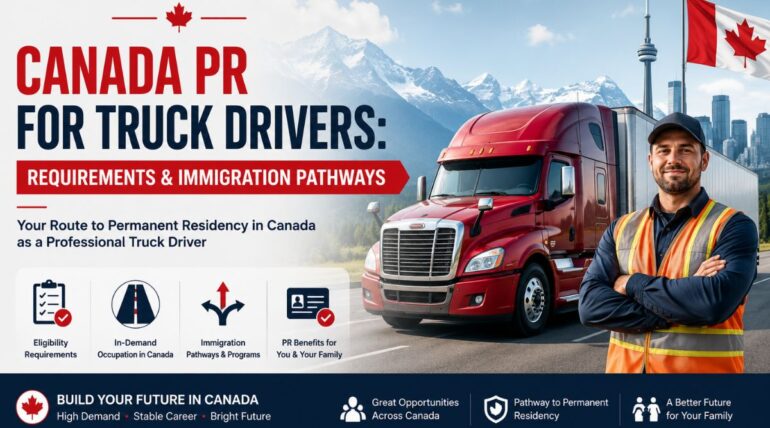
Canada’s trucking industry needs skilled drivers more than ever. Many provinces list trucking as an in-demand job. This has opened real immigration opportunities for foreign drivers. Canada PR for truck drivers is now a practical, achievable goal.
This guide breaks down the full process in simple terms. You’ll learn about the NOC code, Express Entry, and PNP options. We’ll also cover documents, salary, and common mistakes to avoid. By the end, you’ll know exactly what steps to take next.
Table of Contents
ToggleKey Takeaways: Canada PR for Truck Drivers
Main benefits: Canada PR for truck drivers is achievable through NOC 73300, giving access to Express Entry’s transport category and multiple PNP streams built for driver shortages.
Other factors: Your CRS score, language level (CLB 5–7+), and how closely your reference letters match NOC 73300 duties all affect which pathway suits you best.
Best solutions: A provincial nomination (+600 CRS points), accurate ECA documentation, and detailed employer reference letters give applications the strongest chance of success.
Processing timing: There’s no fixed timeline. Processing depends on the province, the PNP stream chosen and how complete your documentation is at submission.
Why Truck Drivers Are in High Demand for Canada PR
Canada’s freight sector is growing faster than its workforce can keep up with. An aging pool of licensed drivers, rising e-commerce volumes, and constant cross-border and interprovincial shipping needs have pushed trucking jobs across Canada into chronic shortage territory. Several provinces now list trucking as a priority occupation, which directly improves the odds for foreign applicants with genuine driving experience.
Truck Driver NOC Code in Canada (NOC 73300) Explained
Every application starts with correctly matching your experience to the truck driver NOC code, which is NOC 73300 – Transport Truck Drivers, classified under TEER 3 (skilled trades). This covers both long-haul and short-haul drivers. Immigration officers compare your actual job duties against the official NOC lead statement, so a matching job title alone isn’t enough the described responsibilities must align closely with the code’s definition.
How Do Truck Drivers Qualify for Canada Express Entry?
Truck drivers can enter the Express Entry transport category through the Federal Skilled Trades Program or the general Express Entry pool, provided their Comprehensive Ranking System (CRS) score meets the draw cut-off. Category-based draws for transport occupations have run periodically since 2023, though eligibility lists are updated by IRCC from time to time, so it’s worth confirming current status before building a strategy around them.
Truck Driver PR Through Provincial Nominee Program (PNP)
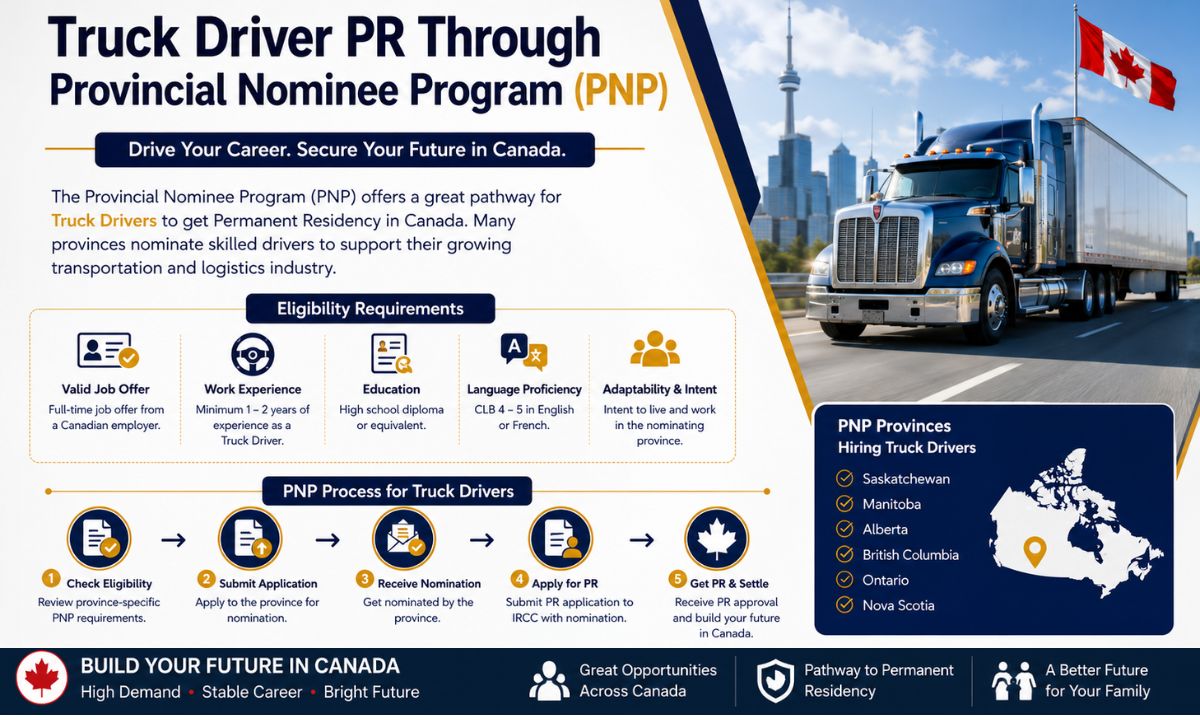
For most drivers, the Provincial Nominee Program is the more reliable route to Canada PR for truck drivers. Unlike general Express Entry draws, PNP streams are designed around specific labour market needs, which means trucking often gets direct recognition as an in-demand occupation. A provincial nomination adds 600 points to your CRS score, which effectively guarantees an invitation to apply.
Provinces such as Alberta, Saskatchewan, and British Columbia run streams specifically built around job-offer-based, in-demand occupations like trucking. Each province sets its own criteria, processing times, and priority lists, so matching your profile to the right stream matters as much as meeting the basic requirements. A well-chosen PNP application often moves faster and with less uncertainty than waiting on federal draws alone — which is why so many people pursue Canada PR for truck drivers through provincial streams first, rather than relying only on Express Entry.
How to Improve Your CRS Score as a Truck Driver
Your CRS score determines whether you get invited to apply, so small improvements in the right areas can make a real difference. Language testing is usually the fastest way to gain points, since even a small jump in CLB level can add a noticeable boost. Education and provincial nomination add further weight on top of that.
A provincial nomination is the single biggest score booster available, adding a flat 600 points and effectively securing your invitation. Beyond your own profile, a spouse’s language ability and education can also contribute to the combined household score. Together, these targeted improvements can move a borderline profile into a competitive range.
Language, Education & Work Experience Proof Required
Every strong truck driver PR application rests on three pillars: language ability, educational credentials, and verified work experience. Officers use these to confirm you meet the minimum standards for your chosen program and that your background genuinely matches NOC 73300. Weak or incomplete proof in any one area can slow down or weaken an otherwise solid application.
- Language ability: IELTS or CELPIP results showing minimum CLB 5, ideally CLB 7+
- Education proof: ECA report confirming Canadian equivalency for foreign credentials
- Work experience proof: Employer reference letters detailing duties, hours, and employment dates
Best Province for Truck Drivers in Canada
Provincial demand and nomination criteria vary significantly:
Province | Trucking Demand | PNP Highlight |
Alberta | High | Alberta Opportunity Stream |
Saskatchewan | High | International Skilled Worker – Employment Offer |
British Columbia | Moderate-High | Skilled Worker, priority sectors |
Ontario | Moderate | Employer Job Offer stream |
Documents Required for Truck Driver PR Application
A complete document set is what keeps a Canada PR for truck drivers application moving without delays. Officers rely on these papers to verify your identity, driving credentials, language ability, and financial readiness. Missing or poorly prepared documents are one of the most common reasons.
Valid Passport and Commercial Driving License
Confirms your identity and proves you hold an active, legitimate license to operate commercial vehicles.
Detailed Employment Reference Letters
Should outline specific duties, working hours, and employment dates to match the NOC 73300 profile.
Language Test Results
IELTS or CELPIP scores demonstrating your CLB level for English or French proficiency.
ECA Report (Where Applicable)
Required if your education was completed outside Canada, to confirm its Canadian equivalency.
Police Clearance Certificates
Background checks from every country you’ve lived in for six months or more since turning 18.
Proof of Settlement Funds
Shows you have enough funds to support yourself and any dependents after arriving in Canada.
How to Present Your Driving Experience for Maximum Points
Reference letters make or break an application. Immigration officers rely almost entirely on these letters to verify that your real-world duties match the NOC 73300 profile, so generic job titles or vague descriptions can weaken an otherwise strong case. The more specific and duty-focused the letter, the easier it is for an officer to confirm your experience at a glance.
Ask employers to clearly distinguish long-haul from short-haul work, and to note route types, distances, and cargo categories handled. Letters should be issued on official company letterhead, signed by an authorized person, and include exact employment dates and working hours. This level of detail leaves little room for doubt and gives your Canada PR for truck drivers application the best chance of being assessed accurately.
Truck Driver Salary in Canada: What to Expect
Truck driver earnings in Canada vary based on province, route type, and years of experience. Long-haul and cross-border routes tend to pay more due to longer hours and extended time away from home. Local and short-haul positions offer more predictable schedules but slightly lower pay. Here’s a general breakdown of what to expect at different experience levels.
- Entry-level drivers: CAD 45,000–55,000 annually
- Experienced long-haul drivers: CAD 60,000–75,000 or more
- Owner-operators: Often see even higher returns
Step-by-Step Process to Become a Truck Driver in Canada
Turning your truck driving experience into Canadian PR follows a clear, sequential process. Each stage builds on the one before it, so completing steps in order helps avoid delays. Here’s how the journey typically unfolds from start to finish.
Step 1: Confirm Eligibility Against NOC 73300
Check that your job duties genuinely match the official NOC 73300 profile before starting any paperwork.
Step 2: Complete Language Testing and ECA
Take IELTS or CELPIP and get your foreign education assessed for Canadian equivalency.
Step 3: Create an Express Entry Profile or Apply to a PNP Stream
Set up your profile or target a province with a trucking-friendly nomination stream.
Step 4: Wait for a Nomination or Invitation to Apply
Monitor draws and provincial responses until you receive an ITA or nomination.
Step 5: Submit Your PR Application With Full Documentation
File your application along with all supporting documents required for review.
Step 6: Complete Medical and Police Clearances
Undergo the medical exam and submit police certificates from all required countries.
Step 7: Relocate to Canada Upon PR Confirmation
Once approved, plan your move and settle into your new province.
Common Mistakes That Delay Truck Driver PR Applications
- Job duties not matching the NOC 73300 lead statement
- Weak or generic reference letters
- Underestimating language score requirements
- Applying to a PNP stream that doesn’t cover trucking
- Submitting incomplete or outdated documents
Canada PR for truck drivers is a realistic goal when the application is built carefully — accurate NOC matching, strong language scores, and a well-chosen provincial stream make the biggest difference. Getting expert guidance early can help avoid the delays that trip up most applicants.
Frequently Asked Questions
Is truck driving a good option for Canada PR?
Yes. Trucking is in high demand across many provinces, making it a realistic path to PR for experienced drivers.
What NOC code do truck drivers fall under?
Truck drivers fall under NOC 73300, which covers both long-haul and short-haul transport driving.
Can truck drivers apply through Express Entry?
Yes, but a competitive CRS score is needed unless you also secure a provincial nomination.
Which province is best for truck driver PR?
Alberta, Saskatchewan, and British Columbia currently offer the strongest PNP options for truck drivers.
What is the fastest way to get Canada PR for truck drivers?
The fastest route for Canada PR for truck drivers is usually a Provincial Nominee Program (PNP) with a valid job offer, since a nomination adds 600 CRS points and often beats waiting on federal Express Entry draws alone.
Do I need a job offer to apply?
Not always, but a job offer or PNP nomination greatly improves your chances of getting an invitation.
What language score do I need?
A minimum of CLB 5 is required, though CLB 7 or higher makes your profile more competitive.
How long does the PR process take?
It varies by pathway, but PNP routes with a nomination are often faster than general Express Entry draws.
Conclusion
Canada PR for truck drivers is a realistic goal for skilled, experienced drivers. Strong demand, clear NOC matching and the right provincial stream make the process manageable. A well-prepared application avoids most common delays. With the right guidance, your PR journey can move forward smoothly.
Book Your Free Immigration Consultation Today!
Want to build a better future for your family in Canada?
Get expert immigration guidance and tailored solutions specifically for Pakistani families.
WhatsApp: +92 311 4464274
Website: https://aircs.pk/
Offices: Rawalpindi & Faisalabad