

September 7, 2026
Getting a PR refusal letter from IRCC is hard. All that waiting, and then bad news. But don’t panic. You still have options, and this guide will walk you through them. You’ll learn why Canada PR refused and what IRCC really looks at. You’ll also learn if you can appeal, and how long you should wait before trying again.
Table of Contents
ToggleKey Takeaways: Canada PR Refusal
Main reasons: Insufficient funds, work experience mismatches, and incomplete documents are the top causes of Canada PR refusal.
Other grounds: Misrepresentation, medical inadmissibility, criminal inadmissibility, and failed program-specific criteria can also lead to a Canada PR refusal.
Fix options: A stronger reapplication, appeal to the IAD, judicial review at Federal Court, or professional legal advice can resolve most cases of Canada PR refusal.
Processing time: There’s usually no mandatory wait to reapply after a Canada PR refusal, but misrepresentation cases can carry a bar of up to 5 years.
Can I Get PR After Being Refused a Visa
Yes. A prior visa refusal whether it was a visitor visa, study permit, work permit, or even an earlier PR application does not automatically disqualify you from getting Canadian PR in the future. IRCC assesses each application on its own facts and the information available at the time of that specific decision.
That said, a past refusal does matter in one important way: every application asks whether you have ever been refused a visa, permit, or entry to Canada (or any other country). You must disclose this honestly. Failing to declare a previous refusal can be treated as misrepresentation, which carries far more serious consequences than the original refusal itself, including a multi-year ban from Canada.
If you address the specific reasons behind the earlier refusal and strengthen your application accordingly, there is no legal barrier to being approved for PR later.
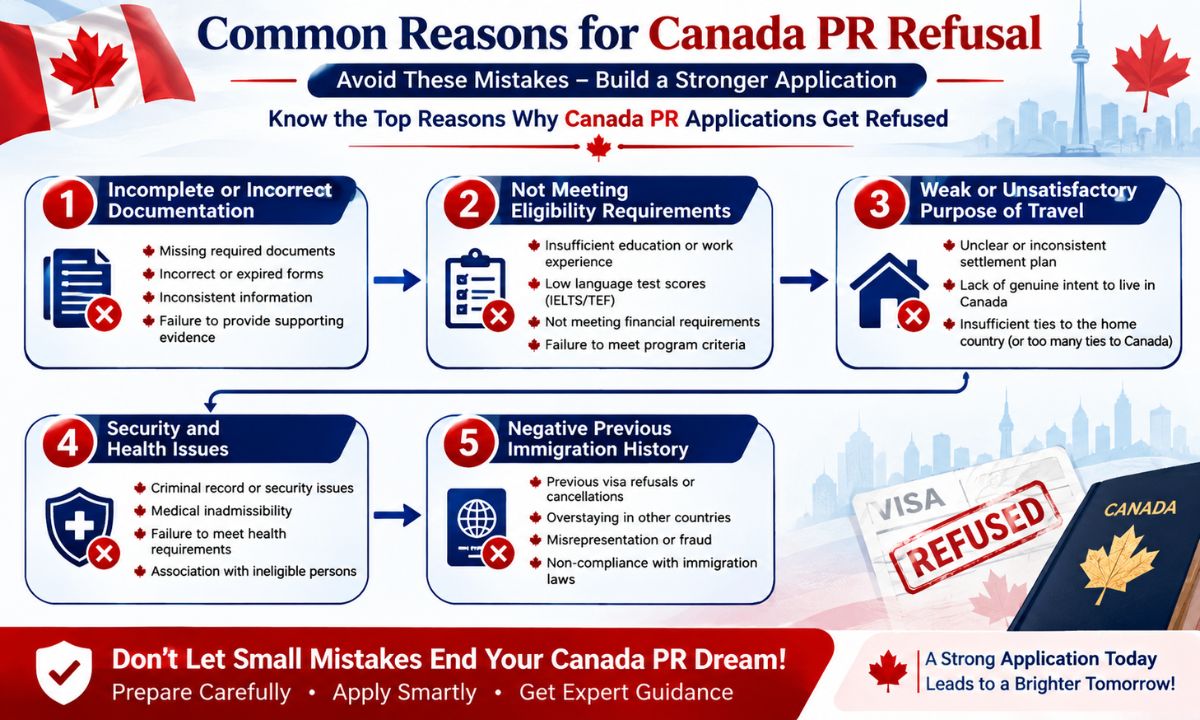
While each case is unique, most refusals fall into a handful of recurring categories:
- Insufficient proof of funds not meeting the minimum settlement funds required for your household size (Express Entry).
- Work experience discrepancies, job duties on paper not matching the NOC (National Occupational Classification) code claimed, or experience letters lacking detail on hours, duties, and pay.
- Education credential issues an Educational Credential Assessment (ECA) that doesn’t align with the program you applied under, or missing transcripts.
- Medical inadmissibility a medical condition that could pose an excessive demand on Canada’s health or social services.
- Criminal inadmissibility past criminal convictions, even minor ones, that have an equivalent offence under Canadian law.
- Misrepresentation providing false information, submitting fraudulent documents, or omitting material facts (including undisclosed family members or previous refusals).
- Failure to meet program-specific criteria such as not meeting a Provincial Nominee Program’s (PNP) job offer or residency conditions, or a spousal sponsorship where the relationship’s genuineness is questioned.
- Incomplete or inconsistent documentation missing forms, expired documents, or inconsistencies between different parts of the application.
- Security concerns associations flagged during background and security screening.
PR Refusal Appeal Lawyer in Canada
Because the right response depends heavily on why you were refused and which program you applied under, many applicants choose to consult a Canadian immigration lawyer or a Regulated Canadian Immigration Consultant (RCIC) before deciding whether to appeal, ask for reconsideration, or reapply.
A qualified immigration lawyer can help you:
- Obtain and interpret your GCMS notes to understand the officer’s exact reasoning.
- Determine whether you have appeal rights (not all refusals can be appealed) or whether judicial review at the Federal Court is the appropriate route.
- Prepare a Notice of Appeal within strict deadlines — for example, sponsorship refusals appealed to the Immigration Appeal Division (IAD) generally must be filed within 30 days of receiving the decision.
- Draft a stronger, corrected application if reapplying is the better strategy.
- Respond to allegations of misrepresentation, which require careful legal handling.
IRCC Refusal Reasons
IRCC is required to give you a reason for refusing your application, but the letter itself is often brief. To get the full picture, applicants can request their GCMS (Global Case Management System) notes through an Access to Information and Privacy (ATIP) request. These notes contain the visa officer’s detailed observations and reasoning, and are usually essential for deciding whether to appeal, seek judicial review, or reapply.
Broadly, IRCC refusal reasons fall into:
- Eligibility-based refusals — you didn’t meet the points threshold, program requirements, or documentation standards.
- Admissibility-based refusals — medical, criminal, financial, or security inadmissibility.
- Credibility-based refusals — the officer wasn’t satisfied that submitted information (relationship, work experience, intentions) was genuine or accurate.
- Procedural refusals — missing signatures, expired documents, or failure to respond to a procedural fairness letter within the deadline.
Canada PR Refusal Appeal
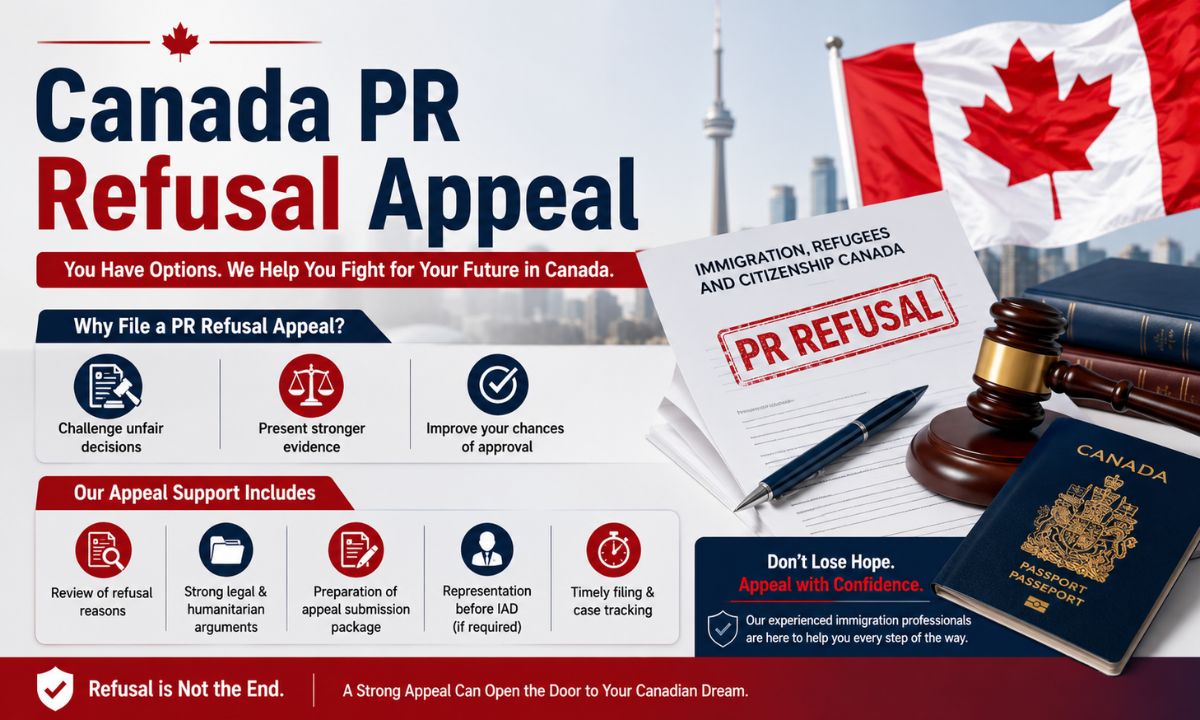
Whether you can appeal and to whom depends on the type of application:
- Spousal or family class sponsorship refusals: The sponsor can typically appeal to the Immigration Appeal Division (IAD) of the Immigration and Refugee Board within 30 days of the refusal.
- Express Entry, PNP-linked, and most economic class refusals: There is generally no appeal to the IAD. Instead, you may apply for leave for judicial review at the Federal Court, usually within 15 or 60 days depending on where the decision was made (inside or outside Canada). Judicial review does not re-decide your case on the merits — the Court examines whether the officer made a legal or procedural error, and if successful, typically sends the case back for a new decision rather than granting PR outright.
- Misrepresentation findings: These can carry an additional inadmissibility period (currently up to 5 years) and often need to be challenged through judicial review or addressed carefully before any future application.
Canada PR Refusal Reapply Waiting Time
In most cases, there is no mandatory waiting period imposed by IRCC before you can submit a new PR application after a refusal — you can, in principle, reapply immediately once you’ve addressed the issues that led to the refusal.
However, some situations do involve a required waiting period or added restriction:
- Misrepresentation findings currently carry an inadmissibility period of up to 5 years from the date of the decision (or the removal order, if applicable), during which you generally cannot apply for PR.
- Certain criminal or medical inadmissibility findings may require you to resolve the underlying issue (e.g., obtain a rehabilitation approval, or show the medical condition no longer applies) before a new application is likely to succeed.
- Express Entry profiles that expire are simply removed from the pool; you can create a new profile at any time if you still meet the eligibility criteria.
What Happens If My PR Application Is Rejected in Canada
If your PR application is rejected:
- You’ll receive a refusal letter stating the general reason(s) for refusal.
- Any processing fees related to the right of permanent residence may be refunded, but the base processing fee is typically non-refundable.
- If you were applying from within Canada on the basis of an existing temporary status your ability to remain in Canada depends on the validity
- If you were outside Canada, you simply remain outside Canada and are not permitted to enter as a permanent resident.
- You can generally choose between: requesting reconsideration, appealing (where applicable), pursuing judicial review, or preparing a new, stronger application.
Can a Permanent Resident Be Deported From Canada
Yes, though this is a separate issue from a PR application being refused — this concerns someone who has already become a permanent resident. A permanent resident can lose their status and be removed from Canada if they:
- Are convicted of serious criminality (an offence punishable by at least 10 years’ imprisonment, or an actual sentence of more than 6 months).
- Are found to have engaged in misrepresentation.
- Fail to meet the residency obligation (generally, being physically present in Canada for at least 730 days within every 5-year period).
- Are found inadmissible on security, human rights violations, or organized criminality grounds.
Frequently Asked Questions
Why was my Canada PR application refused?
Your PR could be refused for many reasons. Common ones include low funds, wrong work experience details, or missing documents.
Can I appeal a Canada PR refusal?
Yes, but it depends on your case. Spousal sponsorships can go to the IAD, while most economic class refusals go to Federal Court.
How long do I have to appeal a PR refusal?
You usually have 30 days to file a sponsorship appeal. Judicial review deadlines are shorter, often 15 to 60 days.
Do I need to wait before reapplying for PR?
No, in most cases you can reapply right away. Just fix the issue that caused your first refusal.
What if my refusal was due to misrepresentation?
This is serious. You could face a ban of up to 5 years before reapplying for PR.
Should I hire a lawyer after a PR refusal?
It helps. A lawyer can explain your refusal letter and pick the right path forward.
Can I still get PR after being refused once?
Yes. A past refusal doesn’t stop you from getting PR later, as long as you’re honest and fix the problem.
Conclusion
A Canada PR refusal feels like a setback, but it’s not the end. Many people get refused once and still succeed later. The key is knowing why it happened.Take time to understand your refusal letter. Fix the real issue, whether it’s documents, funds, or eligibility. With the Best immigration consultant, your next application has a much better chance.
Book Your Free Immigration Consultation Today!
Want to build a better future for your family in Canada?
Get expert immigration guidance tailored solutions specifically for Pakistani families.
WhatsApp: +92 311 4464274
Website: https://aircs.pk/
Offices Rawalpindi & Faisalabad