

August 31, 2026
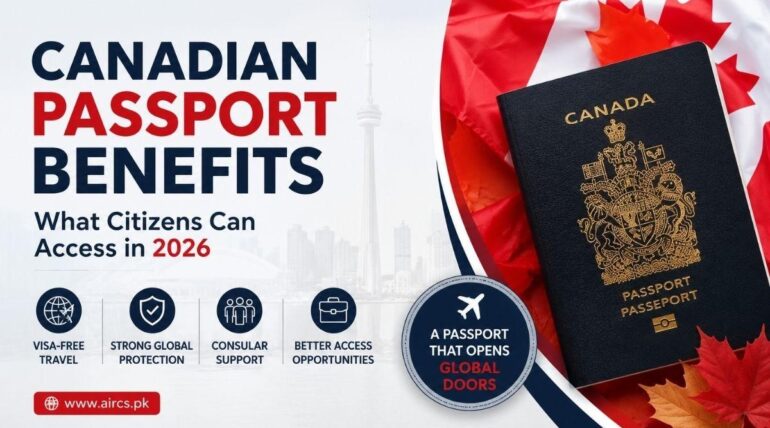
A Canadian passport is more than a travel document. It’s proof of citizenship and it opens doors that a permanent resident card simply can’t. If you’re weighing whether to apply for citizenship, or you just want to understand what you’re holding, this guide breaks down the real Canadian passport benefits — from visa-free travel to healthcare, voting rights and government support.
Table of Contents
ToggleKey Takeaways: Canadian Passport Benefits
Main benefits: The main Canadian passport benefits are visa-free access to 183 destinations and consular help abroad, on top of the voting rights and secure status that come with citizenship.
Other factors: Global mobility ranking, dual citizenship rules, and family sponsorship options all shape how much value citizens get from their passport.
Best solutions: Applying for citizenship as soon as you’re eligible, keeping documents accurate, and renewing early all help you get the most out of your passport.
Processing timing: There’s no single fixed timeline for passport applications. Processing time depends on application type, season, and how complete your documents are.
What Is a Canadian Passport and Who Can Get One?
A Canadian passport is an official document issued by the Government of Canada to citizens. It confirms your identity and your right to enter and leave the country freely. Unlike a driver’s license or a provincial ID, it’s recognized internationally as proof of who you are and where you belong.
Only Canadian citizens can hold a full valid passport. This includes people born in Canada, people born abroad to Canadian parents and immigrants who have completed the citizenship process after living in Canada as permanent residents. Permanent residents cannot apply for a Canadian passport; they travel on the passport of their home country, along with a PR card to re-enter Canada.
Visa-Free and Visa-on-Arrival Travel Benefits
This is usually the first thing people think of when they picture Canadian passport benefits and for good reason. Canadian citizens can travel to a large share of the world without arranging a visa ahead of time. That means less paperwork, lower travel costs and the freedom to book a trip on short notice.
Visa-free doesn’t always mean zero checks at the border. In many countries it means you still need a valid passport, a return ticket and sometimes proof of funds but you skip the embassy visit and the visa application fee. Some destinations offer visa-on-arrival instead, where you get a stamp or short-term permit right at the airport.
Top Countries Canadians Can Visit Without a Visa
Canadians enjoy visa-free or visa-on-arrival access to well over 180 destinations. Some of the most popular ones include:
|
Region |
Popular Visa-Free Destinations |
|
Europe |
UK, France, Germany, Italy, Spain, Portugal, most EU/Schengen countries |
|
Americas |
United States, Mexico, most Caribbean nations, Argentina, Chile |
|
Asia-Pacific |
Japan, South Korea, Singapore, Australia, New Zealand |
|
Africa & Middle East |
UAE, Israel, South Africa, Morocco |
Canadians also enter the United States without a visa for tourism and business. Schengen countries will require an ETIAS travel authorization once it takes effect.
Global Mobility Ranking of Canadian Passport
The Henley Passport Index ranks passports by visa-free access using data from the International Air Transport Association. Canada currently ranks seventh globally with access to 183 destinations, tied with Australia, New Zealand, Malaysia, Czechia, Latvia, Slovakia and Slovenia.
Singapore leads with 192 destinations, followed by Japan, South Korea and the United Arab Emirates at 188. The United States ranks tenth with 180, placing Canada ahead of it. Canada gained ground during 2026, helped by China opening visa-free entry to Canadian passport holders from 17 February for stays of up to 30 days.
Rankings shift every few months as countries revise their visa policies, so check the current index before relying on a specific figure.
Canada Citizenship Benefits vs Permanent Residence
Many newcomers assume permanent residence vs citizenship is a small difference, since both seem to offer similar rights. They don’t. PR status lets you live, work and study almost anywhere in Canada but it comes with real limits that citizenship removes entirely. Understanding Canada citizenship benefits compared to PR status helps explain why so many permanent residents choose to naturalize as soon as they’re eligible.
Permanent residents must renew their PR card periodically and meet a residency obligation generally living in Canada for at least two out of every five years or risk losing their status. Citizens face no such requirement. Once you’re a citizen that status is yours for life unless you formally renounce it.
Rights Only Citizens Have
Only Canadian citizens can:
- Vote and run for office in federal, provincial, and municipal elections
- Hold a Canadian passport and access consular help abroad
- Apply for jobs requiring high-level security clearance, including many federal government roles
- Pass citizenship to children born outside Canada. Under Bill C-3, which came into effect on 15 December 2025, a Canadian parent who did not become a citizen by birth in Canada can now pass citizenship to a child born or adopted abroad, provided the parent spent at least three years in Canada before that child’s birth or adoption.
- Never lose their status regardless of how long they live outside Canada, unlike permanent residents who must meet a residency obligation.
Limitations of Permanent Residence Status
Permanent residents have strong protections, but they aren’t the same as a citizen’s. PR status can be revoked for serious criminal activity or for failing to meet the residency obligation. Permanent residents also cannot vote, cannot hold certain government positions, and must carry their home country’s passport when traveling internationally, along with their PR card to return to Canada.
Canadian Citizenship Advantages for Families
Citizenship doesn’t just change your own rights it changes what you can offer your family. These Canadian citizenship advantages show up most clearly at home since many people apply for citizenship specifically because of how it simplifies sponsorship, education access and long-term planning for their children and parents.
Sponsoring Family Members
Citizens generally have more flexibility when sponsoring close family members, including spouses, dependent children and parents or grandparents through Canada’s family sponsorship programs. While permanent residents can sponsor family too, citizens face fewer restrictions in some categories and aren’t at risk of losing their own status while the sponsorship is processed.
Access to Education and Healthcare
Citizens and permanent residents both get provincial healthcare coverage and access to public schools, so this isn’t a major dividing line day-to-day. The real difference shows up over time: citizenship removes any uncertainty about long-term access, since it can’t be affected by time spent outside Canada or changes in immigration policy. For families planning decades ahead, stability matters as much as any single benefit.
Work and Business Advantages of Canadian Citizenship
Most jobs in Canada are open to permanent residents and citizens alike, but citizenship removes a few specific barriers. Federal government positions requiring security clearance, certain roles in defense and intelligence, and some regulated professions are reserved for citizens only.
Citizenship can also matter for entrepreneurs. Some government contracts, grants, and export programs favor Canadian-owned businesses, and being a citizen simplifies cross-border business travel since you’re never dependent on maintaining PR residency requirements while working abroad for extended periods.
Social Security and Government Benefits for Citizens
Canada’s major social programs, the Canada Pension Plan (CPP) Old Age Security (OAS), and Employment Insurance (EI) are generally available to both citizens and permanent residents who meet contribution and residency requirements. Citizenship doesn’t unlock these programs on its own.
Where citizenship helps is continuity. Since citizens can leave and re-enter Canada without any residency clock ticking, they don’t risk disrupting eligibility for programs like OAS, which depends on years of Canadian residency. A permanent resident who spends years working abroad could jeopardize their PR status entirely, something a citizen never has to worry about.
Dual Citizenship Rules for Canada
Canada allows dual citizenship, which is one of the more flexible policies among major countries. You do not have to give up your original citizenship to become a Canadian citizen and Canadian-born citizens can hold a second nationality without any conflict under Canadian law.
That said, dual citizens should check the rules of their other country of citizenship, since not every nation permits dual status. A few countries require citizens to renounce other nationalities and some place restrictions on property ownership or military service for dual nationals. Canada itself places no such restrictions on its citizens.
How to Apply for a Canadian Passport
Once you’ve completed the citizenship process, applying for a passport is a fairly straightforward administrative step.
Required Documents
You’ll generally need:
- Proof of Canadian citizenship (birth certificate, citizenship certificate, or previous passport)
- A completed passport application form
- Two identical passport photos meeting government specifications
- A guarantor or references, depending on your application type
- Payment for the applicable fee
Processing Time and Fees
Service standards for passport applications run between 10 and 20 business days plus mailing time, depending on where you apply, whether that is a Service Canada Centre, an embassy or consulate, or by mail. Express and urgent services are available in person and have their own shorter timelines.
Since 1 April 2026, you receive a full refund of your passport fee if processing takes more than 30 business days. Refunds are issued automatically. The clock starts when a complete application is received and stops when the passport is printed and verified, and it excludes mailing time. A complete application means a filled-out form, all required documents including a compliant photo, and full payment.
Passport fees rose on 31 March 2026, the first increase since 2013. For applications made within Canada: .
|
Passport type |
Fee (CAD) |
|
10-year adult (16 and over) |
$163.50 |
|
5-year adult (16 and over) |
$122.50 |
|
5-year child (under 16) |
$58.50 |
Fees are higher when applying from outside Canada. The 10-year passport costs more upfront but works out cheaper per year than the 5-year option.
Common Mistakes to Avoid When Applying
A rejected or delayed application usually comes down to a small, avoidable error. Most of these mistakes are easy to fix once you know what to check. Here’s a quick table of the most common ones and how to avoid them.
|
Mistake |
Why It Causes Problems |
|
Photos that don’t meet spec |
Wrong size, background, or an outdated photo can bounce your application back |
|
Incomplete guarantor information |
The guarantor must meet specific eligibility rules and sign correctly |
|
Applying too close to travel dates |
Standard processing takes weeks, not days |
|
Mismatched personal details |
Names or dates that don’t match your citizenship documents cause delays |
|
Forgetting to sign the application |
A simple oversight that’s surprisingly common |
Tips to Make the Most of Your Canadian Passport
- Renew early. Many countries require at least six months of validity remaining before they’ll let you enter — don’t wait until your passport is about to expire.
- Register foreign travel with Global Affairs Canada’s registration service so the government can reach you in an emergency abroad.
- Keep digital copies of your passport’s photo page stored securely in case of loss or theft while traveling.
- Check visa rules before every trip, even to countries you’ve visited before, since entry requirements change more often than most travelers expect.
- Apply for citizenship as soon as you’re eligible if you’re a permanent resident — the sooner you naturalize, the sooner you gain full mobility and the security that comes with it.
Frequently Asked Questions
Can permanent residents get a Canadian passport?
No. Only citizens can hold a Canadian passport. Permanent residents travel on their home country’s passport.
How many countries can Canadians visit without a visa?
Canadians can enter over 180 countries visa-free or with visa-on-arrival. This ranks Canada among the top 10 passports worldwide.
Is dual citizenship allowed in Canada?
Yes. Canada allows dual citizenship. You don’t have to give up your original nationality to become Canadian.
Do citizens get better healthcare than permanent residents?
No, not really. Both groups get the same provincial healthcare coverage. Citizenship just removes any long-term risk to that access.
How long does it take to get a Canadian passport?
Standard processing usually takes a few weeks. Urgent options are available for an extra fee if you’re traveling soon.
Can I lose my Canadian citizenship if I live abroad?
No. Once you’re a citizen, your status is permanent. This is different from permanent residents, who must meet a residency requirement.
Why should a permanent resident apply for citizenship?
Citizenship brings voting rights, a Canadian passport and permanent status with no residency clock. It also makes travel and family sponsorship easier.
Conclusion
A Canadian passport is way more than just a travel document. It’s proof of full citizenship. These Canadian passport benefits cover visa-free travel, the right to vote, and status that lasts a lifetime. They also protect your family in ways permanent residence just can’t match. So if you’re eligible, don’t wait — apply sooner and start enjoying these benefits sooner.
Book Your Free Immigration Consultation Today!
Want to build a better future for your family in Canada?
Get expert immigration guidance and tailored solutions specifically for Pakistani families.