

November 26, 2026
EB-2 NIW recommendation letters are signed statements from experts in your field that explain your achievements and their value to the United States. Under the USCIS Policy Manual, these letters can be persuasive when the writer has first-hand knowledge of your work, gives specific examples and is supported by independent evidence in your petition.
A balanced set combines dependent letters from supervisors and collaborators with independent letters from experts who know you only through your published work or results. Dependent letters confirm your exact role, while independent letters show recognition beyond your own institution.
This guide covers who to ask, how many letters to include and what each letter must contain, with an annotated sample letter and a recommender plan for a civil engineer from Rawalpindi.
What Are EB-2 NIW Recommendation Letters?
EB-2 NIW recommendation letters support your Form I-140 petition by explaining how your work meets the three-prong test from Matter of Dhanasar, the framework USCIS has applied to national interest waiver petitions since 2016:
- Prong 1: Your proposed endeavor has substantial merit and national importance
- Prong 2: You are well positioned to advance the proposed endeavor
- Prong 3: On balance, waiving the labor certification requirement benefits the United States
USCIS does not list recommendation letters as required evidence. They are standard in most NIW petitions because an expert can explain the significance of your work, which degrees, certificates and a CV cannot show on their own.
How Does USCIS Weigh NIW Expert Letters?
USCIS treats recommendation letters as supporting evidence rather than proof on their own. Its Policy Manual update of 15 January 2025 states that letters from experts “may be persuasive” when the writer has “first-hand knowledge” of your achievements, gives specific examples and is “supported by other independent evidence”.
Each key statement in a letter therefore needs matching evidence in your petition. A letter describing your research impact becomes persuasive when citation records, project reports or media coverage in your file confirm it.
USCIS weighs evidence by its quality rather than its volume, a principle from Matter of Chawathe that its Policy Manual applies.
How Recommendation Letters Support the Three Dhanasar Prongs
Each recommendation letter should address at least one prong of the Dhanasar test, and together the letters should cover all three.
| Prong | What the letters explain | Supporting evidence |
|---|---|---|
| 1. Merit and national importance | The broader impact of your work on your field or the United States | Industry reports, government data, media coverage |
| 2. Well positioned | Your education, record of success and plan for the endeavor | Degrees, citations, patents, project results |
| 3. Benefit of the waiver | Why waiving the labor certification requirement benefits the United States | US government agency letters, critical STEM work |
Independent vs Dependent Recommendation Letters for EB-2 NIW
Dependent recommenders know you through work or study, while independent recommenders know you only through your published work or professional results. Combining both types gives the officer a detailed and objective view of your record.
| Type | Who they are | What their letter supports |
|---|---|---|
| Dependent | Supervisors, professors, co-authors, project directors | Your exact role and skills, from first-hand experience |
| Independent | Experts who cited, adopted or evaluated your work | Recognition of your work beyond your own institution |
Dependent letters are valuable because the writer can describe your contributions in detail. The USCIS Policy Manual’s emphasis on first-hand knowledge means these letters carry weight when they include specific, verifiable examples.
Independent letters show that experts outside your institution recognise your work. When an expert who has never worked with you explains how your findings shaped their own research or projects, the officer has clear evidence of your influence on the field.
Who Should Write Your EB-2 NIW Recommendation Letters?
The strongest recommenders are recognised experts who can describe your work with specific examples. Suitable choices include:
- Your supervisor or project director: Explains your role, responsibilities and results on key projects
- Your professor or thesis advisor: Describes your research and its contribution to the field
- Co-authors or research collaborators: Confirm your share of joint work and its outcome
- Experts who cited your work: Explain how your findings informed their own research or projects
- Industry leaders who adopted your methods: Show use of your work beyond your employer
- US organisations interested in your work: Potential clients, partners or investors whose letters support Prong 2
Recommenders in Pakistan are acceptable, particularly for dependent letters. For independent letters, experts in the United States or other countries strengthen your file, because they show international recognition of your work.
Letters from US government agencies or quasi-governmental bodies are particularly strong. The USCIS Policy Manual lists this interest as evidence for Prong 2 and as a positive factor for Prong 3.
How Many Recommendation Letters for EB-2 NIW?
EB-2 NIW petitions commonly include 4 to 6 recommendation letters, usually with 2 or 3 dependent letters and 2 or 3 independent letters. USCIS sets no minimum or maximum, so a smaller set of detailed, well-documented letters is stronger than a longer set that repeats the same points.
NIW Recommendation Letter Sample: Annotated Excerpt
This excerpt shows how an independent expert could write about Usman Tariq, the civil engineer in the sample profile below. It is not a template, and each paragraph is followed by a note explaining why it is effective.
“I am a Professor of Civil and Environmental Engineering at a public research university in Texas, where I have led flood-resilience research for 15 years. I serve on a national technical committee on hydraulic structures and have reviewed more than 60 manuscripts for engineering journals.”
Why it works: It states the writer’s position and expertise in specific terms, and her attached CV allows the officer to verify them.
“I do not know Mr. Tariq personally. I first encountered his work in 2023, when his method for designing scour-resistant bridge foundations was published in a peer-reviewed engineering journal.”
Why it works: It explains how the writer knows his work, which establishes the letter as independent.
“In our laboratory tests, his method reduced the error in predicted scour depth by about 30% compared with the standard approach. My research group has since applied it in two studies of bridges in flood-prone areas of Texas.”
Why it works: It gives a measurable result and shows adoption of his work by other researchers, which supports Prong 2.
“Scour is the most common cause of highway bridge failures in the United States, according to the Federal Highway Administration. Mr. Tariq’s plan to apply his method to bridge assessment and design in the United States addresses a need that extends beyond any single employer.”
Why it works: It connects his past work to his proposed US endeavor and supports its national importance with an authoritative fact, which addresses Prong 1.
Every letter must be written in the recommender’s own words and reflect what they personally know. Copied wording weakens a petition, so use this excerpt as a guide to quality, not as text to reuse.
What to Include in an EB-2 NIW Recommendation Letter
A persuasive NIW recommendation letter covers seven elements, ideally in this order so the officer can find each point quickly:
- Writer’s credentials: Position, experience and achievements, with a CV attached
- Relationship: How and when the writer came to know your work
- Your contributions: Your exact role in projects, research or products, with measurable results
- Impact on the field: How others have cited, adopted or built on your work
- Your proposed endeavor: What you plan to do in the United States and why it has national importance
- Your positioning: Why your record shows you are well positioned to advance that endeavor
- Supporting evidence: References to the citations, patents, project reports or awards in your petition
Each recommender should write in their own words and focus on what they personally know, so that every letter presents your work from a different angle.
NIW Recommendation Letter Format and Signing
A properly formatted letter allows the officer to verify the writer’s identity and credentials. Each letter should include:
- The writer’s official letterhead, the date and full contact details
- The writer’s signature, commonly a scanned copy of a handwritten signature
- The writer’s CV, attached as a supporting exhibit
- A typical length of 2 to 3 pages, which leaves room for specific examples
- English text, as USCIS requires a full certified English translation of any document in another language
USCIS does not require recommendation letters to be notarised.
Sample Recommender Plan: Civil Engineer from Rawalpindi
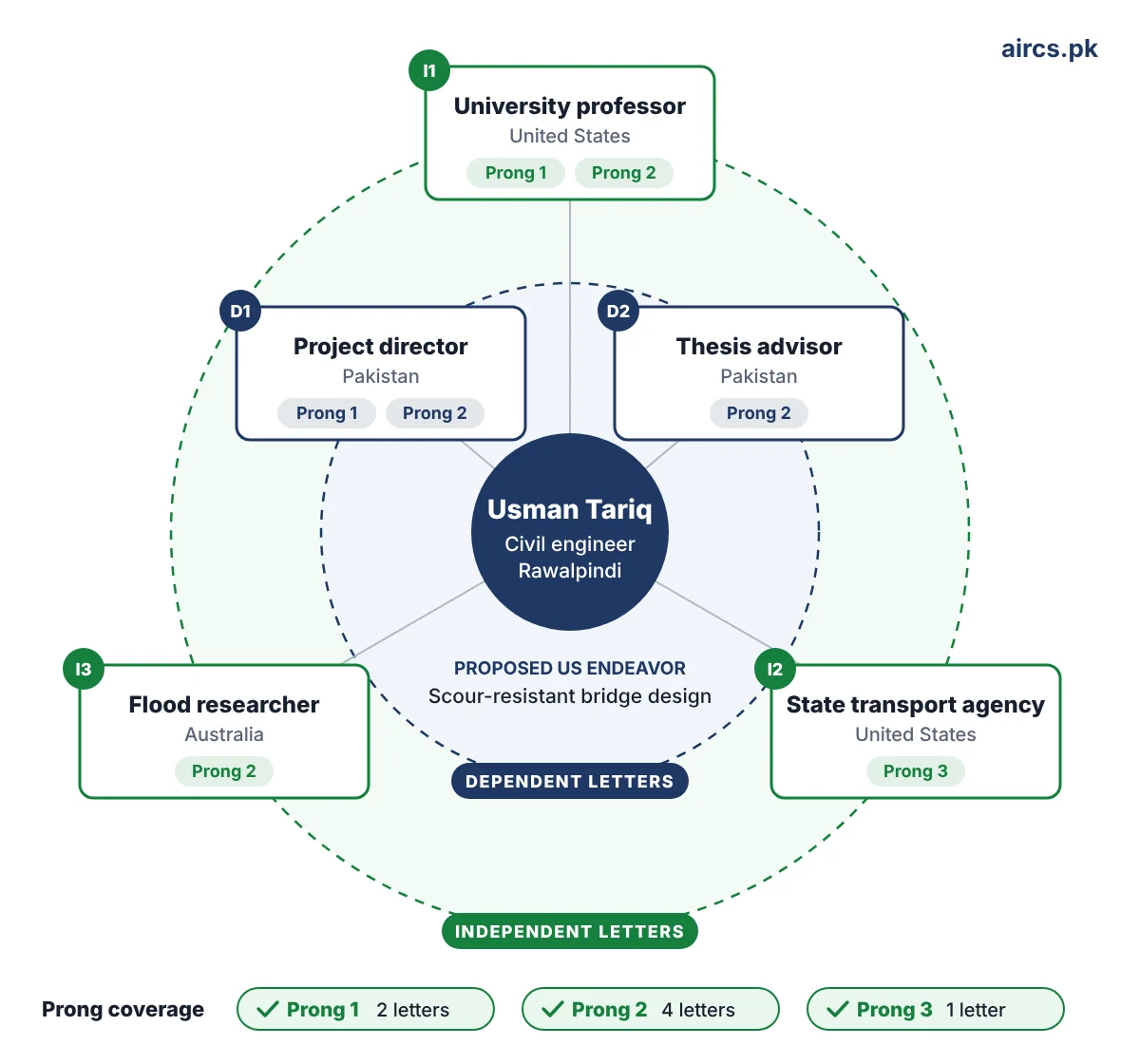
Usman Tariq is a civil engineer from Rawalpindi with a master’s degree in structural engineering and 9 years of experience on bridge and flood-protection projects. His proposed endeavor is applying his scour-resistant design method to bridge assessment and design in the United States, and his published work has been cited in 40 research papers.
- Dependent letter 1: His former project director, explaining his role in designing scour-resistant bridge foundations on three national projects
- Dependent letter 2: His master’s thesis advisor, describing the design method he developed and published
- Independent letter 1: A US university professor whose research group applied his method in two flood-resilience studies
- Independent letter 2: A bridge engineer at a US state department of transportation who reviewed his findings for a state infrastructure project
- Independent letter 3: A researcher in Australia who used his data in a regional flood study
Each letter covers a different part of his record and references supporting evidence, such as citation reports and project documents. The dependent and independent letters support Prongs 1 and 2, and the state agency’s interest strengthens Prong 3.
Common Mistakes in NIW Recommendation Letters
These are the most common weaknesses in NIW recommendation letters, and each can be corrected before filing.
- Identical wording across letters: Repeated phrases across letters reduce their credibility with the officer
- General praise: Words such as “brilliant” or “exceptional” carry little weight without specific results
- Only dependent letters: Without independent letters, a petition struggles to show recognition beyond your own institution
- No link to the endeavor: Each letter should connect your past work to your proposed work in the United States
- Unsupported claims: Key achievements in a letter need matching evidence in your petition
- Missing credentials: Without the writer’s position and CV, the officer cannot assess the writer’s expertise
Since 5 August 2026, USCIS officers can deny a petition without first issuing a Request for Evidence when eligibility is not established at filing. A denial costs up to USD 1,015 in filing fees and the petition’s priority date, as explained in our guide to EB-2 NIW processing time.
AIRCS selects the right mix of recommenders, prepares a detailed brief for each one and matches every key claim to evidence in your petition, with no template letters. Learn more on our EB-2 NIW service page.
Call (051) 8442721 in Rawalpindi or (041) 5482721 in Faisalabad.
Book Your EB-2 NIW Consultation →
Or WhatsApp us on +92 311 4464274
Frequently Asked Questions
Are recommendation letters required for EB-2 NIW?
No. USCIS does not list recommendation letters as required evidence. They are standard in most NIW petitions because a degree or certificate alone does not show the significance of your work.
Should my recommenders work in the same field as me?
Yes, ideally. A recommender with expertise in your field can judge the significance of your work credibly, while a letter from outside your field carries less weight with the officer.
Can my supervisor write my NIW recommendation letter?
Yes. A supervisor’s letter is valuable because it describes your work from first-hand experience. Pair it with independent letters to show recognition beyond your own institution.
Do my recommenders need to be in the United States?
No. Recommenders in Pakistan and other countries are acceptable. Independent experts in the United States strengthen your petition, because they confirm the relevance of your work to the US.
Do NIW recommendation letters need to be notarised?
No. USCIS does not require notarisation. Each letter should be signed, dated and printed on the writer’s letterhead with full contact details.