
July 6, 2026
You can immigrate to Canada as a physiotherapist in 2026 through Express Entry healthcare draws, which invited applicants at a CRS score of 467 in February and 475 in June, far below the 507 plus needed in general draws. Your job code is NOC 31202, and you do not need a Canadian license to apply. Your PR rests on your DPT degree, your IELTS score, and 12 months of physiotherapy work.
Table of Contents
ToggleQuick Answer: Immigrate to Canada as a Physiotherapist
- Main pathway: Express Entry healthcare category draws, with PNPs as the backup route.
- Your job code: NOC 31202, a TEER 1 occupation.
- 2026 change: CAPR replaced the old two-part PCE with the CPTE in January 2026, a single virtual exam taken in one day.
- Key point: You do not need a Canadian license to get PR, because IRCC treats immigration and licensing as two separate processes.
- Timeline: A strong file takes about 9 to 12 months from profile to PR.
Immigrate to Canada as a Physiotherapist through Express Entry
You can immigrate to Canada as a physiotherapist through the Express Entry healthcare draw, which invited 4,000 people at a CRS score of 467 on 20 February 2026, and the next round on 25 June 2026 invited at 475. General draws in the same period stayed between 507 and 518, so a physiotherapist enters with a much lower score than a regular applicant.
To enter this draw, you need 12 months of physiotherapy work experience within the last three years. Canada set this rule on 18 February 2026, and we explain it in our guide on the Express Entry new rules.
The New CPTE Exam Explained
The licensing test for physiotherapists changed completely in January 2026. The Canadian Alliance of Physiotherapy Regulators (CAPR) retired the old Physiotherapy Competency Examination (PCE) and launched the Canadian Physiotherapy Examination.
Under the old PCE, you passed a national written exam and then waited months for a seat in your province’s clinical exam. The CPTE ends that wait. You take the whole test online in one day, with a 2.5 hour oral part that carries 60 percent of your marks and a 2.5 hour written part that covers the other 40.
The standard fee is CAD 2,500, and CAPR runs the exam several times a year. You get a maximum of three attempts, so prepare well before you book. See full details on the official CAPR website.
Physiotherapist NOC 31202 Explained
Physiotherapists apply under NOC 31202, a TEER 1 occupation that qualifies for Express Entry and for every healthcare draw. A wrong code, like NOC 32109 for therapy technicians or NOC 31303 for physician assistants, will not match your real duties, and IRCC can refuse a file where the code and the work do not line up.
IRCC verifies your NOC code through your reference letters, so each letter must show your weekly hours, employment dates, and duties that match real physiotherapy practice, such as assessment, treatment planning, and patient rehabilitation.
Do You Need a License Before Applying for Canada PR?
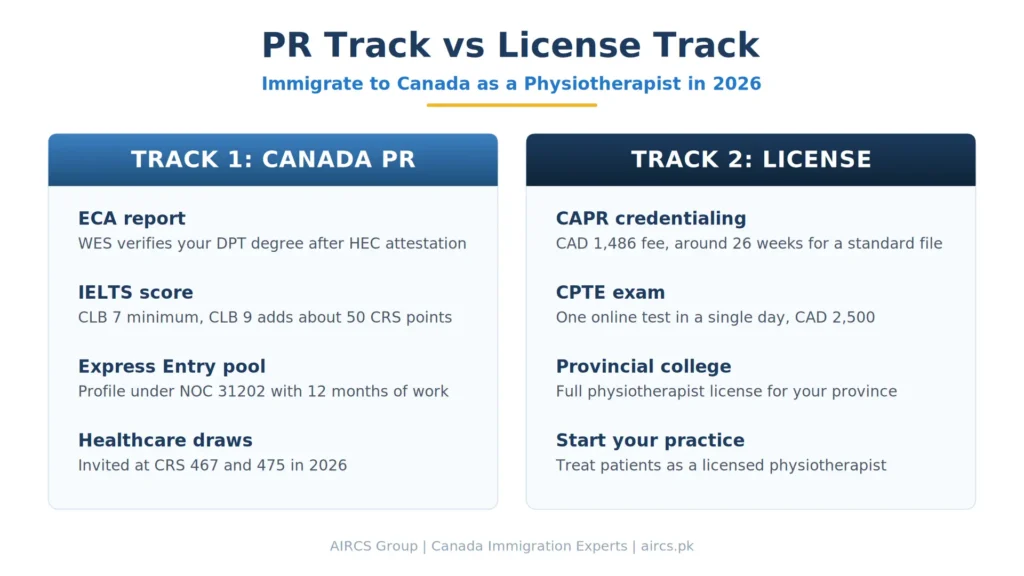
You can apply for Canada PR without passing the CPTE or holding any Canadian license, because IRCC never asks for exam results. Your PR file rests on your degree, your IELTS, and your work experience, while your license is a separate process.
Canada PR Requirements for Physiotherapists
The requirements for physiotherapists to apply for Canada PR is as follow:
- Verify your degree. Get your degree verified by a Canadian educational evaluation body and get your ECA report, finish HEC attestation before that, because ECA only accepts attested documents.
- Take the IELTS. CLB 7 band is the minimum requirement, and CLB 9 adds around 50 extra CRS points, the biggest single boost available to most applicants.
- Enter the pool. Create your Express Entry profile under NOC 31202 with 12 months of physiotherapy work experience from the last three years and enter the pool.
- Keep a PNP option open. A provincial nomination adds 600 CRS points in your express entry profile.
Canada PR for physiotherapists follows the same process as for other healthcare workers, and our guide on Canada immigration for healthcare professionals explains each step in detail.
CAPR Credentialing and the CPTE Exam
Licensing starts with CAPR credentialing. CAPR reviews your DPT degree, and your supervised clinical hours against Canadian standards, charges CAD 1,486, and takes around 26 weeks for a standard file.
After CAPR approves your credentials, you register for the CPTE, and passing it lets you apply to the physiotherapy college of your province for your complete physiotherapist license in Canada. Quebec is the one exception, since it runs its own system through the OPPQ.
Which Province Should a Physiotherapist Pick?
Canada immigration for physiotherapists runs through six active provinces, and every province has a dedicated healthcare pathway in 2026, but each works differently. The right choice still depends on your profile and your licensing plan.
A nomination from any of them adds 600 CRS points to your Express Entry profile. A physiotherapist waiting at 440 moves to 1,040 with a nomination, this is why targeting a PNP alongside Express Entry is the dominant 2026 strategy.
Saskatchewan (SINP)
Saskatchewan reserves at least half of its 4,761 nominations for priority sectors, healthcare included, and accepts applications from inside or outside Canada all year. It also grants physiotherapists a provisional licence for up to 24 months once CAPR credentialing is done and a CPTE date is booked.
Nova Scotia (NSNP)
Nova Scotia placed healthcare at Level 1 of its new priority framework in April 2026, and only this level accpets applicants from outside Canada. You enter through an Expression of Interest, valid for 12 months, which makes this one of the most direct provincial doors for offshore physiotherapists. Read more on CIC News.
Manitoba (MPNP)
Manitoba targets health workers through occupation-specific draws, and its Draw 269 in April 2026 sent 192 of its 308 invitations to health occupations. Some Manitoba streams need no job offer, though real ties to the province, like family or past study, add points to your score in Manitoba’s selection pool.
Alberta (AAIP)
Alberta lists physiotherapists by name on its Dedicated Health Care Pathway and runs several draws every month. Cutoffs stay low on Alberta’s own points scale, with the Express Entry track inviting at 57 in May 2026 and the non-Express Entry track dropping into the mid-40s. You need an Alberta job offer from a healthcare employer, plus proof from the College of Physiotherapists of Alberta that you meet its practice requirements.
British Columbia (BC PNP)
BC rebuilt its program around a Care priority in April 2026, and its healthcare draws invited at 100 to 108 points in May and June with the physiotherapist NOC 31202 on the list. A full-time job offer is required, and note that these provincial scores come from BC’s own 200-point system, not the CRS.
Ontario (OINP)
Ontario has some limitations. Its new Ontario Workforce Priority stream, launched on 26 June 2026, needs an Ontario job offer for physiotherapists, and the province has ended provisional practice.
Cost and Timeline for a Physiotherapist
The total cost to immigrate to Canada as a physiotherapist from Pakistan is around CAD 6,300 in government and assessment fees, based on the rates updated in 2026.
Item | Fee (CAD) | Stage |
PR processing fee | 990 | Immigration |
Right of Permanent Residence Fee | 600 | Immigration |
Biometrics | 85 | Immigration |
ECA through WES (with courier) | Around 300 | Immigration |
IELTS test | Around 375 | Immigration |
CAPR credentialing | 1,486 | Licensing |
CPTE exam | 2,500 | Licensing |
Fees change from time to time, so always confirm the latest figures before you pay.
For timeline, a well-prepared Express Entry file takes about 9 to 12 months from profile to PR. CAPR credentialing takes around 26 weeks.
What Physiotherapists Earn in Canada
Physiotherapists in Canada earn between CAD 30 and 56 per hour according to Job Bank, with a median of CAD 46.15, which works out to roughly CAD 70,000 to 95,000 a year for full-time work. Private clinics, senior roles, and specialist fields pay more. Your spouse and children join the same PR file as dependants, so when you immigrate to Canada as a physiotherapist, they become permanent residents with you and can live, work, and study anywhere in Canada.
Frequently Asked Questions
Do I need to pass the CPTE exam before applying for PR?
No. You don’t need to pass any exam before applying for PR throuh Express Entry. It requires your ECA, IELTS, and work experience, and IRCC never asks for exam results. You can immigrate to Canada as a physiotherapist first and finish the exam later.
Which NOC code do physiotherapists use?
Physiotherapists apply under NOC 31202, a TEER 1 occupation. Using another NOC will disqualify your application from all physiotherapist-specific Express Entry draws and dedicated provincial nominee streams.
Is a Pakistani DPT degree accepted in Canada?
Yes. WES assesses your DPT degree for the ECA, and CAPR reviews it separately for licensing. Finish your HEC attestation first, since both bodies only accept verified documents.
What CRS score does a physiotherapist need in 2026?
Canada PR for physiotherapists needs a CRS score of around 475 or higher, since the 2026 healthcare draws invited at 467 in February and 475 in June. Below that, a PNP nomination adds 600 points to your profile and secures your invitation.
Want to Immigrate to Canada as a Physiotherapist?
Canada immigration for physiotherapists is open at cutoffs as low as 467, and the June 2026 healthcare draw only accepted profiles created before 21 May 2026. AIRCS Group has helped hundreds of Pakistani professionals to get Canada PR through Express Entry streams. Book your free assessment today and let your physiotherapy career carry you to Canada.