November 12, 2026
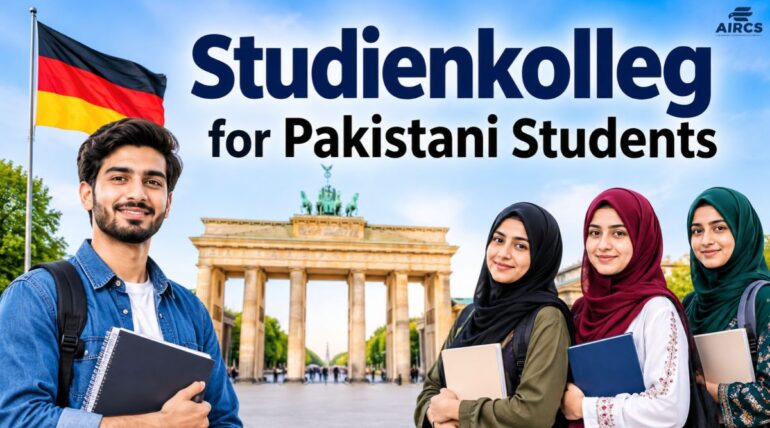
Most Pakistani students with an FSc cannot enter a German Bachelor’s program directly. German universities expect 13 years of schooling, and FSc counts as 12. Studienkolleg for Pakistani students closes that gap. It is a one-year course that prepares FSc holders for a German university.
This guide explains who needs Studienkolleg, which course to choose, how the Feststellungsprüfung works, what it costs, and how to apply in 7 steps. It is written for FSc and A-Level students planning a degree in Germany.
Table of Contents
ToggleWhat Is Studienkolleg for Pakistani Students?
Studienkolleg is a preparatory course for international students whose school certificates do not give direct access to German universities. It usually runs for two semesters (one year).
You study German, mathematics and subjects linked to your future degree. At the end, you sit the Feststellungsprüfung, the exam that qualifies you for university admission.
Key facts:
- Classes are taught in German, not English.
- Public Studienkollegs are linked to universities and usually cost far less than private ones.
- Passing the final exam gives you access to your chosen subject area at German universities.
Who Needs Studienkolleg for Pakistani Students?
Germany’s school system has 13 years. The Pakistani FSc/HSSC counts as 12 years, so most FSc-only applicants must complete a Germany foundation course before starting a Bachelor’s.
Who Must Attend
- Students with FSc, HSSC or Intermediate only
- A-Level students who do not meet a university’s subject requirements
- Applicants whose certificates are classified as “not equivalent” in the German recognition database
Who May Skip It
- Applicants with a recognized completed Bachelor’s degree
- Students with enough previous university study, depending on the university’s rules
- Some students with FSc plus a year at a recognized university, though this varies by institution and grades
Rules differ by university. Always confirm yours on the program’s admissions page or on the DAAD website before you plan your route.
Studienkolleg Course Types
Your Studienkolleg course must match the degree you want. The main courses are:
- T-Course (Technical): engineering, computer science, mathematics, natural sciences
- M-Course (Medical): medicine, dentistry, biology, pharmacy
- W-Course (Economics): business, economics, management
- G-Course (Humanities): languages, social sciences, humanities
- S-Course (Languages): language-focused degrees
Which Course Fits Your FSc Group?
- Pre-Engineering students usually choose the T-Course.
- Pre-Medical students usually choose the M-Course.
- Commerce or ICS students often choose the W-Course or T-Course, depending on their target degree.
Choose carefully, because your course decides which degrees you can enter afterwards.
Studienkolleg for Pakistani Students: Eligibility Requirements
Each institution sets its own rules, but most ask for the following:
- School certificates: Matric and FSc/HSSC, attested as required
- German language proof: usually level B1, though some colleges ask for more
- Entrance exam (Aufnahmeprüfung): testing German and sometimes mathematics
- Valid passport and passport photos
- CV and application form, plus any other documents the college lists
Why German Level Matters
Lessons are fully in German, and your final exam includes demanding German-language papers. Pakistani students who begin language classes six to twelve months before applying are usually far better prepared. Our Germany study abroad team can help you plan your language timeline alongside your application.
Understanding the Feststellungsprüfung
The Feststellungsprüfung (FSP) is the final exam of Studienkolleg. It decides whether you can enter a German university.
What the Exam Covers
- German language: reading, writing, listening and speaking
- Mathematics for T, W and M courses
- Subject papers such as physics, chemistry, biology or economics
- Oral components in some courses
How to Prepare
- Attend every class and finish homework weekly.
- Practice past papers if your college shares them.
- Build vocabulary around your subject from the first month.
- Study with classmates to test each other.
Many colleges allow a limited retake, but the rules differ, so check yours early.
Studienkolleg Fees and Costs in 2026
Costs depend heavily on the type of college.
- Public Studienkollegs usually charge a modest semester contribution rather than full tuition, but amounts vary by state and institution.
- Private Studienkollegs can charge several thousand euros per year, so compare them carefully.
Blocked Account and Other Expenses
- Blocked account (Sperrkonto): €11,904 for one year, which equals €992 per month. Read our German blocked account guide for the opening process.
- Health insurance
- Visa fee and document attestation
- Rent, food and transport
Budget Tips for Studienkolleg for Pakistani Students
Plan the blocked amount plus a buffer for flights, deposits and unexpected costs. Compare at least three colleges before you apply, and ask each one for its current fee sheet in writing.
Not sure which Studienkolleg fits your budget and FSc group?
Our Germany team can check your documents and suggest realistic options. Book a free consultation before you pay any application fees.
Studienkolleg for Pakistani Students: How to Apply in 7 Steps
Step | Action | What to Do |
1 | Check your eligibility | Confirm whether your FSc needs a foundation year. |
2 | Pick your course | Match the T, M, W, G or S course to your target degree. |
3 | Learn German | Aim for at least B1 before you apply. |
4 | Shortlist colleges | Compare location, fees, deadlines and entrance exams. |
5 | Prepare documents | Gather attested certificates, translations, passport copies and language certificates. |
6 | Apply and pass the entrance exam | Apply through uni-assist or directly, depending on the college. Sit the entrance exam if required. |
7 | Apply for your visa | Open your blocked account, collect your admission letter and book your embassy appointment early. |
Application Deadlines
Most Studienkollegs offer a winter intake, and some also offer a summer intake. Deadlines often fall several months before the course starts, so begin preparing 9 to 12 months ahead.
Common Mistakes Pakistani Applicants Make
- Starting German too late and missing the language requirement
- Choosing the wrong course for the intended degree
- Applying to a private Studienkolleg without comparing costs
- Submitting unattested or incomplete documents
- Missing application or visa deadlines
- Relying on unofficial advice instead of the college’s own requirements
A single missing document can delay your admission by a full semester.
After Studienkolleg: Study, Work and Career in Germany
Once you pass the Feststellungsprüfung, you can apply to German universities in your subject area, through uni-assist or directly. Many public universities charge no tuition for Bachelor’s degrees, though a semester contribution applies. Some states and institutions have introduced fees for international students, so check each university.
Working While You Study
Students from outside the EU may work up to 140 full days or 280 half days per year without approval from the Federal Employment Agency, according to Make it in Germany, the official portal. A day of up to four hours counts as half a day. The same source says you may alternatively work up to 20 hours per week during lectures. Check your residence permit, since your local foreigners office can set limits, and self-employment needs separate approval.
After Graduation
Graduates can apply for a residence permit of up to 18 months to look for a job. Fields such as engineering, IT and healthcare offer strong demand. For a full overview, read our guide on how to study in Germany from Pakistan.
Is Studienkolleg for Pakistani Students Worth It?
For most FSc holders, yes. It is not optional if your certificate does not qualify for direct entry, and it opens the door to tuition-free or low-cost public universities in Germany. The year also gives you structured German language training and clear preparation for your chosen degree, so you start university ready for lectures, exams and academic writing in German.
The year does demand real effort. You add one extra year before your Bachelor’s, you must reach a solid level of German, and you need to cover living costs while you study. If a German degree is your goal, these trade-offs are usually worth it, because the course builds the language skills and study habits that carry you through your degree.
FAQs
Is Studienkolleg for Pakistani Students Compulsory?
Not for everyone, but most FSc/HSSC holders need it. Applicants with enough previous university study or a recognized Bachelor’s degree may qualify for direct entry.
Can I Join a Studienkolleg Without German?
Almost never. Most programs require around B1, and teaching is in German.
How Long Does Studienkolleg for Pakistani Students Take?
Usually two semesters, or one academic year.
Ist die Feststellungsprüfung Difficult?
It is challenging but passable with steady study, good German skills and past-paper practice.
Can I Work While Attending Studienkolleg?
Non-EU students may generally work 140 full days or 280 half days per year, or up to 20 hours per week during lectures, as explained in the working section above. Confirm the exact limits for your residence permit with your local foreigners office.
AIRCS Group helps Pakistani students
Planning early saves money and avoids rejected applications. AIRCS Group helps Pakistani students with course selection, document checks and study visa preparation. Book your free consultation with our Germany study team, or reach us through the contact page and we will review your profile.
Call: (+92) 311 4464274 | WhatsApp: Chat with us | Email: info@aircs.pk
Offices: Rawalpindi, Islamabad and Faisalabad | Hours: Mon to Sat, 9:30 am to 6:30 pm