

April 8, 2026
The Canada PR processing time is about 6 months for the Canadian Experience Class and 7 months for the Federal Skilled Worker Program, according to IRCC figures updated on 3 September 2026. These timelines begin when IRCC receives your complete application, not when you start preparing documents.
For applicants from Pakistan, the full process from language testing to landing can take 12 to 24 months, depending on document preparation and the wait for an invitation.
Table of Contents
ToggleHow Long Does It Take to Get PR in Canada in 2026?
As of 3 September 2026, IRCC’s published processing times were 6 months for the Canadian Experience Class (CEC) and 7 months for the Federal Skilled Worker Program (FSWP) and enhanced Provincial Nominee Program (PNP). These figures cover only the permanent residence application stage. They do not include the time spent preparing documents or waiting for an Invitation to Apply (ITA).
- IRCC processing: 6 to 7 months, measured from the date you submit your application to the final decision.
- Applying from Pakistan (FSWP or PNP): typically 12 to 24 months, including the language test, Educational Credential Assessment (ECA), Express Entry profile, wait for an ITA, 60-day application window and IRCC processing.
- Already working in Canada (CEC): 7 to 9 months after you complete one year of skilled work, provided your CRS score meets recent CEC cut-offs (518 to 523 in August and September 2026).
- International graduates in Canada: typically 18 to 24 months after graduation, including one year of skilled work, the wait for an ITA, and IRCC processing.
Canada PR Processing Time by Program (2026)
Express Entry programs are currently the fastest route to Canadian permanent residence, with processing times of 6 to 7 months. Base PNP, family sponsorship and the Atlantic Immigration Program take 13 to 28 months. These times cover only the federal PR application stage. They do not include the provincial nomination stage or the wait for an Invitation to Apply.
Immigration program | Processing time | Key details |
Canadian Experience Class (CEC) | 6 months | Requires at least one year of skilled work experience in Canada |
Federal Skilled Worker Program (FSWP) | 7 months | Rose from 6 to 7 months in the September 2026 update |
Federal Skilled Trades Program (FSTP) | Not published | Not published by IRCC due to insufficient data |
Provincial Nominee Program, enhanced (Express Entry) | 7 months | Federal processing after a provincial nomination |
Provincial Nominee Program, base (non-Express Entry) | 13 months | Provincial nomination comes first and adds to the total time |
Quebec Skilled Workers | 11 months | Federal processing after Quebec selection |
Atlantic Immigration Program (AIP) | 26 months | Requires a job offer from a designated Atlantic employer and a provincial endorsement |
Spouse or common-law partner sponsorship (inside Canada) | 18 months | Partner is already living in Canada |
Parents and Grandparents Program (PGP) | 26 months | Sponsor must meet a minimum income for the past 3 years |
Start-up Visa Program | 28 months | No longer accepting new applications; submitted applications are still being processed |
Self-Employed Persons Program | 10+ years | Paused since April 2024; submitted applications are still being processed |
Source: IRCC processing times as of 3 September 2026, reported by CIC News. Family sponsorship times apply to applications outside Quebec. Check the official IRCC processing times tool before you apply.
When Does Canada PR Processing Time Start?
IRCC starts counting processing time when it receives your complete PR application and ends when it makes a final decision. For online applications, the start date is the day you submit it online.
Processing time does not include IELTS preparation, your Educational Credential Assessment (ECA) or time spent in the Express Entry pool.
After you receive an Invitation to Apply (ITA), you have 60 days to send your application. IRCC processing, which takes 6 to 7 months, begins only after you submit.
The PR times Canada publishes on the IRCC website are estimates, not guaranteed decision dates. Most are based on how long IRCC took to process 80% of past applications.
Canada PR Timeline from Pakistan: Step by Step
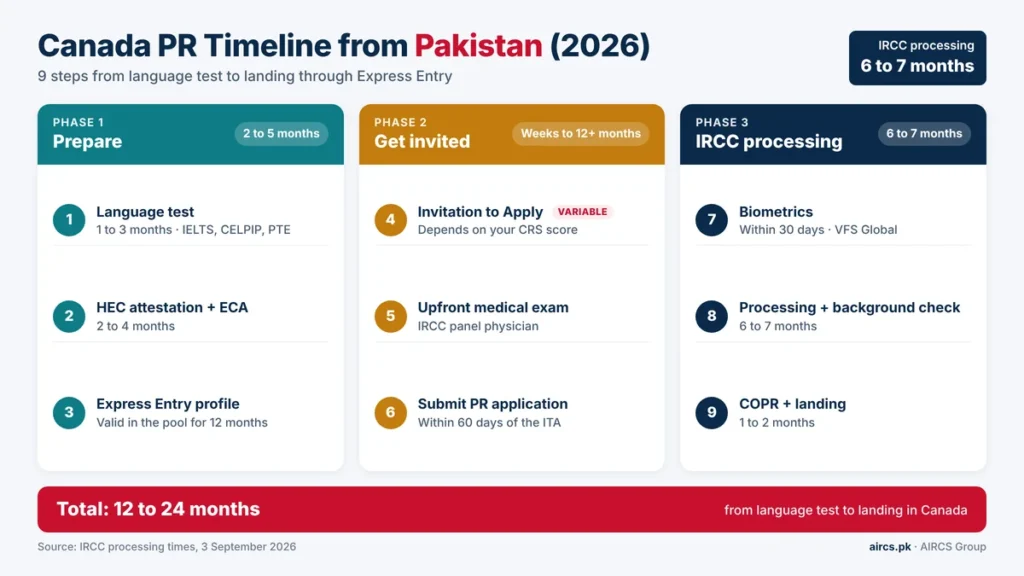
Plan for 12 to 24 months from start to landing if you apply from Pakistan through Express Entry. The biggest unknown is how long you wait for an ITA, and that depends on your CRS score.
Step | Typical timeframe | Key requirement |
1. Language test (IELTS General Training, CELPIP-General or PTE Core) | 1 to 3 months, including preparation | Results must be less than 2 years old when you submit your PR application |
2. HEC attestation and Educational Credential Assessment (ECA) | 2 to 4 months | HEC attestation takes 2 to 6 weeks; WES needs about 35 business days after receiving documents through HEC’s dispatch service |
3. Express Entry profile | Same day, once your test results and ECA are ready | A profile remains valid in the pool for up to 12 months |
4. Invitation to Apply (ITA) | A few weeks to more than a year | Depends on your CRS score and the types of draws IRCC holds |
5. Upfront medical exam | Within the 60-day window after your ITA | Mandatory before you submit (since 21 August 2025); must be done by an IRCC panel physician |
6. Submit your PR application | Within 60 days of your ITA | Must include police certificates, proof of funds, reference letters and proof of your medical exam |
7. Biometrics | Within 30 days of the biometric instruction letter | Required for every PR application, even if you gave biometrics before; collected at VFS Global centres in Islamabad, Lahore and Karachi |
8. IRCC processing and background checks | 6 to 7 months | Measured from the day you submit your complete application |
9. Passport request, COPR and landing | Typically 1 to 2 months | You must land in Canada before your Confirmation of Permanent Residence (COPR) expires |
Express Entry vs PNP Processing Time
IRCC processes Express Entry applications in 6 to 7 months. A base PNP application takes 13 months at the federal stage, plus the time the province takes to issue a nomination.
- Enhanced PNP: Enhanced streams are linked to Express Entry, and a provincial nomination adds 600 CRS points to your profile. Recent PNP draw cut-offs ranged from 697 to 760, with the latest at 725 on 28 September 2026, so a nomination almost guarantees an ITA. IRCC then processes your application in 7 months.
- Base PNP: You apply directly to the province, outside Express Entry. After nomination, you submit your PR application to IRCC online, and IRCC processes it in 13 months.
A PNP takes longer, but for applicants whose CRS score is below recent draw cut-offs, a provincial nomination is often the most realistic route to an ITA. Read our Express Entry vs PNP guide to compare both routes for your profile.
How Long Does PR Take After a Work Permit in Canada?
To apply through the Canadian Experience Class (CEC), you need at least one year (1,560 hours) of skilled work experience in Canada. This work must be in a TEER 0, 1, 2 or 3 job and gained within the 3 years before you apply. Part-time work also counts if it adds up to 1,560 hours. For example, 15 hours a week for 24 months qualifies.
If your CRS score meets the CEC cut-off (518 to 523 in August and September 2026), you can expect to receive PR about 7 to 9 months after you complete one year of work. This allows up to 2 weeks for an ITA (CEC draws were held every two weeks), up to 60 days to submit your application and 6 months of IRCC processing.
If your work permit will expire before IRCC decides on your PR application, you may qualify for a Bridging Open Work Permit (BOWP). To qualify, you must be in Canada, be the principal applicant, hold an Acknowledgement of Receipt (AOR) and have a work permit that expires within 4 months.
How Long Does PR Take for International Students in Canada?
For international students, the total time to PR is typically the length of your study program plus 18 to 24 months. After graduation, you need one year of skilled work on a Post-Graduation Work Permit (PGWP), followed by the wait for an ITA, the 60-day application window and 6 months of IRCC processing.
Work done during full-time study, including co-op terms, does not count toward the CEC. Only work completed after your studies end counts toward the one-year requirement.
Common Causes of Canada PR Delays for Pakistani Applicants
Missing or inconsistent documents can lead to additional requests from IRCC, longer processing or a refusal for incompleteness. Pay close attention to these issues:
- Name inconsistencies: Your name must appear the same way on your passport, CNIC, degree and application forms. For example, your father’s name may appear as a surname on one document but not on another.
- Incomplete reference letters: Each letter must be on company letterhead and include your job title, duties, employment dates, weekly hours and annual salary. The listed duties should match the description for your NOC code.
- Missing police certificates: You need a certificate from every country where you lived for 6 months or longer in a row since turning 18, within the last 10 years. In Pakistan, provincial police issue these certificates. If you live abroad, apply through the nearest Pakistani embassy or consulate.
- Expired medical results: Medical results are valid for 12 months. If they expire before IRCC finalises your application, IRCC may ask you to complete a new exam.
- Background checks: Security and background checks vary by case and can extend processing beyond the published time.
- Missed deadlines: IRCC sets a deadline whenever it requests documents or information. A late or missing response can lead to a refusal.
If a police certificate is delayed, IRCC accepts a letter of explanation with proof that you applied, such as a receipt or tracking number.
How to Check Your Canada PR Application Status
You can track your application in your IRCC online account. It shows each stage, including eligibility, medical, background check and final decision.
IRCC also offers an application status tracker for PR applications. If your application is past the published processing time, you can contact IRCC through its web form.
Frequently Asked Questions
How many years does it take to get PR in Canada?
For applicants in Pakistan, the full process typically takes 1 to 2 years from the language test to landing. Of this, IRCC processing takes 6 to 7 months, counted from the day you submit your complete application.
How long does PR take through a PNP?
IRCC processes an enhanced PNP application in 7 months from the day you submit it. A base PNP application takes 13 months at the federal stage, plus the time needed for the provincial nomination.
How long does it take to get a PR card after landing?
As of 1 October 2026, IRCC’s processing time for a new PR card is 34 days. You must give IRCC a Canadian mailing address within 180 days of becoming a permanent resident, or you will need to apply and pay for the card separately.
How long does Canada PR last?
Your PR card is usually valid for 5 years, but PR status itself does not expire. To keep your status, you must live in Canada for at least 730 days within every 5-year period, and those days do not need to be continuous.
Does applying from Pakistan take longer than applying from inside Canada?
IRCC publishes the same Express Entry processing time for both. However, applicants in Pakistan must also submit their passport for a PR visa and travel to Canada to land before their COPR expires.
Check Your Canada PR Processing Time with AIRCS Group
Your Canada PR processing time depends on your CRS score, your occupation and your pathway. As a Canada PR consultant in Pakistan, AIRCS Group can assess your profile and map out your timeline. Visit us in Rawalpindi or Faisalabad, book a free consultation or message us on WhatsApp.