


September 23, 2026
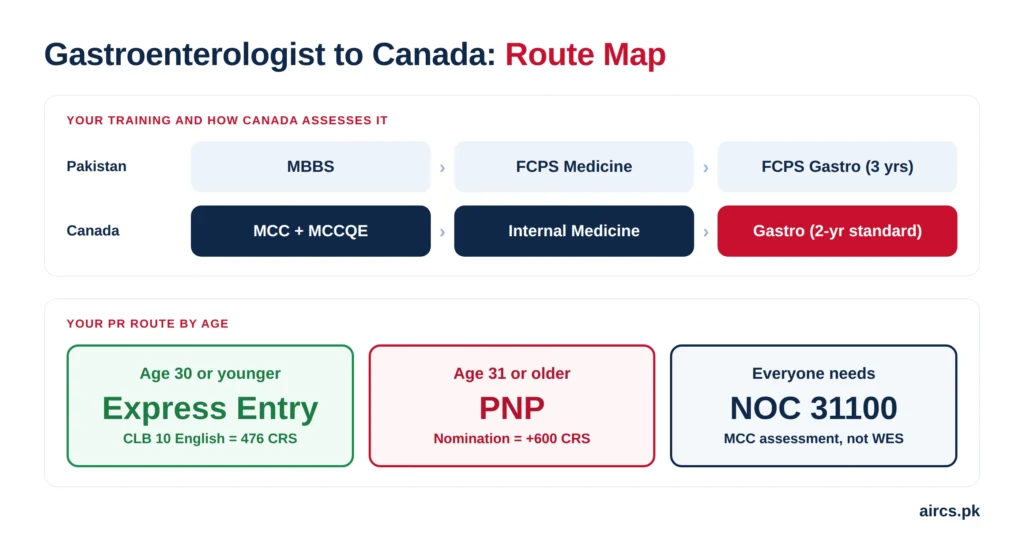
For gastroenterologists trained in Pakistan, Canada immigration for gastroenterologists depends largely on age, CRS score, language results, and paid work experience. Because FCPS Gastroenterology is completed after FCPS Medicine, many applicants are over 31 when they apply, which lowers their CRS score.
This guide covers Express Entry, PNP options and the key requirements for gastroenterologists from Pakistan.
Table of Contents
ToggleCanada Immigration for Gastroenterologists: Key Facts
- NOC code: 31100, Specialists in clinical and laboratory medicine (TEER 1)
- Express Entry category: Healthcare and Social Services
- Work requirement: 12 months of paid, full-time or equivalent work in the past three years, in Canada or abroad
- Latest healthcare draw: 4 September 2026, with 3,500 invitations at CRS 475
- Credential assessment: Medical Council of Canada (MCC) for the MBBS (WES not accepted)
- Provincial nomination: An Express Entry-linked nomination adds 600 CRS points
- Specialist certification: Royal College Internal Medicine certification first, then assessment against the two-year gastroenterology standard
How Can Gastroenterologists from Pakistan Qualify for Canada PR?
Gastroenterologists are classified under NOC 31100, which IRCC includes in the Express Entry Healthcare and Social Services category. To qualify, you need 12 months of paid, full-time or equivalent work in this occupation within the past three years, in Canada or abroad. The work does not need to be continuous.
You must also meet the requirements of an Express Entry program. For applicants from Pakistan, this is usually the Federal Skilled Worker Program, which requires one year of continuous paid work in the last 10 years and at least CLB 7 English. Express Entry does not require a Canadian job offer or medical license. Licensing is handled separately by the provincial medical regulator.
The application process has five steps:
- Get your credential assessment: Apply to the Medical Council of Canada through physiciansapply.ca to have your MBBS assessed.
- Take an approved English test: IELTS General Training, CELPIP-General or PTE Core.
- Create your Express Entry profile: Enter your education, language results and work experience under NOC 31100.
- Apply for a provincial nomination if needed: An Express Entry-linked nomination adds 600 CRS points, making it the main option when your score is below the cut-off.
- Receive your ITA and apply: Submit your complete PR application within 60 days of your Invitation to Apply (ITA).
Which Gastroenterology Training Pathway Do You Have?
Your training pathway does not affect your Express Entry category, but it determines how the Royal College assesses you for specialist certification.
- FCPS Medicine followed by FCPS Gastroenterology: CPSP requires FCPS Medicine, or an equivalent qualification, before its three-year Gastroenterology fellowship. This follows the same sequence as Canada, where gastroenterology training comes after internal medicine. Paid FCPS-II years count as NOC 31100 work, because Statistics Canada includes specialist residents in this group.
- FCPS Medicine with a gastroenterology practice: Your work also falls under NOC 31100. The Royal College assesses your internal medicine training first.
- Specialty training in the UK or Ireland: Both are Royal College-approved jurisdictions, so this training may qualify for the Approved Jurisdiction Route instead of the Practice Eligibility Route (PER). Approval is specialty- and program-specific, and MRCP alone is a membership exam, not completed specialty training.
What CRS Score Does a Gastroenterologist Need?
The latest Healthcare and Social Services draw had a cut-off of 475 CRS points. A single gastroenterologist with an MBBS, CLB 9 English and three or more years of paid foreign work earns 359 points before age is added.
Age | CRS with CLB 9 | CRS with CLB 10 | Points below 475 (CLB 10) |
33 | 447 | 459 | 16 |
35 | 436 | 448 | 27 |
38 | 420 | 432 | 43 |
What Documents Does a Gastroenterologist Need for Canada PR?
Gastroenterologists need documents at two stages: before creating an Express Entry profile and after receiving an Invitation to Apply (ITA).
- MCC credential assessment: If NOC 31100 is your primary occupation, IRCC requires the Medical Council of Canada to assess your MBBS through physiciansapply.ca. The report must be less than five years old when you create your profile and when you submit your PR application. Details are on the IRCC credential assessment page.
- English test results: IELTS General Training, CELPIP-General or PTE Core. Results must be less than two years old when you create your profile and when you submit your application.
- Reference letters: Each letter must be on hospital letterhead and signed by your head of department or HR officer. It should state your position, dates, weekly hours and salary, plus clinical duties such as managing liver disease and inflammatory bowel disease, and procedures such as upper GI endoscopy, colonoscopy, ERCP and variceal banding.
- Proof of funds: CAD 15,263 for a single applicant, rising with family size, including family members who are not coming with you. You are exempt if you are authorized to work in Canada and hold a valid job offer.
- After your ITA: Police certificates for every country where you or a family member aged 18 or older stayed for six months or more in a row during the last 10 years, plus a medical exam with an IRCC-approved panel physician.
An FCPS in Medicine or Gastroenterology does not add CRS points. The MBBS alone earns 135 points as a professional degree, while two credentials counted together earn only 128.
For more options, read our guide on how to immigrate to Canada as a doctor.
Check Your Canada PR Eligibility
Find out where your CRS score, FCPS training and work experience stand as a gastroenterologist, with a free AIRCS assessment.
Check My Profile Free → | Chat on WhatsApp
Which Provinces Support Canada Immigration for Gastroenterologists?
Saskatchewan, Newfoundland and Labrador and Ontario offer physician routes to nomination, while New Brunswick offers licensing support. IRCC has also reserved up to 5,000 additional PNP spaces for doctors with a job offer or a letter of support. Nominated doctors with a qualifying job offer can have work permits processed within 14 days.
- Saskatchewan: The SINP Health Talent Pathway includes NOC 31100 and requires a permanent, full-time job offer from a Saskatchewan health-sector employer. You must also meet the registration requirements of the College of Physicians and Surgeons of Saskatchewan.
- Newfoundland and Labrador: The NLPNP selects candidates through an Expression of Interest system that prioritizes healthcare occupations. A qualifying job offer from a Newfoundland and Labrador employer is required.
- New Brunswick: The free IEHP Navigation Service guides internationally trained physicians through licensing with the College of Physicians and Surgeons of New Brunswick. It is a licensing support service, not a PNP stream.
- Ontario: The self-employed physicians pathway under the Ontario Workforce Priority stream is the only route in this list that requires no job offer. Applicants need CPSO membership and eligibility to bill OHIP.
For stream details, see our guide to the Ontario Immigrant Nominee Program.
How to Get a Gastroenterologist License in Canada
A gastroenterologist license in Canada is issued by the provincial medical regulator, separately from PR. Specialist practice also requires Royal College certification, which Job Bank lists among the employment requirements for this occupation.
Stage 1: Internal Medicine Certification
The Royal College requires certification in Internal Medicine, or in Pediatrics for pediatric gastroenterology, before gastroenterology certification. Pakistan is not an approved jurisdiction, so your FCPS Medicine training is assessed under the Practice Eligibility Route against the Royal College internal medicine standard. The PER assessment fee is CAD 4,965, and a ruling takes three to six months.
Stage 2: Gastroenterology Certification
Royal College gastroenterology training lasts two years after internal medicine, based on the current requirements in effect since 1 July 2025. After Stage 1, the Royal College assesses your three-year FCPS Gastroenterology training separately against this gastroenterology standard. Training duration alone does not establish equivalence.
Exams, Practice and Professional Membership
You also need to pass the MCCQE and complete two years of supervised practice in a continuous practice location in Canada. At least 50% of that practice must be in your primary specialty. You can take the Royal College exam before or during this period, and one year of a Canadian clinical fellowship can count toward the two years if the fellowship overlaps substantially with your specialty.
The Canadian Association of Gastroenterology offers Regular membership at CAD 575 a year and trainee membership at CAD 50. Members receive discounted rates for its annual conference, CDDW, and its SEE training courses.
When Should a Pakistani Gastroenterologist Start the PR Process?
The best time to start is now, regardless of your current stage of training or practice. Between ages 30 and 40, CRS age points decrease by 5 to 6 each year, so delaying your application directly reduces your score. The steps below are organized by career stage.
- If you are an FCPS-II trainee: Start your Medical Council of Canada credential assessment on physiciansapply.ca now. IRCC does not accept a WES report for NOC 31100. Once you have 12 months of paid residency, take IELTS General Training, CELPIP-General or PTE Core and create your Express Entry profile.
- If you have recently completed FCPS Gastroenterology: Collect reference letters from each hospital while your supervisors are still available, and begin your MCC assessment and English test together. You can also start the Royal College PER assessment, which requires completed postgraduate training.
- If you are a practicing consultant: Your recent paid experience already meets the work requirement, so the main task is improving your CRS score.
- At every stage: The MCC report must be less than five years old, and English results less than two years old, when you create your profile and when you apply.
Canada Immigration Readiness Checklist for Gastroenterologists
Give yourself one point for each statement that is true today:
- I have at least 12 months of paid gastroenterology or internal medicine work in the past three years.
- I have, or can achieve, CLB 9 or higher in IELTS General Training, CELPIP-General or PTE Core.
- I have started, or am ready to start, my MCC credential assessment.
- My hospital can issue signed reference letters stating my duties, weekly hours and salary.
- I am prepared to apply through a provincial nomination if my CRS score is below the cut-off.
- I can show CAD 15,263 in settlement funds, or the higher amount required for my family size.
5 to 6 points: Your profile is ready for Express Entry. 3 to 4 points: One or two gaps need attention, usually English scores or documents. 0 to 2 points: Start with a full profile review before booking any tests.
Assess Your Gastroenterology Profile for Canada PR
Get a free AIRCS review of your CRS score, FCPS training and work experience to find the Canada PR route that fits your profile.
Send My Score on WhatsApp → | Book Your Free Assessment
FAQ’s
Is FCPS Gastroenterology recognized in Canada?
FCPS Gastroenterology is not automatically recognized in Canada. The Royal College first assesses your internal medicine training and then compares your gastroenterology training with its two-year standard.
Do gastroenterologists need FCPS Medicine for Canada immigration?
No, PR is based on your MBBS, English score and paid work under NOC 31100. FCPS Medicine is only required later, when you apply for Royal College certification in Internal Medicine.
Can a hepatologist apply under NOC 31100?
In most cases, yes. Hepatologists who practice as specialist physicians are assessed under NOC 31100 when their reference letters clearly show specialist duties.
Does gastroenterology work in Saudi Arabia or the UAE count?
Yes, IRCC accepts paid foreign work experience, so gastroenterology work in the Gulf counts toward your application as long as your duties match NOC 31100.