


July 15, 2026
You can immigrate to Canada as a doctor from Pakistan without a job offer and without a Canadian license. Canada PR for doctors runs through Express Entry, and your permanent residence file needs three things: an MBBS degree assessed by the Medical Council of Canada, an IELTS score and 12 months of medical practice.
In 2026, the Express Entry healthcare draw invited doctors at CRS 467 to 475, well below the 507 to 523 needed in Canadian Experience Class draws. IRCC asks for no licensing exam at this stage, so your medical license comes later, after you land as a permanent resident and complete the MCCQE1 and provincial registration.
This guide explains Canada immigration for doctors in 2026 step by step. It covers the full pathway for Pakistani doctors: your NOC code, the healthcare draw, the physicians category, the PNP routes for doctors and the licensing steps that follow.
Key takeaways: Immigrate to Canada as a Doctor from Pakistan
- PR without a license or a job offer. Express Entry for doctors in Canada runs through the healthcare category, which accepts foreign medical experience. Its 2026 draws invited at CRS 467 in February and 475 in June and September, well below the 507 to 523 needed in Canadian Experience Class draws.
- You need 12 months of medical practice in the last three years. The months can add up across more than one job.
- Your ECA comes from the Medical Council of Canada, not WES. MCC is the designated body for medical degrees, and an ECA is not a licensing exam.
- Most PNP routes need a license or a job offer first. Ontario’s physician stream requires CPSO registration and OHIP billing eligibility, and Alberta’s health pathway requires an Alberta job offer, so Express Entry is the realistic starting option from Pakistan.
- PR first, MCCQE1 after. Once you practice in Canada, a dedicated physicians draw exists for doctors with Canadian experience. Its 2026 cutoffs ran from CRS 169 to 223, among the lowest ever recorded.
Canada PR for Doctors: What Changed in 2026
Canada PR for doctors has new routes in 2026. Canada’s population is aging, many physicians are close to retirement, and the healthcare system already depends on foreign-trained doctors.
In 2024, 31 percent of family physicians in Canada were internationally trained, and Pakistani doctors in Canada are part of that group.
IRCC introduced three new measures for doctors on its official physicians page.
There is now a dedicated Express Entry category for physicians, 5,000 reserved PNP spaces for doctors with a job offer or a letter of support, and a 14-day work permit for doctors nominated by a province. All three need a province to back you or Canadian experience first, so doctors in Pakistan usually start with the healthcare draw.
PR First, License After: The Two-Stage Pathway for Doctors
The Canada pathway for doctors has two stages. Stage one is immigration. Your file depends on your MBBS degree, your IELTS score and your work experience.
IRCC asks for no licensing exam at this stage, so you can immigrate to Canada as a doctor before you pass any exam.
Stage two is your license, and it begins after you land in Canada as a PR. You cannot treat patients as soon as you arrive, because each province clears you through its own licensing process. Our guide on Canada immigration for healthcare professionals explains this two-stage system for every medical field.
How to Immigrate to Canada as a Doctor from Pakistan
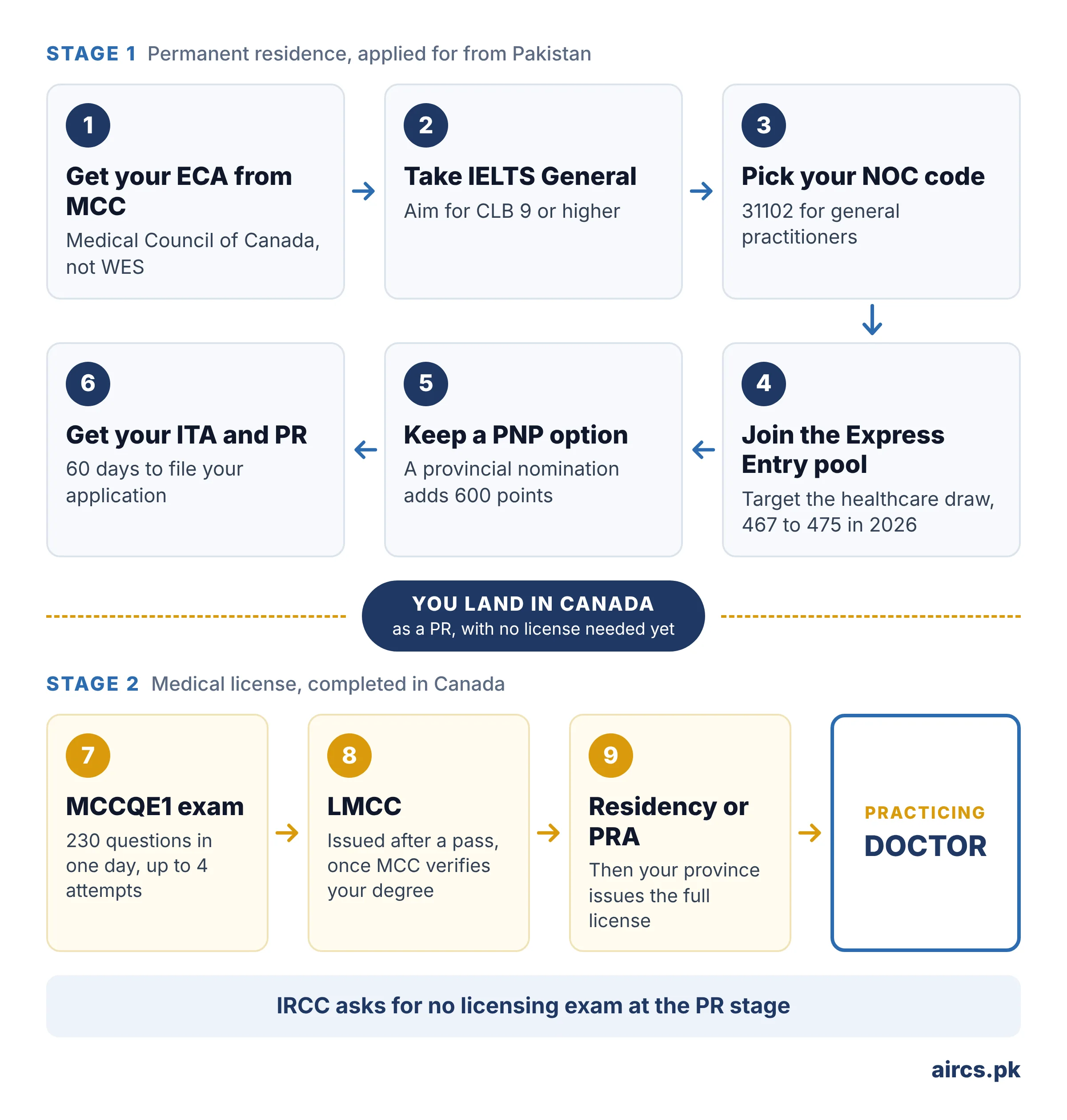
Step 1: Get Your ECA from the Medical Council of Canada
Get your ECA report from the MCC, not from WES. IRCC only accepts an MCC assessment for your medical degree when your job code is NOC 31100, 31101, or 31102. You open an account on physiciansapply, MCC verifies your MBBS directly with your university, and then issues your ECA report.
Step 2: Pass Your IELTS
Next, take the IELTS General Training test. IRCC converts your band scores into CLB levels, and those levels set your language points. Moving from CLB 7 to CLB 9 can add up to 106 CRS points. CLB 9 means 8.0 in Listening and 7.0 in Reading, Writing and Speaking.
Step 3: Pick the Right NOC Code
Family physicians and general practitioners apply under NOC 31102, a TEER 1 occupation. Specialists in surgery use NOC 31101, and specialists in clinical and laboratory medicine use NOC 31100.
Your NOC code is decided from your daily duties, not your job title. IRCC checks this through your reference letters, so each letter must show your working hours and clinical duties such as diagnosis and patient care. You can confirm your code on the official IRCC NOC page.
Step 4: Enter the Pool and Target the Healthcare Draw
Express Entry for doctors in Canada starts with your profile, so create it and join the pool. The healthcare category draw is the realistic route to Canada PR for doctors applying from Pakistan, because foreign medical experience counts here.
On 20 February 2026, this draw invited 4,000 people at CRS 467, and the rounds on 25 June and 4 September 2026 both invited at 475. Canadian Experience Class draws in the same period needed 507 to 523, so doctors enter with a much lower score.
Step 5: Keep a PNP Option
Is your CRS score below the healthcare cutoff? Then go for a provincial nomination, which adds 600 points, more than any 2026 draw has needed.
Some provinces run physician-specific routes. Ontario’s new Workforce Priority stream accepts self-employed physicians without a job offer, though it requires CPSO registration and eligibility to bill OHIP first. Alberta’s AAIP runs a Dedicated Health Care Pathway and nominated 50 practice-ready physicians this year outside its normal quota.
Step 6: Get Your ITA and PR
When your CRS score clears a draw, IRCC sends you an ITA, which is your invitation to apply for PR. You then have 60 days to file your complete application.
After approval, you move to Canada, and your spouse and children come as dependants on the same file. Our Canada PR services cover this stage from ITA to landing.
What Is the Express Entry Physicians Category?
The Express Entry physicians category is a draw for doctors with 12 months of Canadian work experience as a physician.
It ran three times in 2026: 391 doctors at CRS 169 on 19 February, 271 at CRS 223 on 24 June and 229 at CRS 198 on 3 September. These are among the lowest cutoffs ever recorded in Express Entry.
Can you immigrate to Canada as a doctor through this category from Pakistan? No. It needs Canadian clinical experience, so a doctor in Faisalabad or Rawalpindi enters through the healthcare draw first.
The MCCQE1 Exam and Your Medical License
Your medical license in Canada runs through the same account you created for your ECA. The Medical Council of Canada already has your verified MBBS degree, so your next step is the MCCQE1, Canada’s national qualifying exam.
MCCQE1 Exam Format, Fee, and Attempts
Since April 2025, the MCCQE1 is a one-day, computer-based test of 230 multiple-choice questions, offered four times a year. You take it at Prometric centres in over 70 countries, including Pakistan.
The fee is CAD 1,500, and you get a maximum of four attempts.
The old clinical exam was cancelled, so this is the only national exam left. Passing it, with your degree source-verified by MCC, earns you the LMCC. Full details are on the MCC pathways page.
From LMCC to Your Full License
After your LMCC, there are two routes to a full license:
- Residency: Most doctors apply for a residency spot through CaRMS, which also requires the NAC OSCE, a separate clinical exam.
- Practice-Ready Assessment: Experienced family doctors can take this instead, and several provinces offer it.
Once you complete either route, the medical college of your province issues your full license.
Cost of Canada PR for Doctors in 2026
The main government and assessment fees to immigrate to Canada as a doctor from Pakistan come to around CAD 4,060. Of that, CAD 1,675 goes to IRCC for a single applicant, and the rest covers your assessment, language test and first licensing exam.
| Item | Fee (CAD) | Stage |
|---|---|---|
| PR processing fee | 990 | Immigration |
| Right of Permanent Residence Fee | 600 | Immigration |
| Biometrics | 85 | Immigration |
| ECA through MCC (account, verification and report) | 512 | Immigration |
| IELTS test | Around 375 | Immigration |
| MCCQE1 application fee | 1,500 | Licensing |
Sources: IRCC fee list and MCC fees
How Long Does Canada PR for Doctors Take?
Most doctors should plan for about 9 to 12 months from Express Entry profile to final PR, or 12 to 18 months through a provincial nomination.
Start your MCC source verification early, because it alone can take several weeks. MCCQE1 sessions also run only four times a year.
Common Mistakes Doctors Make When Applying
- Waiting for a job offer. Canadian employers rarely hire unlicensed doctors, so the offer you are waiting for will not come easily. The healthcare draw needs no job offer, and your foreign experience counts there.
- Waiting to pass the MCCQE1 before applying. IRCC asks for no licensing exam at the PR stage. A year spent on exam preparation delays your PR, and after age 29 each year also costs about 5 CRS points.
- Sending a WES report instead of MCC. IRCC only accepts a Medical Council of Canada ECA for physician NOC codes. A WES report is not accepted, so it earns no education points and delays the file.
- Reference letters that read administrative. IRCC verifies your NOC code through your job duties. A letter that lists ward management but not diagnosis and patient care will not match NOC 31102.
- Treating an MBBS as enough. Express Entry runs on CRS points, not credentials. A doctor with ten years of experience and CLB 6 English cannot enter the pool, because the Federal Skilled Worker Program requires CLB 7 in all four skills. Moving up to CLB 9 can add up to 106 points.
Canada Immigration for Doctors: FAQs
Do I need to pass the MCCQE1 before moving to Canada?
No. IRCC asks for no licensing exam at the PR stage. You move to Canada first, then pass the MCCQE1 and complete your province’s licensing steps before you start practicing.
What do I need to immigrate to Canada as a doctor from Pakistan?
Canada immigration for doctors needs three things in 2026: an ECA report from the Medical Council of Canada, an IELTS score and 12 months of work as a doctor within the last three years. With these, you enter the Express Entry pool and target a healthcare draw.
Which NOC code do doctors use?
Family physicians and general practitioners use NOC 31102. Specialists in surgery use NOC 31101, and clinical and laboratory specialists use NOC 31100. Your job duties decide your NOC code, not your job title.
Can I qualify for the CRS 169 physicians draw from Pakistan?
No. The Express Entry physicians category requires 12 months of Canadian work experience, so it opens up only after you practice in Canada. From Pakistan, the healthcare draw is your route, and it invited at CRS 467 to 475 in 2026.
Can I work in Canada before passing the MCCQE1?
Yes, but not as a licensed physician. Many doctors work in related health roles while they prepare for the exam, and PR gives you the right to work in any job from the day you land.
Want to Immigrate to Canada as a Doctor?
Recent healthcare draws invited doctors at CRS 467 to 475. AIRCS Group checks your score and prepares your file to IRCC standards, from MCC verification to draw strategy.