
August 22, 2026
Are you a teacher? Do you want to move to Canada? Canada immigration for teachers is easier than you think. Many schools in Canada need good teachers today. This guide explains everything you need. Getting PR is not that hard. You just need the right steps and this guide makes it simple for you.
Table of Contents
ToggleKey Takeaways: Canada Immigration for Teachers
Main benefits: No job offer required for most pathways, dedicated Express Entry draws for teachers, lower CRS cutoffs and multiple provincial options.
Who qualifies: Teachers under NOC 41220, 41221, 42202, 42203 or 43100 with the right education, language score and work experience.
What strengthens your file: A correct NOC code, a valid ECA, strong language scores and a complete document file boost your chances of an ITA.
Priority pathways: Express Entry Education category, Provincial Nominee Programs, Atlantic Immigration Program and Rural Community Immigration Pilot (RCIP).
Processing timing: No single fixed timeline. It depends on your pathway, the CRS cutoff and how complete your application is.
Why Canada Needs Skilled Teachers – Demand Overview
Canada’s school-age population keeps growing. Many provinces are struggling to fill classrooms, especially in rural areas, French immersion programs and subjects like math and science. A lot of current teachers are also retiring, which adds even more pressure on schools trying to hire.
IRCC created a dedicated education category in 2025 and ran two draws under it, inviting teachers at CRS 462 and 479, well below the general draws. No education draw has been held so far in 2026, so provincial nomination is currently the more reliable route for teachers.
Eligibility for PR in Canada as a Teacher
Before you apply, check that your job, education, and experience match what Canada expects from teachers seeking PR. Here’s what matters most.
Teacher NOC codes and TEER levels
Canada sorts every job into a code called the NOC, or National Occupational Classification. Your code decides which immigration programs you can use. The main codes for teachers are:
- 41221 – Elementary and kindergarten teachers (TEER 1)
- 41220 – Secondary school teachers (TEER 1)
- 42202 – Early childhood educators and assistants (TEER 2)
- 42203 – Instructors of persons with disabilities (TEER 2)
- 43100 – Elementary and secondary school teacher assistants (TEER 3)
Educational Credential Assessment (ECA)
If you studied outside Canada, you’ll need an Educational Credential Assessment. This proves your teaching degree or diploma matches Canadian standards. Express Entry requires it and most provincial programs ask for it too. Get this done early through an approved agency, since it can take several weeks. A missing or outdated ECA is one of the most common reasons applications get stuck.
Language requirements (CLB/IELTS scores)
Teaching relies heavily on communication, which is why your language score matters so much. You’ll need results from an approved test like IELTS, CELPIP, or TEF. Aim for a score that shows true fluency not just the bare minimum. Most teaching jobs ask for at least CLB 7. A higher score also lifts your CRS score for teacher applications and opens up more provincial options.
Work experience criteria
You’ll generally need at least one year of full-time paid teaching experience within the last ten years in a role that matches your NOC code. Private school experience still counts toward classroom teaching, even without a provincial teaching license. That said, once you’re teaching in a publicly funded Canadian school, you’ll usually need to get licensed.
What CRS Score Do Teachers Need?
The Comprehensive Ranking System or CRS is the points system Express Entry uses to rank everyone in the pool. Knowing how it works helps you see where you stand.
How CRS points are calculated
Your CRS score comes from four main areas: age, education, language ability and work experience. You can also earn extra points for a job offer, a provincial nomination, French language skills or Canadian education and work history. The highest possible score is 1,200 points but real invitations happen at a much lower cutoff.
Minimum CRS score needed to receive an ITA
There’s no single fixed number here since the cutoff changes with every draw. General Express Entry draws have recently needed scores in the 500s. The newer education-specific draws for teachers have had lower cutoffs often somewhere between 450 and 490. That’s good news since it means you don’t need a top score to get an Invitation to Apply through the education category.
Factors that Boost Your CRS Score
A few things can lift your score fast. A provincial nomination adds 600 points, which almost guarantees an invitation. Strong language scores, especially bilingual skills in English and French, add real points too. Canadian work experience or Canadian education also counts for a lot, so make sure any time you’ve spent teaching or studying in Canada shows up clearly in your profile.
Immigration Pathways for Teachers
Teachers have more than one way into Canada. The best fit for you depends on your NOC code, your experience, and whether you already have a job offer.
Express Entry – Federal Skilled Worker Program (FSWP)
Most classroom teachers apply through the Federal Skilled Worker Program, one of three programs under Express Entry. Since 2025, IRCC has also run category-based draws just for education occupations, which gives teachers a real edge over the general pool. TEER 1 roles like 41220 and 41221 fit naturally here.
Provincial Nominee Program (PNP) for teachers
Several provinces list teaching roles on their in-demand occupation streams, since school boards across the country are short-staffed. British Columbia, for example, has run targeted draws for French-speaking secondary teachers and elementary teachers. If your Comprehensive Ranking System score is not high enough for a federal Express Entry draw, the Provincial Nominee Program is often the fastest way for a teacher to boost their score enough to guarantee an ITA.
Atlantic Immigration Program (AIP) route
The four Atlantic provinces, Nova Scotia, New Brunswick, Prince Edward Island, and Newfoundland and Labrador, use the AIP to help local employers, including schools, hire from outside Canada. If you already have a job offer from a designated employer there, this route can move faster than the general Express Entry pool, since it doesn’t rely on a competitive points draw.
Best Province for Teachers in Canada
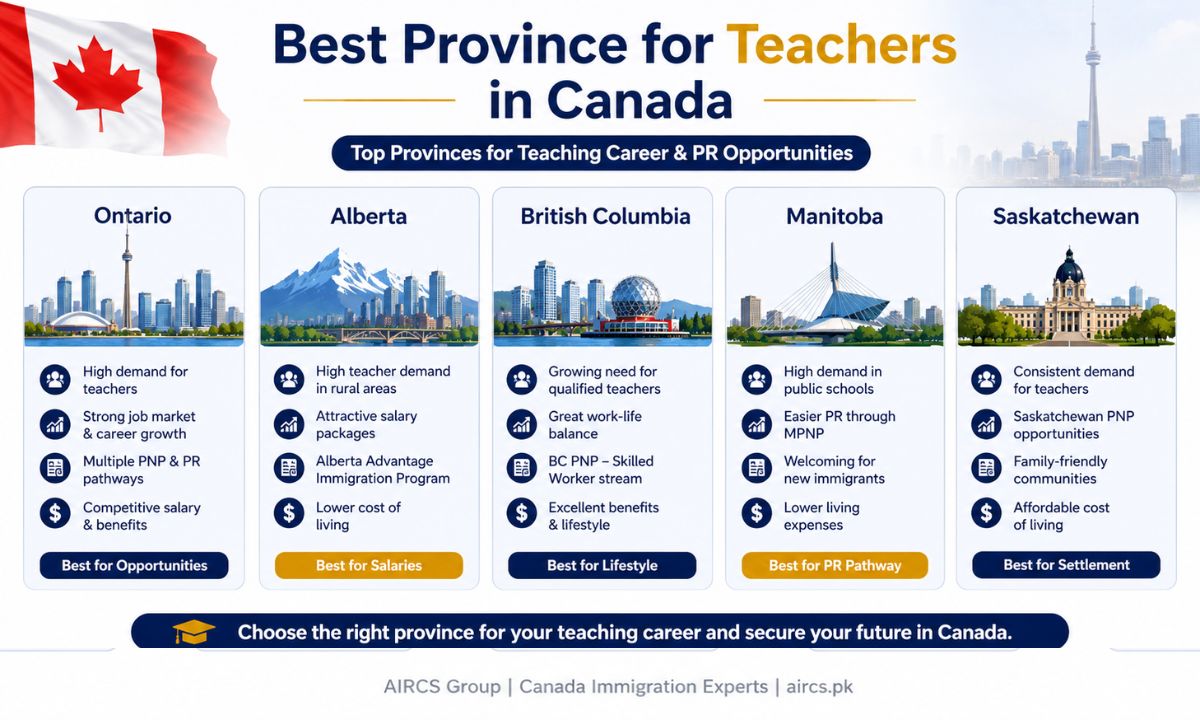
No single province is the “best” for every teacher. It depends on your subject, your language skills and whether you’d rather live in a city or a smaller town. Still, a few patterns stand out.
British Columbia has actively targeted French-speaking and English-speaking K-12 teachers through its provincial program. Ontario, home to the largest school system in the country, has steady demand for teacher assistants and specialized instructors.
Saskatchewan and Manitoba often have shorter processing times and less competition, simply because fewer applicants target them. Atlantic provinces offer a more direct, employer-driven route through AIP, which suits teachers who already have a job lined up. Rural communities under RCIP are also worth a look if you’re open to a smaller town, since these routes usually face less competition than big-city PNP streams.
Step-by-Step Process to Apply for Canada PR as a Teacher
Canada immigration for teachers usually follows four main stages. Skipping a step, or rushing through your paperwork, is one of the easiest ways to lose time or face a refusal.
Get your NOC code and Educational Credential Assessment (ECA)
Start by matching your actual job duties to the right NOC code, then get your ECA done through an approved agency. These two pieces form the base of your whole application, so get them right first.
Create an Express Entry profile
Once your ECA and language results are ready, create your profile in the Express Entry system. You’ll enter your education, work history, language scores, and any provincial or family ties. The system then works out your CRS score for you.
Apply for Provincial Nomination (if applicable)
If a province has a stream that fits your job, apply for a provincial nomination alongside or after your Express Entry profile. A nomination adds 600 points to your CRS score, which is usually enough to guarantee your next invitation.
Receive ITA and Submit PR Application
Once you get an ITA, you have 60 days to submit your full PR application with all supporting documents. From there, processing usually takes around six months, though this can shift depending on how complete your file is.
Documents You Need for Your PR Application
Most Canada immigration for teachers applications ask for a similar set of core documents:
Document | Purpose |
Valid passport and ID documents | Confirms your identity |
Educational Credential Assessment (ECA) | Proves your teaching degree matches Canadian standards |
Language test results (IELTS/CELPIP/TEF) | Must match the scores in your Express Entry profile |
Work experience reference letters | Should clearly state your job duties, hours, and dates |
Teaching license or certification (if applicable) | Needed if your role requires provincial licensing |
Police clearance certificates | Required for background checks |
Proof of funds | Shows you can support yourself and your family after arrival |
Resume/CV | Should match your stated work history exactly |
Check every document against your profile before you submit. Even a small mismatch, like a slightly different job title, can hold up your application.
Processing Time and Fees for PR Visa
There’s no single fixed timeline for Canada immigration for teachers. It depends on the pathway you use, how many applications IRCC is handling, and how complete your documents are. Express Entry applications generally take around six months after you submit your PR application, though education category draws have sometimes moved faster.
PNP applications add extra time for the nomination stage itself, which can run a few weeks to a few months depending on the province.Application fees cover the processing fee, the right of permanent residence fee and biometrics. IRCC sets and updates these fees regularly, so check the current fee schedule on the official IRCC website before you apply.
How to Get a Teaching Job in Canada as a Newcomer
Landing a teaching job in Canada usually starts with provincial certification, since each province has its own teacher regulatory body, like the Ontario College of Teachers. You’ll typically need your ECA, reference letters, and sometimes extra coursework or exams to meet local certification rules.
Private schools, language academies, and after-school programs are often more flexible, since they don’t always ask for provincial certification. That makes them a useful way in while you work on getting licensed for the public system. Job boards run by individual school boards, along with Canada’s Job Bank, are good places to start once you’re eligible to work.
Common Mistakes Teachers Make in Their Application
A few avoidable mistakes show up again and again:
- Using the wrong NOC code. Matching your job title instead of your actual duties can lead to the wrong classification.
- Submitting an outdated or missing ECA. This is one of the most common causes of delay.
- Language score mismatches. If your test results don’t match what’s in your Express Entry profile, that’s an instant red flag.
- Weak reference letters. Letters that don’t clearly cover your duties, hours, and dates often get rejected.
- Missing the 60-day deadline. Once you get your ITA, waiting too long to submit your full application can get you disqualified.
- Ignoring provincial licensing rules. Being eligible for PR doesn’t automatically mean you’re licensed to teach once you arrive.
Tips to Improve Your CRS Score and PR Chances
If your CRS score isn’t quite where it needs to be, a few things can help:
- Retake your language test. Even a small jump in your CLB band can add real points, especially if you’re close to a cutoff.
- Aim for a provincial nomination. The extra 600 points from a PNP nomination is the biggest boost you can get.
- Build Canadian experience if you can. Time spent teaching or studying in Canada adds real weight to your profile.
- Learn French. Bilingual teachers, especially French-speaking secondary teachers, are in high demand across several provinces.
- Keep your documents accurate and consistent. A clean application means fewer delays and a lower risk of refusal.
- Watch for education category draws. These often have lower CRS cutoffs than general draws, so timing your profile around them can help your odds.
Canada immigration for teachers has become more accessible in recent years thanks to dedicated Express Entry draws and provincial programs built for educators. Get your NOC code right, keep your documents in order and work on boosting your CRS score through language skills or a provincial nomination. Do that and you’ll be in a strong position to make the move.
Frequently Asked Questions
Do I need a job offer to immigrate as a teacher?
No. Express Entry and most PNP streams don’t require one. Note that a job offer no longer adds CRS points, though it can help you qualify for some provincial streams.
What is the correct NOC code for a teacher?
It depends on your role. Use 41220 for secondary teachers, 41221 for elementary teachers, and 43100 for teacher assistants.
What CRS score do I need as a teacher?
The two education draws held so far were invited at CRS 479 and 462. None have run in 2026, so most teachers now target a provincial nomination, which adds 600 points.
Can teacher assistants apply for PR in Canada?
Yes. NOC 43100 qualifies for FSWP since it accepts TEER 0 to 3, but scoring competitively is harder, so a PNP or RCIP route is usually stronger.
Do I need a Canadian teaching license to get PR?
No, not for PR itself. You’ll need a provincial license later, once you’re actually teaching in a public school.
How long does the whole process take?
It varies by pathway. After your ITA, PR processing usually takes about six months.
Is French helpful for teacher immigration?
Yes, significantly. French-language Express Entry draws in 2026 have invited candidates at CRS scores between 382 and 420. These draws run nearly every month, which makes French the strongest single advantage a teacher can build.
Conclusion
Canada immigration for teachers has become more accessible than ever before. A job offer is not a requirement to begin. You simply need the correct NOC code, a strong CRS score and complete documentation.
Choose the pathway that best suits your profile whether that’s Express Entry, a PNP or a rural program. Keep your documents accurate and well-organized. Do that and your move to Canada becomes far more achievable.
Book Your Free Immigration Consultation Today!
Want to build a better future for your family in Canada?
Get expert immigration guidance and tailored solutions specifically for Pakistani families.
WhatsApp: +92 311 4464274
Website: https://aircs.pk/
Offices: Rawalpindi & Faisalabad