

August 20, 2026
Are you considering applying to Canada PR but still lack a job offer? The SINP Occupation In-Demand stream might be your answer. It’s built for skilled workers who want a path at Saskatchewan without employer sponsorship.This guide covers everything you need to know. Let’s go through eligibility, points grid, required documents, and the complete application process.
Table of Contents
ToggleKey Takeaways: SINP Occupation In-Demand Stream
Main benefits: No Express Entry profile required, no job offer required, broader range of occupations and direct path to provincial nomination.
Who qualifies: Your occupation must be in TEER 0, 1, 2 or 3 and must not appear on Saskatchewan’s Excluded Occupation List.
Best solutions: A good EOI profile, proper NOC verification and complete documents enhance your chances to get an invitation.
Priority sectors: Healthcare, agriculture, skilled trades, mining, manufacturing, energy and technology. At least half of all nominations are reserved for these fields.
Processing timing: There’s no single fixed timeline. Processing time depends on your pathway, application volume, and how complete your documents are.
What Is the SINP Occupation In-Demand Stream?
The SINP Occupation In-Demand stream is part of Saskatchewan’s International Skilled Worker category. It’s built for people who don’t have a job offer from a Saskatchewan employer but still have the skills, education, and work experience the province needs.
It’s one of the few provincial routes in Canada that doesn’t require employer sponsorship. You apply on your own, without an employer, and you are assessed on the SINP Point Assessment Grid, where you need at least 60 points out of 110 to be considered. That is why the stream is popular with skilled workers applying from Pakistan and other countries overseas.
Eligibility & Requirements for SINP Occupation In-Demand
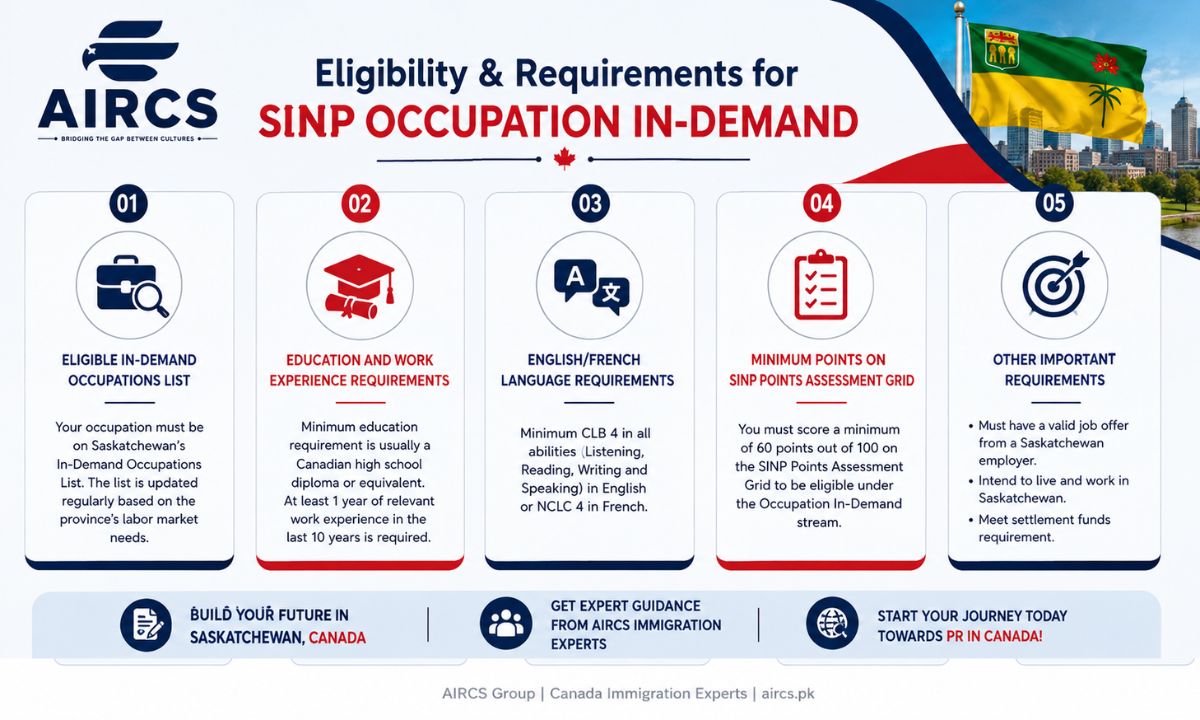
There are a few key requirements you must meet to be eligible for the SINP Occupation In-Demand stream. Your occupation must be eligible and you need the right education, work experience, language scores and points grid total. Let’s unpack each one.
Eligible In-Demand Occupations List
Your job must be on the Saskatchewan approved NOC (National Occupational Classification) list. This program is for high-skilled occupations only (TEER 0, 1, 2 or 3). TEER 4 and 5 jobs, which typically require only a high school education or on-the-job training, do not qualify.
Saskatchewan does not publish an approved list. Instead it publishes an Excluded Occupation List, and your occupation qualifies as long as it is not on that list and is considered in-demand in Saskatchewan at the time you apply. So before you proceed too far into planning, double-check your occupation against the official list.
Education and Work Experience Requirements
On the education side, you’ll need at least a post-secondary diploma, certificate, or degree that’s comparable to what’s offered in Canada. If your degree is from outside Canada, you’ll need an Educational Credential Assessment (ECA) to prove it lines up with Canadian standards.
For work experience, you need at least one year of full-time paid work, meaning a minimum of 30 hours per week, gained within the past 10 years and related to your field of education. That experience must be in a TEER 0, 1, 2 or 3 occupation.
English/French Language Requirements
All SINP streams require proof of language ability and so does this one. You’ll need to provide a valid language test score from a designated testing agency and it must be consistent with what you entered in your Express Entry profile . Your results cannot be more than two years old at the time of application. Most applicants need at least CLB 4 but some occupations require a higher score. So it’s worth checking the requirements for your job before you apply.
Minimum Points on SINP Points Assessment Grid
Getting your occupation approved is only half the battle. You also need to score well on the points grid. The grid is split into two sections: Human Capital factors (education, language, work experience and age), worth up to 55 points and Saskatchewan Connections factors (things like a job offer, relatives in the province, or prior study/work there) worth up to 40 points. That adds up to 110 points total.
To even be considered, you need a minimum score of 60 out of 110. Since Occupation In-Demand doesn’t require a job offer, most of your points will need to come from education, work experience, language and age.
Updated List of Saskatchewan In-Demand Occupations
Saskatchewan’s in-demand occupations are very dynamic, as they are closely aligned with the needs of the province’s labor market at any given time. The list covers a wide range of sectors healthcare, engineering, IT, finance and more. These updates are not random. They’re based on the province’s economic needs, current labor shortages and feedback from employers so the list stays focused on the jobs Saskatchewan really needs filled.
For 2026 seven sectors have been named priority sectors Healthcare, Agriculture, Skilled Trades, Mining, Manufacturing, Energy and Technology and at least half of all nominations are reserved for people working in these fields. If your job falls into one of these categories your odds of getting selected go up noticeably.
How to Check If Your Occupation Qualifies for SINP
SINP assesses the duties in your NOC code, not the title on your contract. Confirm the correct code first, then check it against the Excluded Occupation List.
If your job is regulated in Saskatchewan, such as nurses, engineers, electricians and plumbers, it’s a little more complicated. You must have a letter from the relevant Saskatchewan regulatory body confirming that you are eligible for licensure before you submit your application. Remember, being eligible does not mean you’re licensed yet. That just means you have the education and credentials you need to get licensed when you get there.
Step-by-Step Process to Apply for SINP Occupation In-Demand
Applying for SINP Occupation In-Demand involves main stages. Skipping steps or rushing through documentation is one of the easiest ways to get your application rejected, so it helps to know exactly what’s coming.
Create an Expression of Interest (EOI) Profile
To begin, you will need to create an Expression of Interest profile in SINP’s OASIS online portal. You will need to give information on your education, work experience, language test scores, age and any links to Saskatchewan. From this, the system will then automatically calculate your points grid score.
Check Occupation Eligibility Against NOC List
Check your occupation against the NOC list before you submit. make sure it is not on the excluded list and is in an eligible TEER category (0, 1, 2 or 3). If you work in a regulated profession, now is also the time to start the process of obtaining your eligibility letter from the regulator.
Receive Invitation to Apply (ITA)
If your EOI profile scores above 60 points and is one of the highest ranking profiles in the candidate pool, SINP will issue you an Invitation to Apply. Once you get that ITA you have exactly 60 days to submit your complete application and pay the non-refundable application fee.
Submit SINP Application with Documents
This is the final stage: uploading all your required documents (listed below) and paying the application fee. Your application needs to be complete and accurate. Applications submitted with missing or untranslated documents are closed or returned, and the fee is not refunded. Check every document before you submit.
Required Documents for SINP Occupation In-Demand Application
SINP Occupation In-Demand applications generally require the following core documents:
Document | Purpose / Notes |
Valid passport and identity documents | Basic requirement for identity verification |
Educational Credential Assessment (ECA) report | Required for foreign degrees, proves equivalence to Canadian education |
Language test results (IELTS / CELPIP / TEF) | Must match the scores listed in your EOI profile |
Work experience reference letters | Should clearly state job duties, hours, and duration |
Regulatory body eligibility/licensure letter | Only needed for regulated occupations (nurses, engineers, electricians, etc.) |
Police clearance certificates | Required for criminal background checks |
Proof of funds | Shows you have enough money to settle |
Resume/CV | Should be consistent with your stated work history |
When you scan and upload your documents, make sure everything is clear, legible, and matches what you entered in your EOI profile. Even a small mismatch can delay your application — or get it refused.
Saskatchewan Immigration Timeline and Processing Time
A Saskatchewan immigration timeline will help you plan. Overall, there are a few different steps in the process: Submitting your EOI, waiting for an ITA, having your application processed, then going through federal PR processing after that.
Processing times will depend on the pathway. Agriculture & Employment Offer Talent pathways generally take about 3 weeks to complete. Tech Talent and Health Talent pathways are faster, usually about 2 weeks. That same range is usually where the Occupation In-Demand stream falls, though the actual time might depend on how many applications the SINP is processing and how complete your documentation is.
Another thing about the Saskatchewan immigration timeline: a provincial nomination is not the final step.Every applicant still has to apply for permanent residency through IRCC (Immigration, Refugees and Citizenship Canada).
Common Mistakes That Lower Your Chances of SINP Selection
Many applicants make small, avoidable mistakes that hurt their chances with SINP Occupation In-Demand. Here are the ones we see most often:
- Applying with an excluded occupation. Not checking your NOC against the excluded list before applying is probably the most common mistake of all.
- Skipping or messing up your ECA. Not getting your foreign degree assessed, or submitting an expired ECA, weakens your application right out of the gate.
- Language score mismatches. If the scores in your EOI profile don’t match your actual test results, that’s an instant red flag.
- Weak work experience letters. Reference letters that don’t clearly spell out job duties, hours, and salary often are rejected.
- Forgetting the regulatory letter. If your occupation is regulated and you don’t include the eligibility letter, your application will be treated as incomplete.
- Missing the 60-day deadline. Once you receive your ITA, waiting too long to submit can get you disqualified automatically.
- Relying on outdated occupation lists. Since the list changes often, applying based on old information can cost you.
Tips to Improve Your SINP Occupation In-Demand Points
Want to boost your SINP Occupation In-Demand points grid score? Here are some practical ways to do it:
- Go for a higher education credential. You get more points for a Master’s or PhD than you do for a Bachelor’s degree so upgrading your qualification can boost your score significantly.
- Push your language score higher. Retaking IELTS or CELPIP to hit a higher CLB band is often worth the effort since language points make up a big chunk of the grid.
- Build solid, well-documented work experience. Experience in your target occupation, well documented, is a big plus for your score.
- Focus on priority sector jobs. Experience in health care agriculture, skilled trades, mining, manufacturing, energy or technology will give you a better chance of being selected.
- Look for Saskatchewan links. If you have relatives in the province or any previous study or work experience in the province this can contribute to your points on the grid.
- Get an offer. Work on it. Not that you have to but it can give your score a big lift.
- Make sure that your documentation is correct. A complete and error-free document saves you delays and minimizes the risk of refusal.
The SINP Occupation In-Demand stream is a great option for skilled professionals who want to settle in Saskatchewan without the need for an employer to sponsor them. Once you understand the eligibility rules max out your points grid score and get your documentation in order you’ll be in a much better position to land your provincial nomination and eventually your Canadian PR.
Frequently Asked Questions
Do I need a job offer for SINP Occupation In-Demand?
No, you don’t. This stream is built for skilled workers who don’t have a Saskatchewan employer lined up yet.
What is the minimum points score I need?
You need at least 60 out of 110 points on the SINP points assessment grid. Anything below that won’t qualify.
Can I apply without an Express Entry profile?
Yes, you can, the program works independently and doesn’t require an active Express Entry profile.
How long does the SINP Occupation In-Demand process take?
It usually takes a few weeks to a few months from the EOI to the ITA. Thereafter, you get a 60-day window to submit your full application.
What happens if my occupation is on the excluded list?
Your application won’t be accepted. Always check your NOC code against the excluded occupations list before applying.
Do regulated occupations need extra documents?
Yes, they do. You’ll need an eligibility letter from the relevant Saskatchewan regulatory body before submitting your application.
Does a provincial nomination guarantee Canadian PR?
Not automatically. You still need to apply for PR through IRCC, though a nomination adds 600 points to your CRS score if you use Express Entry.
Conclusion
The SINP Occupation In-Demand stream gives skilled workers a real shot at Canadian PR. You don’t need a job offer to apply. You just need the right occupation, education and points score. It’s one of the simplest routes into Saskatchewan for people building a career from scratch.
Getting there takes some planning, though. Check your occupation against the excluded list first. Keep your documents accurate and complete. Do that and your chances of a smooth nomination go up a lot.
Book Your Free Immigration Consultation Today!
Want to build a better future for your family in Canada?
Get expert immigration guidance and tailored solutions specifically for Pakistani families.
WhatsApp: +92 311 4464274
Website: https://aircs.pk/
Offices: Rawalpindi & Faisalabad