
October 24, 2026
- by abdulrehmanaircs@gmail.com
- Leave a Comment on Canada Study Visa from Pakistan: Requirements and Cost
Planning to study at a university in Toronto or a college in Vancouver? As a Pakistani student, you need a Canadian study permit, and approval depends on your letter of acceptance, proof of funds and ties to Pakistan.
This guide explains how to get a Canada study visa from Pakistan in 2026, including the requirements, documents checklist, bank balance, fees, processing time and application steps.
Table of Contents
ToggleKey Facts: Canada Study Visa from Pakistan 2026
- Permit: a study permit is required, and the visitor visa is issued with it at no extra cost.
- Fees: CAD 235 in total (CAD 150 permit and CAD 85 biometrics).
- Proof of funds: CAD 23,448 for one year of living costs, plus first-year tuition and return travel.
- PAL: required for most students, except master’s and PhD students at public institutions.
- Work rights: up to 24 hours a week off campus during term, and full time during breaks.
- Processing time: about 7 weeks from Pakistan, counted from the biometrics.
What Is a Canada Study Visa?
A Canada study visa is the study permit that allows you to study at a designated learning institution (DLI) for any program longer than 6 months. You apply only for the permit, and IRCC issues your visitor visa automatically when it is approved.
In 2026, IRCC plans to issue up to 408,000 study permits: 155,000 to new students and 253,000 as extensions for students already in Canada. The total is 7% below the 2025 target of 437,000.
Canada Study Visa Requirements for Pakistani Students
To qualify for a study permit, you must show IRCC that you:
- Have a letter of acceptance from a designated learning institution
- Hold a provincial or territorial attestation letter, unless you are exempt
- Can pay for tuition, living costs and return travel
- Will leave Canada when your permit ends, unless you switch to a Post-Graduation Work Permit or another status
- Meet the health and character requirements, including a medical exam or police certificate if requested
IRCC checks every letter of acceptance directly with your institution. A fake or unverified letter leads to refusal, and a fraudulent one can result in a five-year ban.
Who Needs a Provincial Attestation Letter?
A provincial attestation letter (PAL) is a letter from the province that confirms your study place is approved under Canada’s student cap. Your institution requests it for you after you accept your offer.
- You need a PAL if you are going to a college, a bachelor’s program or a private institution.
- You do not need a PAL if you are a master’s or PhD student at a public institution (since 1 January 2026) or a school-age student.
A PAL issued in 2026 is valid until 31 December 2026. Students going to Canada’s territories receive a territorial attestation letter (TAL), and those going to Quebec need a Quebec Acceptance Certificate (CAQ) instead.
Not sure if you meet the requirements? AIRCS Group checks your eligibility, PAL status and documents before you apply. Get a free eligibility check on WhatsApp or book a consultation.
Canada Study Visa Documents Checklist
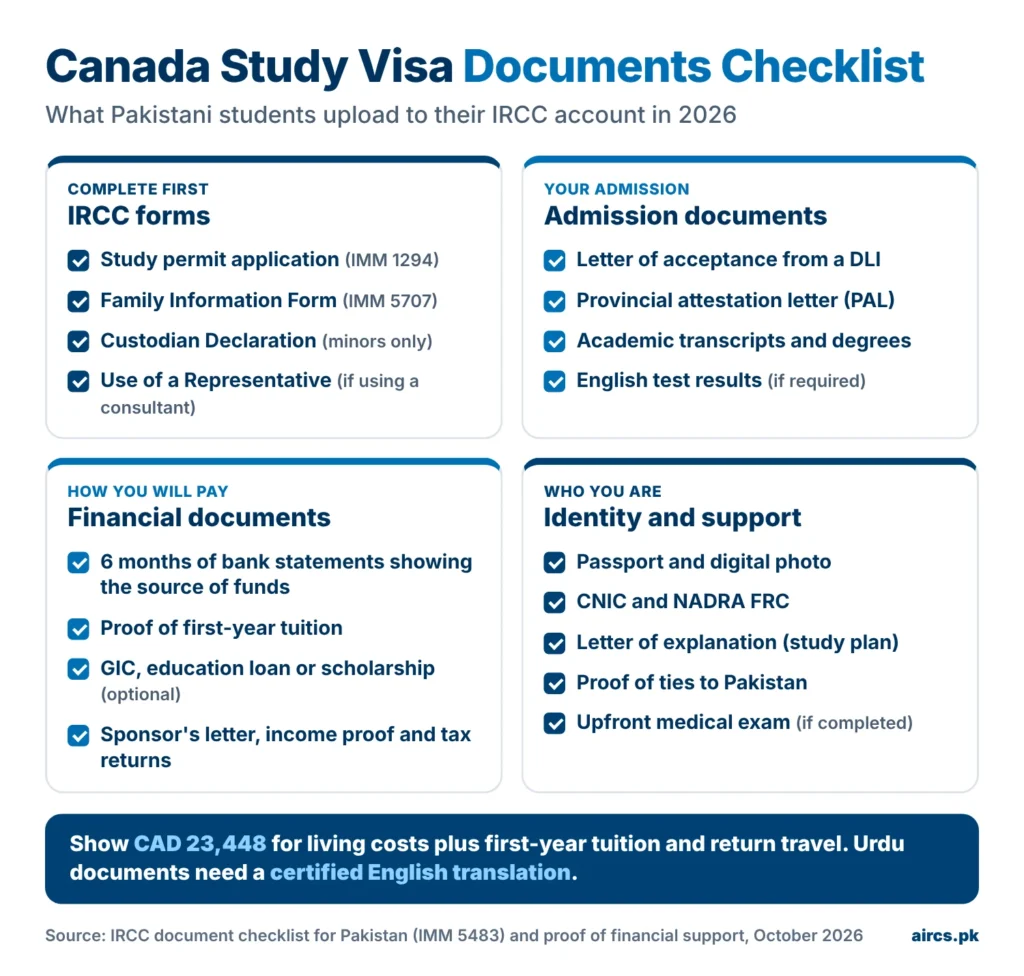
Your documents must prove your admission, your funds and your reasons to return to Pakistan. IRCC’s checklist for applicants in Pakistan (IMM 5483) gives the full list.
IRCC Forms
- Application for a Study Permit Made Outside of Canada (IMM 1294)
- Family Information Form (IMM 5707)
- Custodian Declaration (IMM 5646), if you are a minor
- Use of a Representative (IMM 5476), if a consultant applies for you
Admission Documents
- Letter of acceptance from a designated learning institution
- Provincial or territorial attestation letter or proof of exemption
- Academic transcripts and degree certificates
- English test results, if your institution requires them
Financial Documents
- Bank statements for the past 6 months, showing where the funds came from
- Proof of tuition paid, or the first-year tuition on your offer letter
- GIC, education loan or scholarship letter, if you have one
- Sponsor’s support letter, income proof and tax returns, if a parent is paying
Identity and Supporting Documents
- Valid passport and a digital photo meeting IRCC specifications
- CNIC and FRC, to prove your relationship with a sponsoring parent
- Letter of explanation (study plan) linking your education, program and career plans
- Proof of ties to Pakistan, such as family property or a family business
- Medical exam confirmation, if you complete an upfront medical exam
Documents not in English or French, such as Urdu property papers, need a certified translation.
How Much Bank Balance Is Needed for a Canada Study Visa?
As proof of funds, a single student must show CAD 23,448 for one year of living costs, plus first-year tuition and return travel. This applies to applications from 1 September 2026 for every province except Quebec.
Number of people | Living costs per year (outside Quebec) |
1 | CAD 23,448 |
2 | CAD 29,192 |
3 | CAD 35,888 |
4 | CAD 43,572 |
Source: IRCC proof of financial support. Quebec requires CAD 24,617 for a single student.
IRCC also checks:
- Source of funds: your bank statements for the past 6 months should show where large deposits came from, such as salary, business income or a property sale.
- Longer programs: if your program lasts more than one year, explain how you will pay for the remaining years, such as through a scholarship or a parent’s income.
- No work income: your funds must cover your stay without relying on a job in Canada.
A GIC is optional, but it remains a clear way to show living funds.
Canada Study Intakes
Canadian institutions admit students in three main intakes:
Intake | Classes start | Key features |
Fall | September | The widest choice of programs and scholarships |
Winter | January | Fewer programs, but often less competition |
Summer | May | Limited programs, mostly at colleges |
Start preparing 6 to 8 months before your intake, because you need your offer letter before your PAL, and your PAL before you can apply for a study permit. VFS Global biometrics appointments in Islamabad and Lahore are hardest to book from May to August, so apply as soon as you receive your PAL.
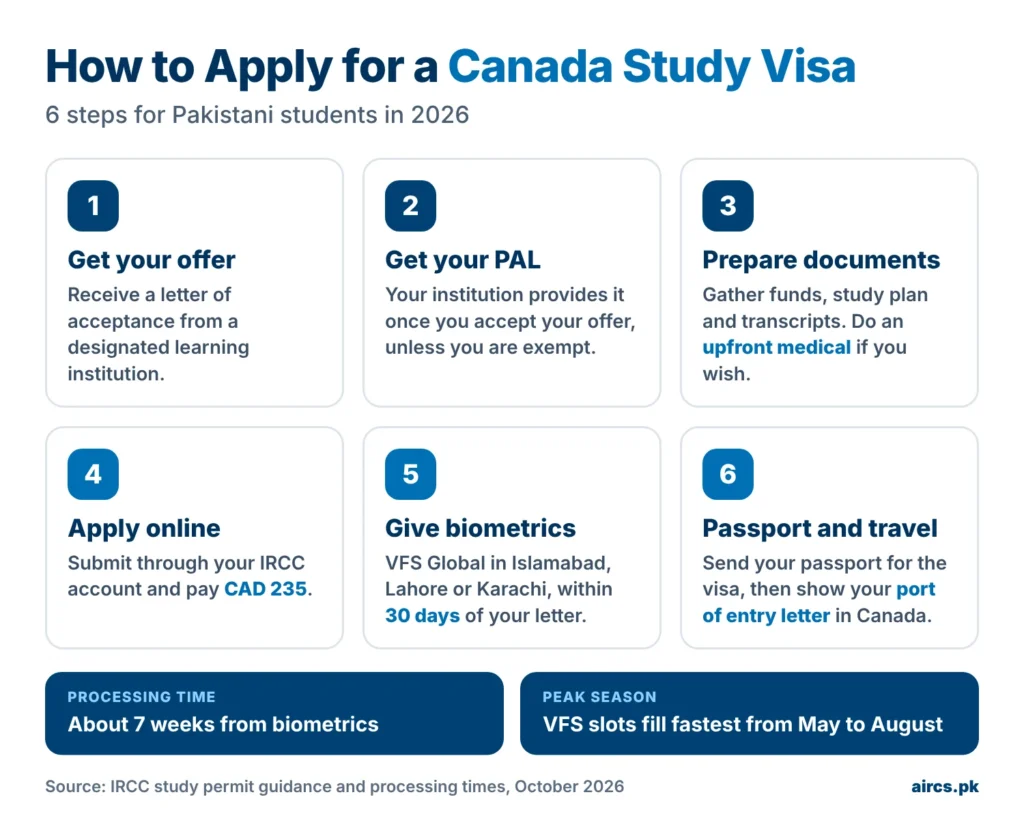
How to Apply for a Canada Study Visa from Pakistan in 6 Steps
You apply online through your IRCC account, then give your biometrics at a VFS Global centre in Pakistan.
- Get your offer: apply to a designated learning institution and receive your letter of acceptance.
- Get your PAL: once you accept your offer, your institution provides the provincial attestation letter, unless you are exempt.
- Prepare your documents: gather your financial evidence, letter of explanation, transcripts and supporting documents. You can also complete an upfront medical exam with an IRCC panel physician.
- Apply online: submit your application through your IRCC account and pay CAD 235 for the permit and biometrics.
- Give your biometrics: book a VFS Global appointment in Islamabad, Lahore or Karachi within 30 days of receiving your biometric instruction letter. Slots fill fastest from May to August.
- Submit your passport: if approved, send your passport to VFS Global within the time given in your passport request letter, usually 30 days, for the visitor visa.
At the Canadian border, show your port of entry letter of introduction and carry your letter of acceptance and proof of funds. A Canada Border Services Agency officer makes the final decision and, if satisfied, issues your study permit
Canada Study Visa Fee and Processing Time
The total government fee is CAD 235: CAD 150 for the study permit and CAD 85 for biometrics.
IRCC’s processing time for study permits from Pakistan stood at 7 weeks in October 2026, measured from the date your biometrics are received.
Cost item | Amount |
Study permit fee | CAD 150 |
Biometrics fee | CAD 85 (CAD 170 maximum for a family) |
Medical exam | Varies, paid directly to the panel physician |
Living costs to show (single student) | CAD 23,448 |
Tuition and travel | Varies by institution and course |
Can You Work While Studying in Canada?
Yes. You can work up to 24 hours a week off campus during academic terms and full-time during scheduled breaks. You must be a full-time student at a post-secondary designated learning institution in a program of at least 6 months that leads to a degree, diploma or certificate.
You can start working only once your program begins. Since 1 April 2026, you no longer need a separate work permit for co-op placements or internships that are part of your program.
Post-Graduation Work Permit and Spouse Work Permits
After graduation, you can apply for a Post-Graduation Work Permit (PGWP) of up to 3 years if you meet these rules:
- English level: CLB 7 for university graduates and CLB 5 for most college graduates, or the same NCLC level in French
- Field of study: degree graduates are exempt, but college diploma and certificate programs must be in an eligible field
- Program type: public-private college partnership programs do not qualify
Your spouse can get an open work permit only if you are in a master’s program of 16 months or longer, a doctoral program or an eligible professional program such as medicine, law or engineering. Canadian work experience gained on a PGWP can lead to permanent residency, as explained in our guide to Canada PR pathways.
Why Are Canada Study Visas Refused for Pakistani Students?
Most refusals happen because the officer is not satisfied that you will leave Canada after your studies. According to ApplyBoard’s analysis of IRCC data, only 41% of study permit applications worldwide were approved in 2025, rising to 44% from January to April 2026. The most common reasons include:
- Limited travel history, cited in about 80% of refusals
- Assets and finances that do not support your study plan, cited in at least half of refusals
- Insufficient funds for tuition or living costs, a reason that rose sharply in 2025
- A study plan that does not link your past education, chosen program and career goals, including unexplained study gaps
If your application is refused, you can reapply with stronger evidence that addresses each reason in the refusal letter.
Since the Student Direct Stream closed on 8 November 2024, all Pakistani students apply
FAQs
What is the Canada study visa fee in Pakistan in 2026?
The study permit costs CAD 150 and biometrics cost CAD 85, a total of CAD 235. IRCC issues the visitor visa with an approved permit at no extra cost.
How much bank balance is required for a Canada study visa from Pakistan?
A single student must show CAD 23,448 for living costs outside Quebec, plus first-year tuition and return travel. IRCC checks where the money came from, not just the closing balance.
Is IELTS required for a Canada study visa?
IRCC sets no minimum, but most institutions require IELTS, PTE or TOEFL, typically IELTS 6.5 overall for universities and 6.0 for colleges. For a PGWP later, you need a general test such as IELTS General Training, CELPIP-General or PTE Core. IELTS Academic does not qualify.
Can I study in Canada without IELTS?
Yes, at some institutions. Many accept the Duolingo English Test or TOEFL instead, and some waive the requirement if your previous degree was taught in English.
Do master’s students need a PAL in 2026?
No. Since 1 January 2026, master’s and doctoral students at public institutions are exempt. College, bachelor’s and private-institution graduate students still need one.