


July 15, 2026
You can immigrate to Canada as a doctor from Pakistan without a job offer and without a Canadian license. Your permanent residence file depends on your MBBS degree, your IELTS score, and 12 months of medical practice. The license is a separate step that starts after your PR, because IRCC treats immigration and licensing as two different processes. You secure PR first on your foreign credentials alone, then complete the MCCQE1 and provincial registration as a permanent resident. This guide covers your NOC code, the physicians category draw, the PNP routes for doctors, and the licensing steps that follow.
Table of Contents
ToggleKey takeaways: Immigrate to Canada as a Doctor from Pakistan
- PR without a license or a job offer. The Express Entry healthcare category accepts foreign medical experience, and its 2026 draws invited at CRS 467 in February and 475 in June, well below the 507 plus in general rounds.
- You need 12 months of medical practice in the last three years. The months can add up across more than one job.
- Your ECA comes from the Medical Council of Canada, not WES. MCC is the designated body for medical degrees, and an ECA is not a licensing exam.
- Most PNP routes need a license or a job offer first. Ontario’s physician stream requires CPSO registration and Alberta’s health pathway requires an Alberta job offer, so Express Entry is the realistic starting option from Pakistan.
- PR first, MCCQE1 after. Once you practice in Canada, a dedicated physicians draw exists for doctors with Canadian experience. It invited at just CRS 169 in February 2026, one of the lowest cutoffs ever recorded.
Canada PR for Doctors: What Changed in 2026
Canada PR for doctors is more accessible in 2026 than it has been in years. Canada’s population is aging, many physicians are close to retirement, and the healthcare system already depends on foreign-trained doctors. In 2024, 31 percent of family physicians in Canada were internationally trained, so a Pakistani medical degree is already a familiar credential in Canadian hospitals.
IRCC introduced three new measures for doctors on its official physicians page. There is now a dedicated Express Entry category for physicians, 5,000 reserved PNP spaces for doctors with a job offer or a letter of support, and a 14-day work permit for doctors nominated by a province. The PNP measures require a provincial connection, so doctors applying from Pakistan can use these two options.
PR First, License After: How the Two Stages Work
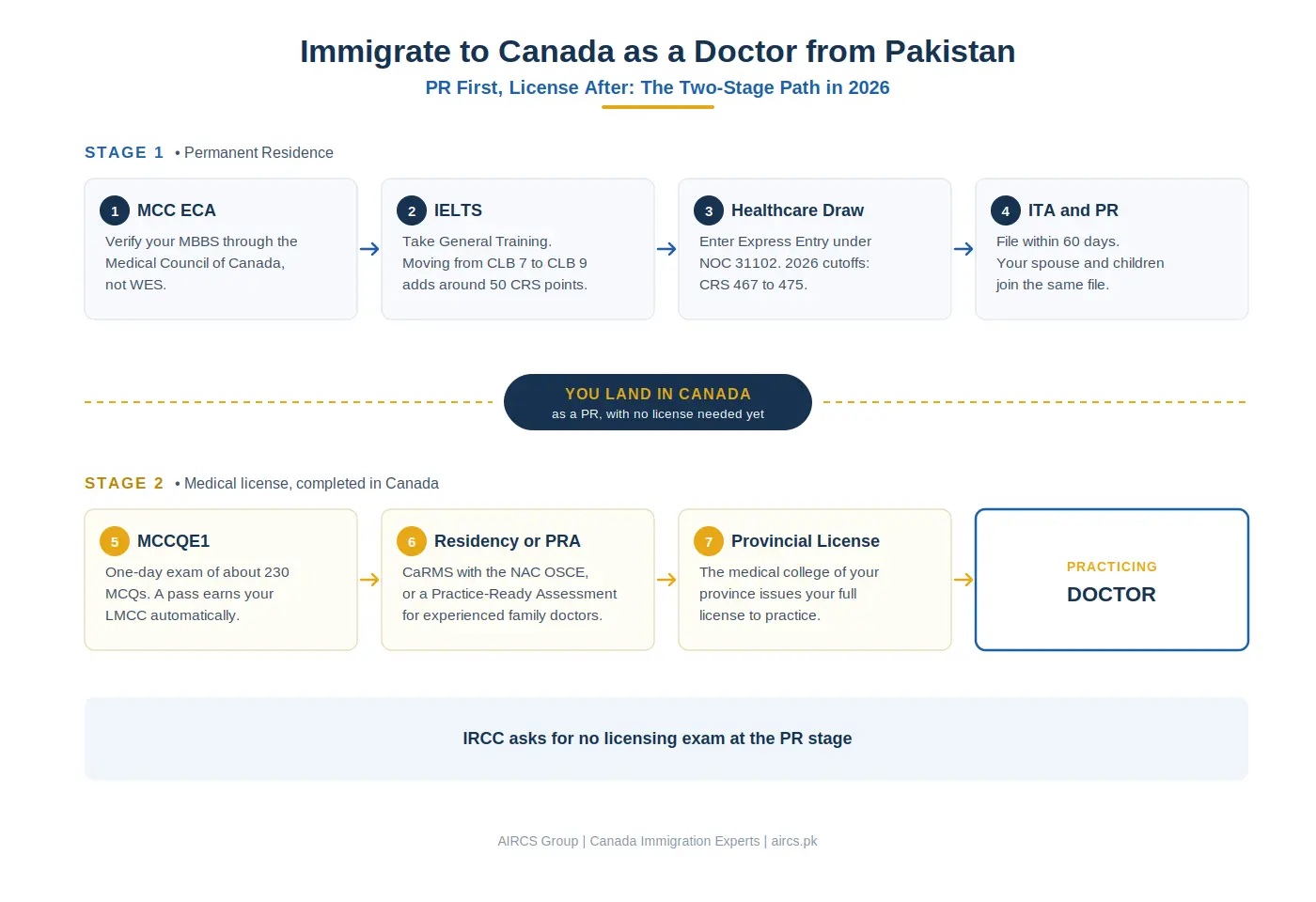
There are two stages to becoming a doctor in Canada. Stage one is immigration where your file rests on your MBBS degree, your IELTS score, and your work experience. IRCC asks for no licensing exam at this stage, so you can immigrate to Canada as a doctor before you pass any exam.
Stage two is your license, and it begins after you land in Canada as a PR. You cannot treat patients as soon as you arrive, because each province clears you through its own licensing process. Many doctors start the licensing preparation from Pakistan while their PR file is in process. Our guide on Canada immigration for healthcare professionals explains this two-stage system for every medical field.
How to Immigrate to Canada as a Doctor from Pakistan
Step 1: Get Your ECA from the Medical Council of Canada
Get your ECA report from the MCC, not from WES. IRCC only accepts an MCC assessment for your medical degree when your job code is NOC 31100, 31101, or 31102. You open an account on physiciansapply, MCC verifies your MBBS directly with your university, and then issues your ECA report.
Step 2: Pass Your IELTS
Next, take the IELTS General Training test. IRCC converts your band scores into CLB levels, and those levels set your language points. Moving from CLB 7 to CLB 9 can add around 50 CRS points.
Step 3: Pick the Right NOC Code
Family physicians and general practitioners apply under NOC 31102, a TEER 1 occupation. Specialists in surgery use NOC 31101, and specialists in clinical and laboratory medicine use NOC 31100. Your NOC code is decided from your daily duties, not your job title. IRCC checks this through your reference letters, so each letter must show your working hours, and clinical duties such as diagnosis and patient care. You can confirm your code on the official IRCC NOC page.
Step 4: Enter the Pool and Target the Healthcare Draw
Now create your Express Entry profile and join the pool. The healthcare category draw is the realistic route to Canada PR for doctors applying from Pakistan, because foreign medical experience counts here. On 20 February 2026, this draw invited 4,000 people at CRS 467, and the round on 25 June 2026 invited at 475. General draws in the same period stayed between 507 and 518, so doctors enter with a much lower score.
Step 5: Keep a PNP Option
Is your CRS score below the healthcare cutoff? Then go for a provincial nomination, which adds 600 points and secures your invitation. Some provinces run physician-specific routes. Ontario’s new Workforce Priority stream accepts self-employed physicians without a job offer, though it requires CPSO registration first. Alberta’s AAIP runs a Dedicated Health Care Pathway and nominated 50 practice-ready physicians this year outside its normal quota.
Step 6: Get Your ITA and PR
When your CRS score clears a draw, IRCC sends you an ITA, which is your invitation to apply for PR. You then have 60 days to file your complete application. After approval, you move to Canada, and your spouse and children come as dependants on the same file.
Not sure your file meets IRCC standards? A doctor’s file fails on small details: a WES report instead of MCC, or a reference letter that reads administrative instead of clinical. AIRCS Group prepares physician files to IRCC standards, from your NOC code to your draw strategy. Message our team on WhatsApp for a free assessment, or explore our Canada PR services.
What Is the Express Entry Physicians Category?
The Express Entry physicians category is a dedicated draw for doctors who already have 12 months of Canadian work experience as a physician. Its first round on 19 February 2026 invited 391 doctors at a CRS score of 169, one of the lowest cutoffs ever recorded in Express Entry. The second round on 24 June 2026 invited 271 doctors at CRS 223.
So can you immigrate to Canada as a doctor through this category straight from Pakistan? No. The draw requires Canadian clinical experience, so a doctor in Faisalabad or Rawalpindi enters through the healthcare draw first. If you reach Canada on a work permit first, you can qualify for this draw after one year of practice. At cutoffs of 169 and 223, almost every eligible doctor gets invited.
The MCCQE1 Exam and Your Medical License
Your licensing runs through the same account you created for your ECA. The Medical Council of Canada already has your verified MBBS degree at this point, so your next step is the MCCQE1, Canada’s national qualifying exam.
MCCQE1 Exam Format, Fee, and Attempts
Since April 2025, the MCCQE1 is a one-day, computer-based test of about 230 multiple-choice questions, offered four times a year. You can take it at Prometric centres in over 70 countries, including Pakistan, or by remote proctoring from home. The fee is around CAD 1,500 and non-refundable, and you get a maximum of four attempts.
The old clinical exam was cancelled, so this is the only national exam left, and passing it now earns your LMCC automatically. Full details are on the MCC pathways page.
From LMCC to Your Full License
After your LMCC, there are two routes to get license. Most doctors apply for a residency spot through CaRMS, which also requires the NAC OSCE, a separate clinical exam. Experienced family doctors can instead take a Practice-Ready Assessment, which several provinces offer to physicians. Once you complete either route, the medical college of your province issues your full license.
Cost of Canada PR for Doctors in 2026
The main government and assessment fees to immigrate to Canada as a doctor from Pakistan come to around CAD 3,950, split between the immigration stage and the first licensing step. The table below shows each item.
Item | Fee (CAD) | Stage |
PR processing fee | 990 | Immigration |
Right of Permanent Residence Fee | 600 | Immigration |
Biometrics | 85 | Immigration |
ECA through MCC (verification and report) | Around 415 | Immigration |
IELTS test | Around 375 | Immigration |
MCCQE1 application fee | Around 1,500 | Licensing |
Fees change from time to time, so always confirm the latest figures before you pay.
For timeline, expect about 9 to 12 months from your Express Entry profile to final PR, and 12 to 18 months if you go through a provincial nomination. MCC source verification alone can take several weeks, and MCCQE1 sessions run only four times a year.
Common Mistakes Doctors Make When Applying
- Waiting for a job offer. Canadian employers rarely hire unlicensed doctors, so the job offer you are waiting for will not come easily. The healthcare draw needs no job offer, and your foreign experience counts there.
- Passing the MCCQE1 before applying. IRCC asks for no licensing exam at the PR stage. Doctors who spend a year on exam preparation before entering the pool delay their own PR for nothing.
- Sending a WES report instead of MCC. IRCC only accepts a Medical Council of Canada ECA for physician NOC codes. A WES report scores zero education points and can delay the file.
- Reference letters that read administrative. IRCC verifies your NOC code through your job duties. A letter that lists ward management but not diagnosis and patient care will not match NOC 31102.
- Treating an MBBS as enough. Express Entry runs on CRS points, not credentials. A doctor with ten years of experience and CLB 6 English cannot even enter the pool, because FSWP requires CLB 7 in all four skills. Moving up to CLB 9 adds around 50 points on top of eligibility.
Frequently Asked Questions
Do I need to pass the MCCQE1 before moving to Canada?
No. IRCC asks for no licensing exam at the PR stage. You move to Canada first, then complete source verification and the MCCQE1 to earn your license and start practicing.
What do I need to immigrate to Canada as a doctor from Pakistan?
You need an ECA report from the Medical Council of Canada, an IELTS score, and 12 months of work as a doctor within the last three years. With these, you enter the Express Entry pool and target a healthcare draw.
Which NOC code do doctors use?
Family physicians and general practitioners use NOC 31102. Specialists in surgery use NOC 31101, and clinical and laboratory specialists use NOC 31100. Your job duties decide your NOC code, not your job title.
Can I qualify for the CRS 169 physicians draw from Pakistan?
No. The Express Entry physicians category requires 12 months of Canadian work experience, so it opens up only after you practice in Canada. From Pakistan, the healthcare draw is your route, and it invited at CRS 467 and 475 this year.
Can I work in Canada before passing the MCCQE1?
Yes,but not as a licensed physician. Many doctors work in related health roles while they prepare for the exam, and PR gives you the right to work in any job from the day you land.
Want to Immigrate to Canada as a Doctor?
The healthcare draws of 2026 invited at CRS 467 and 475, and Canada has reserved 5,000 PNP spaces for physicians on top of them. These cutoffs will not stay low forever, because every draw invites more doctors into the pool. AIRCS Group prepares physician files to IRCC standards, from your MCC verification to your draw strategy. Book your free assessment before the next healthcare round.