


September 26, 2026
In Canada, ENT is known as Otolaryngology, Head and Neck Surgery, covering the medical and surgical care of the ear, nose, throat and related structures of the head and neck. Patients wait a median of 43.8 weeks from GP referral to ENT treatment, which creates strong demand for qualified surgeons. If you practice in Pakistan, you can immigrate to Canada as an ENT specialist through Express Entry or a provincial nomination.
Table of Contents
ToggleCanada’s ENT Wait Times and Provincial Gaps
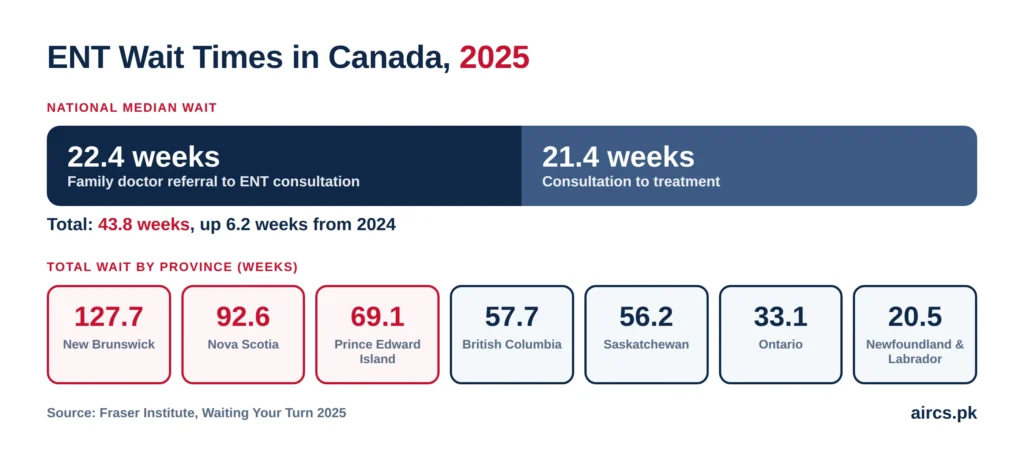
Canadian patients usually see an ENT specialist only after a family doctor refers them. The Fraser Institute 2025 report found these national median waits:
- 22.4 weeks from family doctor referral to an ENT consultation
- 21.4 weeks from consultation to treatment
- 43.8 weeks in total, up 6.2 weeks from 2024
Otolaryngology had one of the largest wait time increases of any specialty between 2024 and 2025. Waits also differ sharply across provinces:
- New Brunswick: 127.7 weeks
- Nova Scotia: 92.6 weeks
- Prince Edward Island: 69.1 weeks
- British Columbia: 57.7 weeks
- Saskatchewan: 56.2 weeks
- Ontario: 33.1 weeks
- Newfoundland and Labrador: 20.5 weeks
Provinces with the longest waits have the strongest demand for new ENT surgeons.
How Canada Defines and Trains ENT Specialists
Otolaryngology, Head and Neck Surgery is a Royal College specialty, and training usually takes five years. Under the current Royal College training requirements, in effect since July 2025, residents train in five areas:
- Head and neck surgery: removal of tumors and masses in the neck, mouth and throat
- Otology: hearing assessment and ear microsurgery
- Rhinology: endoscopic and open sinus surgery
- Pediatric otolaryngology: ear, nose and throat care for children
- Facial plastic and reconstructive surgery: facial repair, reconstruction and trauma care
Residents progress through four stages of competence: Transition to Discipline, Foundations of Discipline, Core of Discipline and Transition to Practice. ENT residents must also complete Surgical Foundations training before they enter the Core of Discipline stage. When the Royal College reviews your FCPS or MS ENT training, it compares it against these five areas and stages.
How ENT Specialists Are Classified Under NOC 31101
ENT specialists apply under NOC 31101, Specialists in surgery. The job titles in this code include otorhinolaryngologist, otolaryngologist, otologist, rhinologist and laryngologist. This TEER 1 code is part of the Express Entry healthcare and social services category.
Medical specialties such as neurology use NOC 31100, and choosing the wrong code can make your work experience ineligible. NOC 31101 also includes surgical residents, so paid FCPS or MS ENT residency years count as work experience. Audiologists are classified separately under NOC 31112 and register with their own provincial regulators.
How to Immigrate to Canada as an ENT Specialist
To qualify for the Express Entry healthcare category, you must meet these requirements:
- Work experience: 12 months of full-time paid work in the past three years, or the same number of hours part-time. The work can be in Canada or abroad and does not need to be continuous.
- Federal Skilled Worker Program: one year of continuous paid work in the same occupation within the last 10 years and at least 67 out of 100 points on its grid. This grid is separate from the CRS score, which ranks your profile against other candidates.
- Credential assessment: a Medical Council of Canada (MCC) assessment of your MBBS. WES reports are not accepted for doctors.
- English: at least CLB 7 in all four skills on IELTS General Training, CELPIP-General or PTE Core. To be competitive, aim for CLB 9 or 10.
A single ENT specialist aged 30 with CLB 10 and three years of paid foreign work scores 476, above the 475 cut-off in the 4 September 2026 healthcare draw. Our CRS score breakdown explains each factor.
After an invitation, you have 60 days to apply, and IRCC aims to process 80% of complete applications within six months. A single applicant needs CAD 15,263 in settlement funds and pays CAD 1,675 in government fees, including biometrics.
Documents That Prove Your FCPS or MS ENT Experience
IRCC checks your reference letters against the duties listed under NOC 31101, so a letter that only confirms your job title will not prove your experience. Each letter should be on hospital letterhead and signed by your immediate supervisor or HR officer, with their name, title and contact details. It should include:
- Employment details: every position you held, dates of employment, weekly hours, annual salary and benefits, and whether the job is current
- ENT duties: procedures such as tonsillectomy, septoplasty, endoscopic sinus surgery, tympanoplasty and head and neck surgery
- Clinical work: outpatient clinics, emergency ENT cover and inpatient care
Keep your operative logbook up to date as well. IRCC does not ask for it, but the Royal College uses records of your surgical training and practice when it reviews your application later.
Provincial Nomination Options for ENT Specialists
An Express Entry-linked provincial nomination adds 600 CRS points. For a single ENT specialist aged 35 with CLB 10 and three years of paid foreign work, that raises the score from 448 to 1,048. Two provinces include NOC 31101 in their physician routes:
- Saskatchewan: the SINP Health Talent Pathway requires a permanent, full-time health sector job offer and a SINP Job Approval Letter. Applicants in its Express Entry stream must also be eligible for Saskatchewan licensing.
- Nova Scotia: the physician pathway under the Skilled Worker stream is open to applicants with a signed approved opportunity from Nova Scotia Health or the IWK Health Centre. This document must confirm your eligibility for licensure with the College of Physicians and Surgeons of Nova Scotia and for hospital privileges and credentials.
Medical Licensing After Canada PR
PR lets you live and work in Canada, but you need a provincial license to practice as an ENT surgeon. Royal College certification is a separate step. Pakistan is not on the Royal College list of approved jurisdictions, so FCPS and MS ENT surgeons usually follow one of two routes.
Route 1: Royal College Practice Eligibility Route
The Royal College reviews your training against Canadian Otolaryngology, Head and Neck Surgery standards, including the Surgical Foundations requirement. The assessment costs CAD 4,965, and a ruling takes three to six months. You can apply before you move, and exam fees are charged separately.
You then complete two years of supervised practice at one location in Canada. You can take the Royal College exam before or during this period, with four attempts within five years of your ruling.
Route 2: Nova Scotia Practice Ready Assessment
Nova Scotia offers an eight-week assessment for specialists if you have a job offer from Nova Scotia Health or the IWK Health Centre. You also need specialist certification from your home country and a return of service agreement. During the assessment, you work under supervision and are never the most responsible physician.
If you pass, you receive a supervised license and a letter supporting your Royal College exam eligibility. Your practice is limited to the scope and locations set out in your return of service agreement.
With a 92.6-week ENT wait, Nova Scotia has one of the strongest needs for new ENT surgeons, so apply for this route as early as possible. Our guide on how to immigrate to Canada as a doctor explains how provincial licensing works.
Frequently Asked Questions
Do I need MRCS or DOHNS to immigrate to Canada as an ENT specialist?
No. IRCC does not require MRCS or DOHNS for Canada PR. The Royal College’s route for approved jurisdictions applies to specialists who completed accredited UK specialty training, so these exams alone do not replace the Practice Eligibility Route.
Will I have to repeat residency in Canada?
Usually not. The Practice Eligibility Route and Nova Scotia’s assessment let you qualify through supervised practice instead of a new residency.
Is MS ENT treated the same as FCPS ENT for Canada immigration?
For Express Entry, yes. IRCC assesses your MBBS and your paid work, not the name of your postgraduate degree. The Royal College reviews the content of either program against Canadian ENT training.
Do I need a job offer for Canada PR as an ENT specialist?
No. Express Entry does not require a job offer. You need one only for provincial routes, such as the Saskatchewan and Nova Scotia pathways in this guide.
Assess Your ENT Specialist Profile for Canada PR
We review your CRS score, FCPS or MS ENT training and surgical experience, then show you which Canada PR pathway fits your profile, including provincial options.
Get My Free Assessment on WhatsApp → or book your profile assessment.