


September 24, 2026
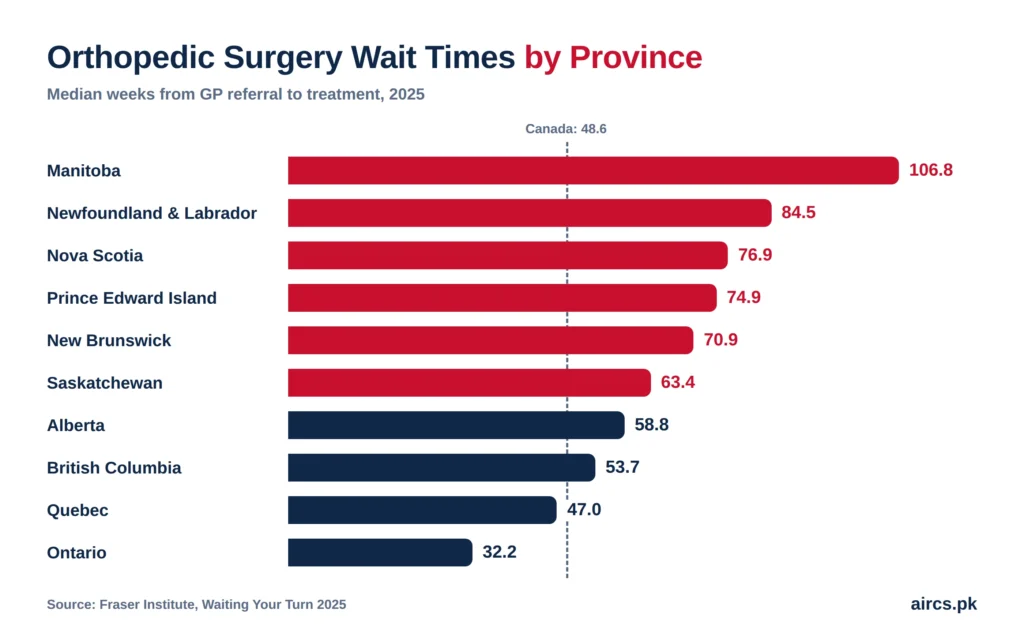
Surgeons in Lahore, Karachi, Islamabad and Faisalabad can immigrate to Canada as an orthopedic surgeon through Express Entry, without a Canadian license or job offer. A job offer becomes important only for certain provincial pathways. Canadian patients wait a median of 48.6 weeks for orthopedic treatment, and several provinces have waits of more than 70 weeks.
This guide explains where orthopedic surgeons are needed most, which provinces have immigration routes for surgeons and how the Express Entry process works for FCPS orthopedic surgeons.
Table of Contents
ToggleCanada’s Orthopedic Backlog in Numbers
Orthopedic surgery has the second-longest wait of any specialty in Canada, behind only neurosurgery. The Fraser Institute 2025 report found:
- 48.6 weeks: the national median wait from GP referral to treatment
- 135,923: the estimated number of orthopedic procedures on waiting lists
- 13.6 weeks: the time patients waited after consultation beyond what specialists consider reasonable, the largest gap of any specialty
Demand for joint replacement continues to rise. According to CIHI, Canada performed 26% more hip replacements and 21% more knee replacements in 2024 than in 2019. Demand still exceeds capacity, as 68% of hip patients and 61% of knee patients were treated within the recommended six months.
Provinces Where Orthopedic Surgeons Are Needed Most
Several provinces have orthopedic waits of more than 60 weeks, well above the national median of 48.6 weeks. The Fraser Institute reported these median orthopedic waits in 2025:
- Manitoba: 106.8 weeks
- Newfoundland and Labrador: 84.5 weeks
- Nova Scotia: 76.9 weeks
- Prince Edward Island: 74.9 weeks
- New Brunswick: 70.9 weeks
- Saskatchewan: 63.4 weeks
Ontario had the shortest orthopedic wait at 32.2 weeks. These six provinces have the greatest unmet need for orthopedic care, so they are the best places for a surgeon from Pakistan to focus a job search.
The long-term outlook is also positive. The Canadian Occupational Projection System projects about 5,400 job openings for surgical specialists from 2024 to 2033, according to a 2026 editorial in the Canadian Journal of Surgery. This points to a national shortage over the next decade.
Which Province Fits Your Orthopedic Profile?
Send your age, FCPS training, years of paid work and English score on WhatsApp. We will check your CRS score and the provinces that match your profile, free of charge.
Check My Profile →
Provinces With Immigration Routes for Orthopedic Surgeons
Saskatchewan and Nova Scotia both have long orthopedic waits and immigration routes that include NOC 31101, Specialists in surgery:
- Saskatchewan: The SINP Health Talent Pathway requires a permanent, full-time health sector job offer and a SINP Job Approval Letter. Applicants in its Express Entry stream must also be eligible for Saskatchewan licensing. A nomination through this stream adds 600 CRS points.
- Nova Scotia: The physician pathway under the Skilled Worker stream includes NOC 31101 and requires an approved job offer from Nova Scotia Health or the IWK Health Centre.
Nova Scotia also offers an eight-week practice ready assessment for specialists. Applicants need specialist certification from their home country and a return of service agreement. Successful candidates receive a supervised license and a letter supporting their Royal College exam eligibility.
Newfoundland and Labrador has a clinical assistant license for internationally trained doctors who are not eligible for standard certification. It requires exams and proof of recent clinical practice.
How to Immigrate to Canada as an Orthopedic Surgeon
Orthopedic surgeons apply under NOC 31101, which lists orthopedic surgeon by name. The code also includes surgical residents, so paid FCPS residency years count as work experience. Your Express Entry application depends on five factors:
- Work experience: 12 months of paid work in the past three years
- Credential assessment: a Medical Council of Canada (MCC) review of your MBBS. WES reports are not accepted for doctors.
- English test: IELTS General Training, CELPIP-General or PTE Core
- CRS score: a single applicant aged 30 with CLB 10 and three years of paid work scores 476, above the latest cut-off of 475. At 35, the same profile scores 448, and a provincial nomination raises it to 1,048.
- Submission: 60 days to apply after an invitation, and IRCC processes most complete files within six months
Royal College Specialist Certification
To practice independently in Canada, you need Royal College certification through the Practice Eligibility Route. The assessment costs CAD 4,965 and requires two years of supervised practice, and you can take the Royal College exam before or during this period. As a surgeon, your training must also meet the Surgical Foundations requirement. Provincial medical licensing is a separate process.
Our CRS score breakdown and guide on how to immigrate to Canada as a doctor explain each step in detail.
Frequently Asked Questions
Is FCPS in Orthopedic Surgery recognized in Canada?
No, it is not recognized automatically. Pakistan is not on the Royal College list of approved jurisdictions, so FCPS orthopedic surgeons are assessed through the Practice Eligibility Route before certification.
Do I need a job offer to immigrate to Canada as an orthopedic surgeon?
No. Express Entry does not require a job offer. A job offer is required for provincial routes such as Saskatchewan’s Health Talent Pathway and Nova Scotia’s physician pathway.
Which orthopedic procedures have the longest waits in Canada?
Hip and knee replacements have some of the longest orthopedic waits. According to the Fraser Institute, waits after seeing a specialist ranged from 20 weeks in Ontario to 52 weeks in Manitoba.
Assess Your Orthopedic Surgeon Profile for Canada PR
We review your CRS score, FCPS training and clinical experience, then show you the provinces where your profile fits best.
Get My Assessment on WhatsApp → or book a free assessment.
Learn more about our Canada PR services.