
September 10, 2026
Many Pakistanis dream of moving to Canada. But not every job qualifies for PR. Knowing the professions that qualify for Express Entry Pakistan saves you time and effort. It also helps you plan your application the right way. Canada picks skilled workers based on real labour needs. Your job title alone won’t help you. What matters is your NOC code and skill level. This guide shows you exactly which professions have the best chances in 2026.
Table of Contents
ToggleKey Takeaways: Professions That Qualify for Express Entry Pakistan
Main benefits: IT, healthcare, engineering, trades, accounting, and teaching are the strongest professions for Express Entry from Pakistan in 2026.
Other factors: Your NOC code, TEER level, education, work experience, and language scores all decide which occupation and program fits you.
Best solutions: Matching your real job duties to the correct NOC code, getting an ECA done early, and checking category-based draws improve your chances.
Processing timing: There’s no fixed timeline for Express Entry. Processing depends on your occupation category, CRS score, and how complete your documents are.
What Is Canada Express Entry and Why Occupation Selection Matters
Express Entry is the online application management system Canada’s immigration department (IRCC) uses to invite skilled workers to apply for permanent residence. It manages three federal programs — the Federal Skilled Worker Program (FSWP), the Federal Skilled Trades Program (FSTP), and the Canadian Experience Class (CEC) — and ranks every candidate in the pool using the Comprehensive Ranking System (CRS).
Here’s the part many first-time applicants underestimate: your occupation isn’t just a line on your resume. It determines which program you’re eligible for, whether you qualify for targeted category-based draws, and in some cases whether you can even enter the pool at all. A software engineer, a nurse, and a shop supervisor in Lahore might all have strong CRS scores on paper, but only some of them will match an occupation category that Canada is actively inviting from.
How NOC Categories Determine Express Entry Eligibility
Every occupation that qualifies for Express Entry is mapped to a code under Canada’s National Occupational Classification (NOC) system. IRCC uses the 2021 version of the NOC, and your job duties — not just your job title — have to genuinely match the description listed under a specific code.
This matters because two people with the title “Manager” could be doing completely different work, and only one of their roles might align with a NOC code that IRCC considers skilled enough for Express Entry. When you apply, you’ll self-select a NOC code based on your actual day-to-day duties, and IRCC checks this against your reference letters and job descriptions later in the process.
For Pakistani applicants, this is often where applications fall apart. A vague or inflated job title on a Pakistani experience letter, one that doesn’t clearly describe your responsibilities, can make it hard to prove you match a qualifying NOC code, even if your real job would have qualified.
TEER Levels and Their Role in Occupation Eligibility
Since 2022, NOC codes have been organized into TEER levels (Training, Education, Experience, and Responsibilities), replacing the older “Skill Type/Level” system. TEER ranges from 0 to 5:
- TEER 0 – Management occupations
- TEER 1 – Occupations usually requiring a university degree
- TEER 2 and 3 – Occupations usually requiring a college diploma, apprenticeship training, or several years of relevant experience
- TEER 4 and 5 – Occupations requiring secondary school and/or short-term training
For the Federal Skilled Worker Program, your work experience generally needs to fall under TEER 0, 1, 2, or 3. The Federal Skilled Trades Program, on the other hand, accepts specific TEER 2 and 3 trade occupations even if they don’t require a degree. Knowing your TEER level before you apply saves you from wasting months building a profile around a program you were never eligible for in the first place.
Top In-Demand Professions for Pakistani Applicants
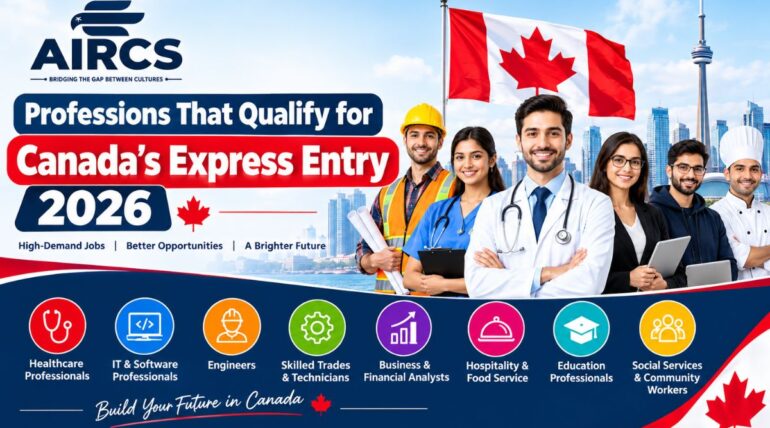
Some occupations consistently show up as strong candidates for Express Entry, both because they meet the skill-level requirements and because Canada faces genuine labour shortages in these fields. Here are the professions that qualify for Express Entry Pakistan applicants most often pursue successfully.
IT & Software Professionals
Software engineers, developers, IT project managers, and data analysts remain some of the most in-demand occupations for Canada Express Entry. Roles like software engineers and designers, information systems analysts, and database administrators typically fall under TEER 1, making them eligible across FSWP and CEC, and they frequently appear in category-based draws targeting STEM occupations. Pakistan’s growing tech and software export sector means many applicants already have documented experience that maps cleanly onto these NOC codes.
Healthcare Workers (Nurses, Lab Technicians, Physicians)
Healthcare and social services occupations are consistently one of the most active category-based streams. Registered nurses, medical laboratory technologists, and licensed practical nurses fall under TEER 1 and 2, while physicians with Canadian work experience now have a dedicated category of their own. The catch for most Pakistani applicants is licensing: Canadian provinces regulate healthcare professions closely, so credential recognition should be researched early, well before you touch your Express Entry profile.
Engineers (Civil, Mechanical, Electrical)
Engineering occupations for Canada Express Entry span civil, mechanical, electrical, and chemical engineering, almost all sitting at TEER 1. These roles regularly appear on STEM-focused category-based draws. Keep in mind that “engineer” as a protected title in Canada may require provincial licensing to practice, but for Express Entry purposes, your NOC eligibility is based on your work experience and duties, not licensure.
Skilled Trades (Electricians, Welders, Plumbers)
The Federal Skilled Trades Program exists specifically for occupations like electricians, welders, plumbers, HVAC technicians, and heavy-duty equipment mechanics. These trades sit at TEER 2 and 3 and don’t require a university degree, which makes them genuinely accessible for many Pakistani tradespeople. The Trades category has also been a strong performer in category-based draws, often issuing invitations at more forgiving CRS cut-offs than general draws.
Accountants & Financial Professionals
Financial auditors, accountants, and financial analysts fall under TEER 1 and are considered in-demand professions in Canada, particularly given the country’s aging accounting workforce. Pakistani applicants with ACCA, CA, or ICMA credentials often have an advantage here, though an Educational Credential Assessment (ECA) is still required to confirm your qualification is equivalent to a Canadian standard.
Teachers & Education Specialists
With education now recognized as its own category-based stream, elementary and secondary school teachers, along with certain education specialists, have a clearer path than in previous years. These roles typically require a TEER 1 level of training. Provincial teaching certification requirements vary, so this is another field where early research into recognition and licensing pays off.
How These Professions Align with Category-Based Express Entry Draws
Since 2023, IRCC has increasingly used category-based selection alongside general draws, inviting candidates from specific occupation groups rather than ranking the entire pool by CRS score alone. In 2026, these categories include healthcare and social services, STEM occupations, trades, education, transport occupations, French-language proficiency, and newly added groups such as physicians, senior managers, and researchers with Canadian work experience.
This is precisely why the professions listed above matter so much. If your occupation matches an active category, you compete only against other candidates in that same category, and cut-off scores in these targeted rounds are frequently lower than in general draws. Most occupation-based categories require at least twelve months of relevant work experience within the past three years, a requirement that increased from six months in earlier years, so it’s worth confirming the current threshold before assuming you qualify.
Occupations tied to Canadian work experience specifically, like the new senior manager and physician streams, generally require that the twelve months of experience be earned inside Canada, which is a meaningful distinction for applicants still overseas.
Eligibility Criteria: Education, Work Experience & Language Requirements
Regardless of which occupation you fall under, Express Entry eligible occupations still need to satisfy baseline requirements:
- Work experience: At least one year of continuous, full-time (or equivalent part-time) skilled work experience in the last ten years, in an occupation matching an eligible NOC code and TEER level.
- Language ability: A minimum Canadian Language Benchmark (CLB) score, usually CLB 7 for FSWP and CEC roles, through IELTS or CELPIP. Competitive candidates typically aim for CLB 9 or higher to maximize CRS points.
- Education: A completed post-secondary credential, verified through an Educational Credential Assessment (ECA) if it was earned outside Canada, such as in Pakistan.
- Proof of funds: Unless you already have qualifying work experience in Canada, you’ll need to show sufficient settlement funds based on your family size.
Meeting these baseline criteria gets you into the pool. It does not guarantee an invitation, since CRS ranking and category-based selection still determine who actually receives one.
How to Verify If Your Profession Qualifies
professions that qualify for Express Entry Pakistan: Don’t rely on guesswork or forum posts to confirm your eligibility. Start by comparing your real job duties, not your title, against the official NOC 2021 descriptions. Use the IRCC and Statistics Canada NOC search tool to find your exact match. Then check the TEER level tied to that code against your program, whether it’s FSWP, FSTP, or CEC.
Next, check IRCC’s current category-based selection list, since it changes from time to time. Get your Educational Credential Assessment done early, as it can take several weeks and often decides your eligibility. If your Pakistani job title doesn’t translate clearly, don’t assume it’s “close enough.” Talk to a licensed immigration consultant (RCIC) instead.
Common Mistakes Pakistani Applicants Make When Selecting an Occupation
A surprising number of otherwise strong candidates get rejected or delayed because of avoidable occupation-related errors:
Mistake | Why It Hurts Your Application |
Picking a NOC code by job title alone | Your title may not match the real duties IRCC expects for that code. |
Using vague experience letters | Missing duties, hours, or dates make it hard for IRCC to confirm your NOC match. |
Assuming a management title auto-qualifies | Real duties may not meet the supervisory level the NOC code needs. |
Ignoring licensing for regulated jobs | Nurses, engineers, and teachers may not be able to practice in Canada without it. |
Ignoring category-based draws | You could miss a lower CRS cut-off made just for your occupation. |
Step-by-Step Guide to Strengthen Your Express Entry Profile
- Identify your correct NOC code and TEER level by matching your real job duties against the official classification, not just your job title.
- Get your credentials assessed through a designated ECA organization to confirm your degree’s Canadian equivalency.
- Take a recognized language test (IELTS General Training or CELPIP) and aim for CLB 9 or above across all four abilities if possible.
- Gather strong documentary evidence of your work experience, including detailed reference letters, tax records, and pay slips that align with your claimed NOC code.
- Calculate your CRS score honestly using the official IRCC calculator, then identify realistic ways to improve it, such as additional language testing, a second language, or provincial nomination.
- Watch category-based draws relevant to your occupation so you can time your profile submission and stay alert to invitations tailored to your field.
- Submit your Expression of Interest profile only once your documents and scores are in order, since a well-prepared profile reduces the risk of errors or delays after an invitation to apply arrives.
Choosing the right occupation isn’t just paperwork — it’s the single factor that shapes whether Canada’s immigration system sees you as a strong match for its labour market needs. This is where knowing the professions that qualify for Express Entry Pakistan really pays off. Get your NOC code, TEER level and documentation right from the start, and the rest of your Express Entry journey becomes far more predictable.
Frequently Asked Questions
Which professions qualify for Express Entry from Pakistan?
IT professionals, nurses, engineers, skilled trades workers, accountants and teachers are among the top choices. Your job duties must match an official NOC code.
Do I need a Canadian job offer to apply?
No. A job offer is not required and no longer adds CRS points. Many applicants get invited without ever having a Canadian employer.
What is a NOC code and why does it matter?
NOC stands for National Occupational Classification. It groups jobs by duties and skill level, and IRCC uses it to check if you qualify.
What is a TEER level?
TEER measures the training and experience a job needs, from 0 to 5. Most Express Entry occupations fall under TEER 0 to 3.
Which Professions That Qualify for Express Entry Pakistan?
Pakistani professionals in IT, engineering, healthcare, accounting and skilled trades commonly qualify for Express Entry, as long as their occupation matches an eligible NOC code and meets the required skill level.
Can tradespeople like electricians or welders apply?
Yes. The Federal Skilled Trades Program was made for occupations like these. A university degree is not required.
Do doctors and nurses need Canadian licensing to apply?
Licensing is not needed to enter the Express Entry pool. But you will need it later to actually work in your regulated profession in Canada.
How do I know if my job title matches a Canadian NOC code?
Compare your daily duties, not your title, to the NOC description online. When unsure, ask a licensed immigration consultant for help.
Conclusion
Choosing the right profession is the first real step toward Canada PR. Get your NOC code right and everything else becomes easier. This is exactly why knowing the professions that qualify for Express Entry Pakistan matters so much. IT, healthcare, engineering, trades, accounting and teaching remain strong choices for Pakistani applicants in 2026. These fields match Canada’s real labour needs. Category-based draws can lower your CRS score requirement. Match your job duties carefully and you may qualify for one. Don’t guess your eligibility. Check your NOC code, get your ECA done and speak to an expert if you’re unsure.
Book Your Free Immigration Consultation Today!
Want to build a better future for your family in Canada?
Get expert immigration guidance and tailored solutions specifically for Pakistani families.
WhatsApp: +92 311 4464274
Website: https://aircs.pk/
Offices: Rawalpindi & Faisalabad