

April 3, 2026
- by Atif Sajjad
- Leave a Comment on How to Get Canada PR from Pakistan: Routes, Requirements and Steps
Canada PR from Pakistan takes about 12 to 24 months through Express Entry, from your first language test to landing in Canada, as long as you receive an Invitation to Apply (ITA). The four main routes are Express Entry, a Provincial Nominee Program (PNP), study-to-PR and family sponsorship.
In 2024, 11,940 Pakistani citizens became Canadian permanent residents, the eighth-largest group from any country. This guide explains each route, the Canada PR requirements, the CRS score you need and how to choose the best Canada immigration consultants in Pakistan.
Table of Contents
ToggleWhat Is PR in Canada and What Rights Do You Get?
PR in Canada means permanent resident status. Your status has no expiry date, but the PR card itself must be renewed, usually every 5 years. Permanent residence is not citizenship, so you keep your Pakistani passport and show your PR card when you return to Canada from abroad. Pakistan has a dual nationality arrangement with Canada, so you can keep your Pakistani citizenship even after you become Canadian.
As a permanent resident, you can:
- live and work in any province and for any employer
- access public health coverage, although some provinces have a waiting period of up to 3 months
- pay domestic tuition at Canadian colleges and universities
- sponsor your spouse, common-law partner or dependent children while you live in Canada
- apply for citizenship after spending 1,095 days in Canada within the previous 5 years
Permanent residents cannot vote, run for office or hold jobs that need a high-level security clearance. To keep your status, you must spend at least 730 days in Canada in every 5-year period.
IRCC paused new parent and grandparent sponsorship applications on 15 July 2026. Your parents and grandparents can still visit on a Super Visa, which allows stays of up to 5 years per entry.
What Are the Main Pathways for Canada PR from Pakistan in 2026?
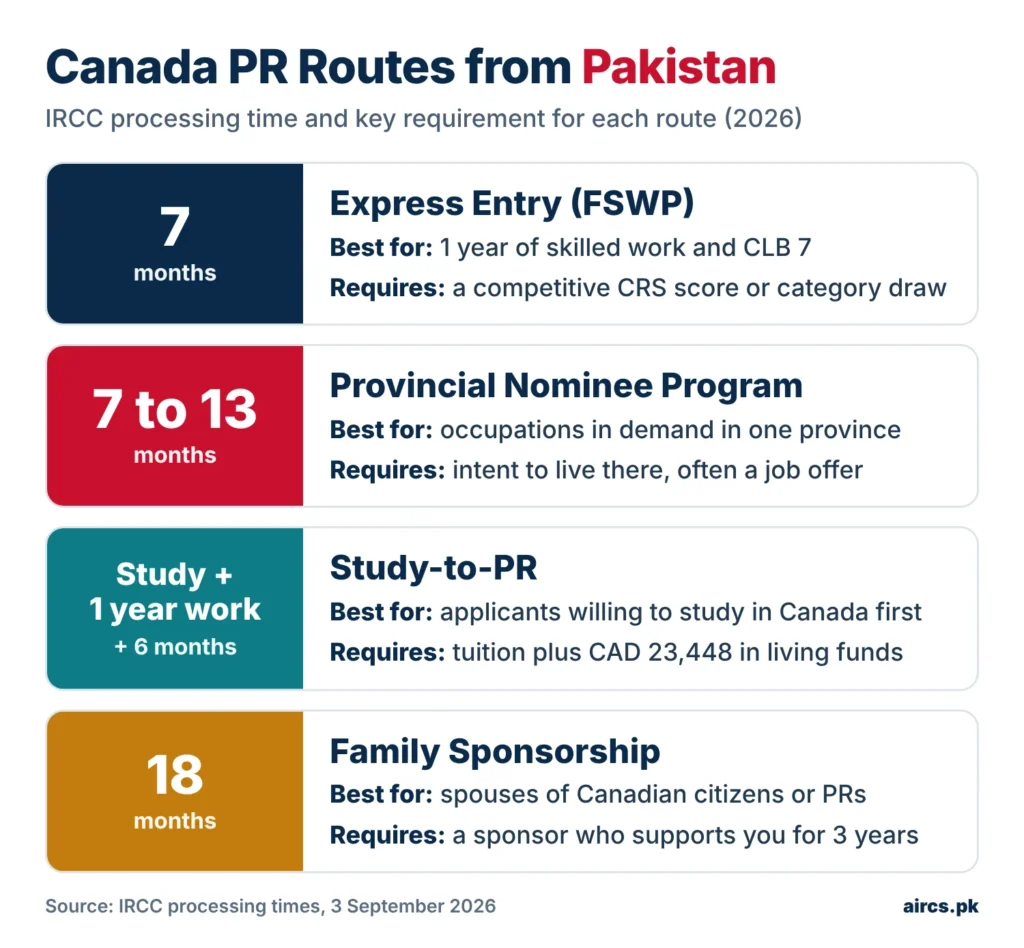
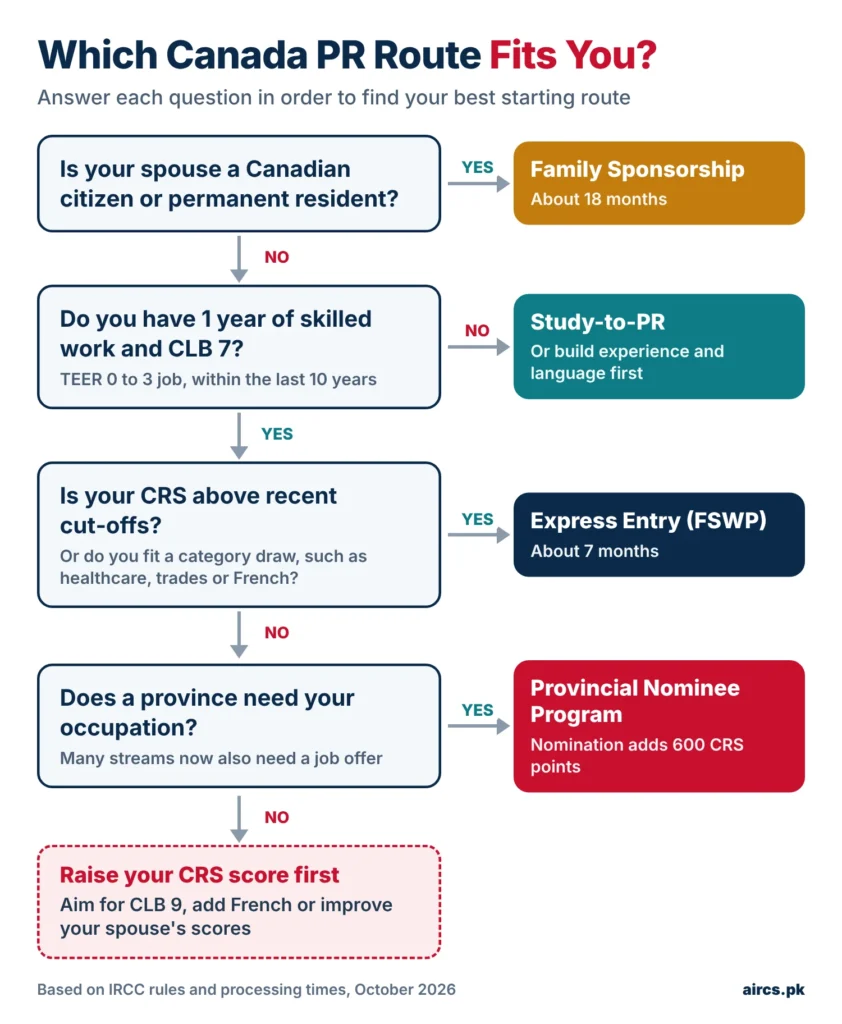
For skilled workers living in Pakistan, Express Entry and Provincial Nominee Programs (PNPs) are the two direct routes to PR. Study-to-PR requires you to study in Canada first, and family sponsorship requires a spouse who is already a Canadian citizen or permanent resident.
|
Pathway |
Best for |
IRCC processing time |
Key limitation |
|
Express Entry (Federal Skilled Worker) |
Workers with at least 1 year of continuous skilled experience and CLB 7 |
About 7 months |
Requires a competitive CRS score or an occupation in a targeted draw category |
|
Provincial Nominee Program |
Workers whose occupation is in demand in a specific province |
About 7 months (Express Entry stream) or 13 months (base stream) |
Requires intent to live in the nominating province |
|
Study-to-PR |
Applicants willing to study in Canada before applying for PR |
Length of study, plus 1 year of Canadian work, plus about 6 months of processing |
Requires high tuition fees, with a 2026 target of 155,000 new student arrivals |
|
Family sponsorship |
Spouses and common-law partners of Canadian citizens or PRs |
About 18 months (spouse living outside Canada) |
Requires the sponsor to commit to 3 years of financial support |
Processing times from IRCC.
Express Entry: The Main Federal Route
Express Entry is IRCC’s online system for managing skilled worker applications. Each candidate receives a Comprehensive Ranking System (CRS) score out of 1,200, and IRCC invites the highest-ranked candidates in regular draws.
It manages three programs: the Federal Skilled Worker Program (FSWP), the Canadian Experience Class (CEC) and the Federal Skilled Trades Program (FSTP). FSWP is the main option for applicants in Pakistan because CEC requires Canadian work experience and FSTP requires a Canadian job offer or trade certificate.
FSWP requires one year of continuous full-time skilled work in a TEER 0 to 3 job within the last 10 years, CLB 7 in all four language skills and at least 67 out of 100 points on the FSW grid.
Most invitations now go through category-based draws. Between 4 August and 1 October 2026, draws for healthcare workers, trades, French speakers and other categories issued 17,779 of 30,599 invitations. Find out which professions qualify for Express Entry from Pakistan.
Provincial Nominee Programs: The Provincial Route
A Provincial Nominee Program (PNP) allows a province to nominate you to fill labour shortages. A nomination through an enhanced (Express Entry) stream adds 600 CRS points, which usually leads to an Invitation to Apply (ITA) in the next PNP draw.
PNP draws in August and September 2026 had cut-offs between 697 and 768. Without a nomination, the highest possible score is 695, so every invited candidate was a nominee. Canada plans 91,500 PNP admissions in 2026.
Many provincial streams now require a provincial job offer:
- Ontario (OINP): The Human Capital Priorities stream closed on 30 May 2026, and the new Workforce Priority Stream requires an Ontario job offer.
- Alberta (AAIP): Express Entry pathways require current Alberta employment or an Alberta job offer.
- Saskatchewan (SINP): International Skilled Worker streams accept applicants abroad without a job offer, but only in selected occupations.
IRCC can refuse your PR application if you do not intend to live in the province that nominated you. Our guide to PNPs for Pakistani professionals explains each stream.
How Does the Study-to-PR Route Work?
Study-to-PR means studying in Canada, working there after graduation and then applying for PR through the Canadian Experience Class (CEC), in four steps:
- Complete a PGWP-eligible program at a Designated Learning Institution (DLI).
- Apply for a Post-Graduation Work Permit (PGWP), valid for up to 3 years. University graduates need CLB 7 and college graduates need CLB 5.
- Work 1,560 hours (one year full-time) in a TEER 0 to 3 job within 3 years.
- Apply through Express Entry, where one year of Canadian work adds up to 40 CRS points.
This route suits applicants under 30, because CRS age points decline from that age. A student applying alone must show CAD 23,448 for living costs plus first-year tuition. Work done during full-time study does not count towards CEC, and college students must choose a field on IRCC’s PGWP list.
Family Sponsorship: If Your Spouse Is Already in Canada
If your spouse or common-law partner is a Canadian citizen or permanent resident, they can sponsor you for PR. This route does not require a language test, ECA or CRS score, and sponsors outside Quebec usually have no minimum income requirement.
Your sponsor must be at least 18 and agree to support you for 3 years. A permanent resident sponsor must also live in Canada. Government fees total CAD 1,345, and processing takes about 18 months for spouses outside Canada.
What Are the Canada PR Requirements for Pakistani Applicants?
Canada PR requirements for an Express Entry applicant cover seven areas: language, education, work experience, funds, police certificates, a medical exam and biometrics. The rules are the same for all applicants, but Pakistani degrees usually go through HEC first.
- Language test: IRCC accepts IELTS General Training, CELPIP-General, PTE Core, TEF Canada and TCF Canada, but not IELTS Academic. Aim for CLB 9, which requires 8.0 in listening and 7.0 in reading, writing and speaking. Read our guide on the IELTS score for Canada PR.
- Educational Credential Assessment (ECA): an IRCC-designated body must assess your degree. World Education Services (WES) receives documents for HEC-recognised universities through HEC, which verifies them first. WES charges CAD 264 plus courier and takes about 35 business days.
- Work experience: your reference letters must list your job title, duties, hours, salary and employment dates.
- Proof of funds: FSWP applicants must show the amounts below. The money must be in your name, readily available and not borrowed. CEC applicants and those with a valid job offer are exempt.
- Police certificates: in Pakistan, apply through your provincial police office. Most provinces accept online or courier applications. You also need one from any other country where you spent 6 consecutive months or more as an adult in the past 10 years.
- Medical exam: Express Entry applicants must complete an upfront exam with an IRCC panel physician before submitting their PR application.
- Biometrics: after you apply, IRCC asks for your fingerprints and photo within 30 days at a VFS Global centre in Islamabad, Lahore or Karachi.
The minimum funds required depend on family size:
|
Family members |
Funds needed (CAD) |
|
1 |
15,263 |
|
2 |
19,001 |
|
3 |
23,360 |
|
4 |
28,362 |
|
5 |
32,168 |
Source: IRCC proof of funds.
What CRS Score Do You Need for Canada PR from Pakistan?
There is no fixed pass mark. The CRS score you need depends on the draw type, and these were the latest cut-offs:
|
Draw (2026) |
Date |
Invitations |
Lowest CRS score |
|
Trades |
1 Oct |
3,500 |
476 |
|
Canadian Experience Class |
29 Sep |
2,000 |
518 |
|
Provincial Nominee Program |
28 Sep |
733 |
725 |
|
Healthcare and social services |
4 Sep |
3,500 |
475 |
|
French |
19 Aug |
5,000 |
382 |
Between August and early October 2026, IRCC held no draw open to all programs. An FSWP applicant in Pakistan therefore usually needs a provincial nomination, French or an occupation in a targeted category.
How to Apply for Canada PR from Pakistan, Step by Step
You apply for Canada PR from Pakistan online through your IRCC secure account. The Express Entry process has ten steps:
- Confirm your NOC: find your occupation and its TEER category in the official NOC 2021 list.
- Take a language test: book IELTS General Training, CELPIP-General or PTE Core and aim for CLB 9 in all four skills.
- Get your ECA: HEC verification and WES assessment take about 2 to 4 months combined.
- Calculate your CRS score: use IRCC’s CRS tool before you create your profile.
- Create your Express Entry profile: it remains in the pool for up to 12 months.
- Wait for an ITA or apply to a PNP: if your score is below recent cut-offs, consider a province that needs your occupation.
- Arrange your medical exam and police certificates: both must be ready before you submit.
- Submit your PR application within 60 days of your ITA: pay the CAD 990 processing fee and CAD 85 biometrics fee. The CAD 600 right of permanent residence fee can be paid now or on request.
- Give biometrics: visit a VFS Global centre within 30 days of IRCC’s letter.
- Send your passport and land: after approval, you send your passport for a PR visa and receive your Confirmation of Permanent Residence (COPR). Land before the COPR expires. Your PR card follows by mail.
IRCC takes about 6 months for CEC and 7 months for FSWP after you submit. Our guide on Canada PR processing time covers each stage. If you plan to work abroad after landing, keep the 730-day residency rule in mind.
How Much Does Canada PR Cost from Pakistan in 2026?
For one adult, Canada PR from Pakistan costs about PKR 5 lakh in fees and tests. You must also show CAD 15,263 (about PKR 29.8 lakh) in savings, which stays in your account.
|
Item |
Cost |
||
|
IELTS General Training |
|
||
|
HEC verification (degree and transcript) |
about PKR 6,000 |
||
|
WES ECA |
CAD 264 (about PKR 51,500) plus delivery |
||
|
Medical exam (IOM) |
|
||
|
Biometrics |
|
||
|
PR processing fee |
CAD 990 (about PKR 193,000) |
||
|
Right of permanent residence fee |
CAD 600 (about PKR 117,000) |
||
|
Total for one adult |
|
||
|
Proof of funds (not a fee) |
CAD 15,263 (about PKR 2,976,000) |
PKR figures use 1 CAD = PKR 195 (7 October 2026). Rupee amounts change with the exchange rate.
A spouse adds CAD 1,590 in PR fees plus their own medical exam, and each dependent child adds CAD 270. Family biometrics are capped at CAD 170. See the full breakdown in our Canada PR cost from Pakistan guide.
What Mistakes Delay Canada PR for Pakistani Applicants?
These document problems can cause delays or refusals in immigration to Canada from Pakistan:
- Inconsistent names. “Muhammad” on a passport and “Mohammad” on a degree or IELTS result can lead to extra checks. Explain any difference with an affidavit before you apply for your ECA.
- An incorrect NOC. If your duties do not match the NOC you claim, IRCC can refuse your work experience.
- Incomplete reference letters. Each letter must show your job title, duties, hours, salary and employment dates. Duties copied word for word from the NOC can raise concerns.
- Unexplained deposits. IRCC may question large or recent deposits. Keep proof of the source, such as a sale deed, gift deed or payslips.
- Expired documents. Language results are valid for 2 years, ECA reports for 5 years and profiles for 12 months. If your test or profile expires, you must retest or create a new one.
- Undisclosed refusals. Failing to declare a visa refusal from any country is misrepresentation, which can ban you from Canada for 5 years.
How to Choose the Best Canada Immigration Consultants in Pakistan
Choose a consultant who works with a licensed representative and never promises a visa. Only CICC-licensed consultants, Canadian law society members and Quebec notaries can charge you to represent you with IRCC.
AIRCS Group works with R711338. Our Rawalpindi and Faisalabad teams check your CRS score, NOC and province options before you spend on tests. WhatsApp us or book your appointment.
Frequently Asked Questions
Can Pakistani applicants get Canada PR without a job offer?
Yes. The Federal Skilled Worker Program does not require a job offer, and job offers stopped adding CRS points on 25 March 2025. However, many provincial streams, including those in Ontario and Alberta, now require one.
What IELTS score do Pakistani applicants need for Canada PR?
FSWP requires at least IELTS 6.0 in each band (CLB 7). For a competitive CRS score, aim for CLB 9, which requires 8.0 in listening and 7.0 in reading, writing and speaking.
How much proof of funds do you need if you apply alone?
You need CAD 15,263, about PKR 29.8 lakh. CEC applicants are exempt, as is anyone already authorised to work in Canada with a valid job offer.
Do you need a consultant to apply for Canada PR from Pakistan?
No. You can submit your application directly to IRCC. If you pay someone to represent you, they must be a CICC-licensed consultant or a member of a Canadian law society.
How long does Canada PR take from Pakistan through Express Entry?
IRCC takes about 6 months for CEC and 7 months for FSWP after you submit. From language test to landing, the full process takes about 12 to 24 months, provided you receive an ITA.