

September 25, 2026
Nearly one in five Canadians aged 15 and older met the criteria for a mental disorder in 2022, while Canada has about 15 psychiatrists per 100,000 people. For psychiatrists trained in Lahore, Karachi, Islamabad and Faisalabad, that gap is a real opportunity. You can immigrate to Canada as a psychiatrist through the Express Entry healthcare and social services category, without first holding a Canadian medical license.
This guide explains the Express Entry requirements, CRS factors, provincial options and licensing pathway for Pakistani-trained psychiatrists.
Table of Contents
ToggleWhy Canada Needs More Psychiatrists
In 2023, Canada had about 5,819 psychiatrists, or 15 for every 100,000 people, according to a study in the Canadian Journal of Psychiatry. The study was led by the chairs of all 17 psychiatry departments in the country, and they agreed that Canada must train and recruit more psychiatrists. The workforce is also aging, as 26.7% of psychiatrists have been in practice for 36 years or more.
Patients already face long waits. The Canadian Psychiatric Association sets a 30-day benchmark for an elective psychiatric assessment, and the chairs agreed unanimously that most provinces and territories miss it.
Language skills give psychiatrists from Pakistan an added advantage. The 2021 Census counted about 667,000 people with Punjabi and 235,000 with Urdu as their mother tongue. Psychiatric care relies on patients describing their thoughts and feelings clearly, and many patients can do this more easily in their first language.
5 Million Canadians Had a Mental Disorder in 2022
About 5 million Canadians aged 15 and older, or 18%, met the criteria for a mood, anxiety or substance use disorder in the past 12 months. These figures come from the Statistics Canada 2022 Mental Health and Access to Care Survey, which also shows a sharp increase since 2012:
- Generalized anxiety disorder: doubled from 2.6% to 5.2%
- Major depressive episodes: increased from 4.7% to 7.6%
- Bipolar disorder: increased from 1.5% to 2.1%
Young women aged 15 to 24 saw the largest change. In this group, generalized anxiety disorder climbed from 3.8% to 11.9%, and major depressive episodes doubled from 9.0% to 18.4%.
Access to care has not matched this need. Only 48.8% of people with a disorder had consulted a health professional about their mental health, and 36.6% said their care needs were unmet or only partly met.
Who Can Immigrate to Canada as a Psychiatrist
To qualify for the Express Entry healthcare category, you must meet these requirements:
- Occupation: psychiatry work under NOC 31100, which lists psychiatrist by name and includes residents
- Work experience: 12 months of paid work in the past three years, gained in Canada or abroad. The months do not need to be continuous, and paid FCPS Psychiatry residency counts.
- Federal Skilled Worker Program: one year of continuous paid work in the same occupation within the last 10 years and at least 67 out of 100 points on its grid. The 67-point grid is a separate test from the CRS score that ranks your profile.
- Credential assessment: a Medical Council of Canada (MCC) assessment of your MBBS
- Language: at least CLB 7 in English or NCLC 7 in French in all four skills. A competitive CRS score usually needs CLB 9 or 10.
Psychiatrists and psychologists follow separate routes. Psychologists apply under NOC 31200, have their degree assessed by WES or another designated organization, and register with a provincial psychology college. Our guide on how to immigrate to Canada as a psychologist covers that route.
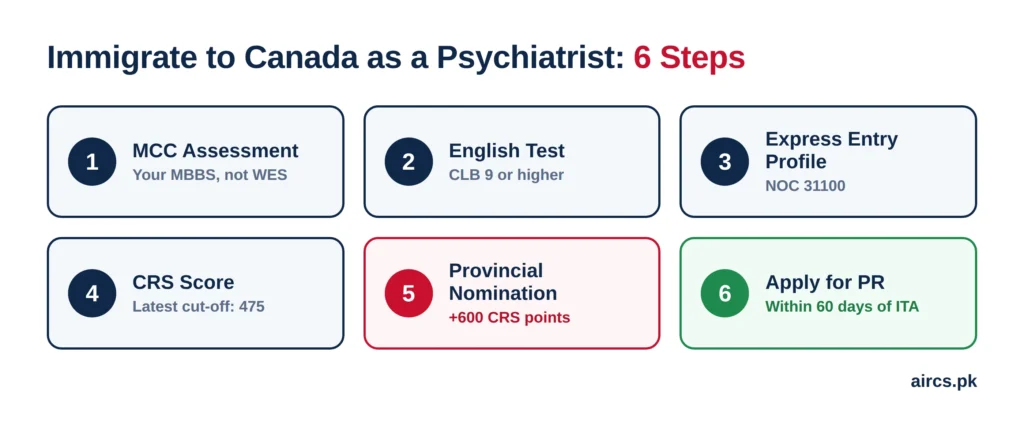
How to Immigrate to Canada as a Psychiatrist: 6 Steps
The first four steps build your Express Entry profile, and the last two lead to your PR application.
Step 1: Get Your MBBS Assessed by the MCC
Create an account on physiciansapply.ca and request an Educational Credential Assessment of your primary medical diploma. IRCC does not accept WES reports for doctors, and your MCC report must be less than five years old when you create your profile and when you apply.
Step 2: Take an Approved English Test
Take IELTS General Training, CELPIP-General or PTE Core. Your results must be less than two years old when you create your profile and when you submit your application. In IELTS General Training, CLB 9 requires 8.0 in listening and 7.0 in reading, writing and speaking. CLB 10 requires 8.5 in listening, 8.0 in reading and 7.5 in writing and speaking.
Step 3: Create Your Express Entry Profile Under NOC 31100
Enter NOC 31100 as your primary occupation and list only paid psychiatry work. Each reference letter should be on hospital letterhead, signed by your supervisor or HR officer, and state your job title, dates, duties, weekly hours and salary. Your profile stays in the pool for 12 months.
Step 4: Check Your CRS Score
IRCC has held three healthcare draws in 2026, with cut-offs of 467 in February and 475 in June and September. The table below assumes a single applicant with three or more years of paid foreign work and the same CLB score in all four English skills:
Age | CRS with CLB 9 | CRS with CLB 10 |
29 | 469 | 481 |
30 | 464 | 476 |
32 | 453 | 465 |
35 | 436 | 448 |
Step 5: Add a Provincial Nomination to Boost Your Score
An Express Entry-linked provincial nomination adds 600 CRS points, raising the score of a 35-year-old with CLB 10 from 448 to 1,048. Two provinces include NOC 31100 in their physician routes:
- Saskatchewan: the SINP Health Talent Pathway needs a permanent, full-time health sector job offer and a SINP Job Approval Letter. Applicants in its Express Entry stream must also be eligible for Saskatchewan licensing.
- Nova Scotia: the physician pathway under the Skilled Worker stream requires an approved job offer from Nova Scotia Health or the IWK Health Centre.
Step 6: Receive Your Invitation and Apply Within 60 Days
After you receive an Invitation to Apply, you have 60 days to submit your application. IRCC aims to process 80% of complete Express Entry applications within six months.
- Settlement funds: CAD 15,263 for a single applicant
- Government fees: CAD 1,675 for a single applicant, including biometrics
- Police certificates: one from each country where you have lived for six months or more in a row in the last 10 years, counting only time after age 18
After PR: Becoming a Licensed Psychiatrist in Canada
PR lets you live and work in Canada, and licensing lets you practice psychiatry. Pakistan is not on the Royal College list of approved jurisdictions, so FCPS psychiatrists usually follow one of two routes.
Route 1: Royal College Practice Eligibility Route
The Royal College reviews your FCPS training against the five-year Canadian psychiatry training standard. The assessment costs CAD 4,965, a ruling takes three to six months and you can apply before you move.
You then complete two years of supervised practice at one location in Canada.
You can take the Royal College exam before or during this period, with four attempts within five years of your ruling. A one-year Canadian clinical fellowship may count toward the supervised practice if it closely matches psychiatry.
Route 2: Nova Scotia Practice Ready Assessment
Nova Scotia offers an eight-week practice ready assessment for specialists for candidates with a job offer from Nova Scotia Health or the IWK Health Centre. It requires specialist certification from your home country and a return of service agreement. Successful candidates receive a supervised license and a letter supporting their Royal College exam eligibility.
After Royal College certification in psychiatry, you can train further in child and adolescent, geriatric or forensic psychiatry. Our guide on how to immigrate to Canada as a doctor explains how each province issues medical licenses.
Frequently Asked Questions
Do I need a job offer to immigrate to Canada as a psychiatrist?
No. Express Entry does not require a job offer. A job offer is required only for provincial routes, such as Saskatchewan’s Health Talent Pathway and Nova Scotia’s physician pathway.
Can I provide online psychiatry to Canadian patients from Pakistan?
Generally, no. Ontario’s CPSO requires physicians treating Ontario patients online to hold an Ontario certificate, with limited exceptions such as urgent care.
How long is child and adolescent psychiatry training in Canada?
It is a 24-month Royal College subspecialty. Candidates must first be certified in psychiatry before taking the subspecialty exam.
Do I need MRCPsych to immigrate to Canada as a psychiatrist?
No. IRCC does not require MRCPsych for Canada PR. The Royal College’s approved jurisdiction route is based on completed specialty training in the UK, so MRCPsych membership alone does not replace the Practice Eligibility Route.
Check Your Psychiatrist Profile for Canada PR
We review your CRS score, FCPS training and psychiatry experience, then show you whether Express Entry alone or a provincial nomination is your fastest route.
Get My Free Assessment on WhatsApp → or book a free assessment.